Salamanes – A Syrian in Perthshire
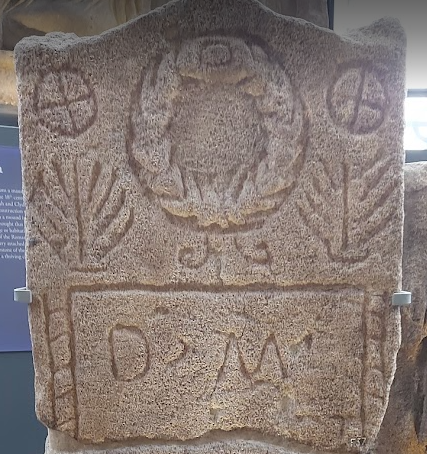
At Ardoch in Perthshire, the following gravestone was found.

Gravestone of Salamanes
DM SALAMAN VIX AN XV SALMANES POSVIT To the spirits of the departed. Salamanes lived fifteen years. Salamanes put (this) up.
This gravestone was dedicated by a father to his son. Since the name is Semitic, it is possible that he travelled to Scotland from the Middle East nearly two thousand years ago. No rank is given, so Salamanes senior was perhaps a merchant. This gravestone is a testament to the multicultural nature of the Roman community on the Antonine Wall, with members of the army and civilians, like Salamanes, coming from every corner of the
Roman Empire. see romaninscriptionsofbritain.org/inscriptions/2182
Found at Shirva, Kirkintilloch, East Dunbartonshire E37. Given by Thomas Calder of Shirva, 1731

A Near-Eastern (Semitic/Palmyrene-Aramaic) name that turns up from Syria to Roman Britain, usually written as Salmanes / Σαλαμάνης (and in Semitic as Shalman/Salman).
- Britannia (Scotland, Antonine Wall) — a tombstone from Auchendavy reads SALMANES… SALMANES POSUIT (now in the Hunterian Museum, Glasgow). Roman Inscriptions of Britain+1
- Syria, Beqaa (Heliopolis/Ba‘albek) — dedication: “Σαλαμάνης and Mercurius, sons of Mambogaios…” (IGLSyr VI 2731). Packhum Inscriptions
- Syria, Hauran (Shaqqa/Maximianopolis) — the name Σαλαμάνης is recorded on an inscription from Shaqqa (IGLS 2147; cited in the standard commentary). Roman Inscriptions of Britain
- Northern Syria (near Aleppo) — attested in Greek as a divine name Σελαμάνης on a 1st-c. AD text. Roman Inscriptions of Britain
- Palmyra — appears in Palmyrene as Shalman (AD 135) and Salman (AD 351). Roman Inscriptions of Britain
- Arabia/Nabataean sphere — the Semitic form Shalman is attested in Nabataean inscriptions. Roman Inscriptions of Britain
- Euphrates frontier (Dura-Europos) — Greek forms of the name are listed among local onomastics in studies of Dura inscriptions. SciSpace


