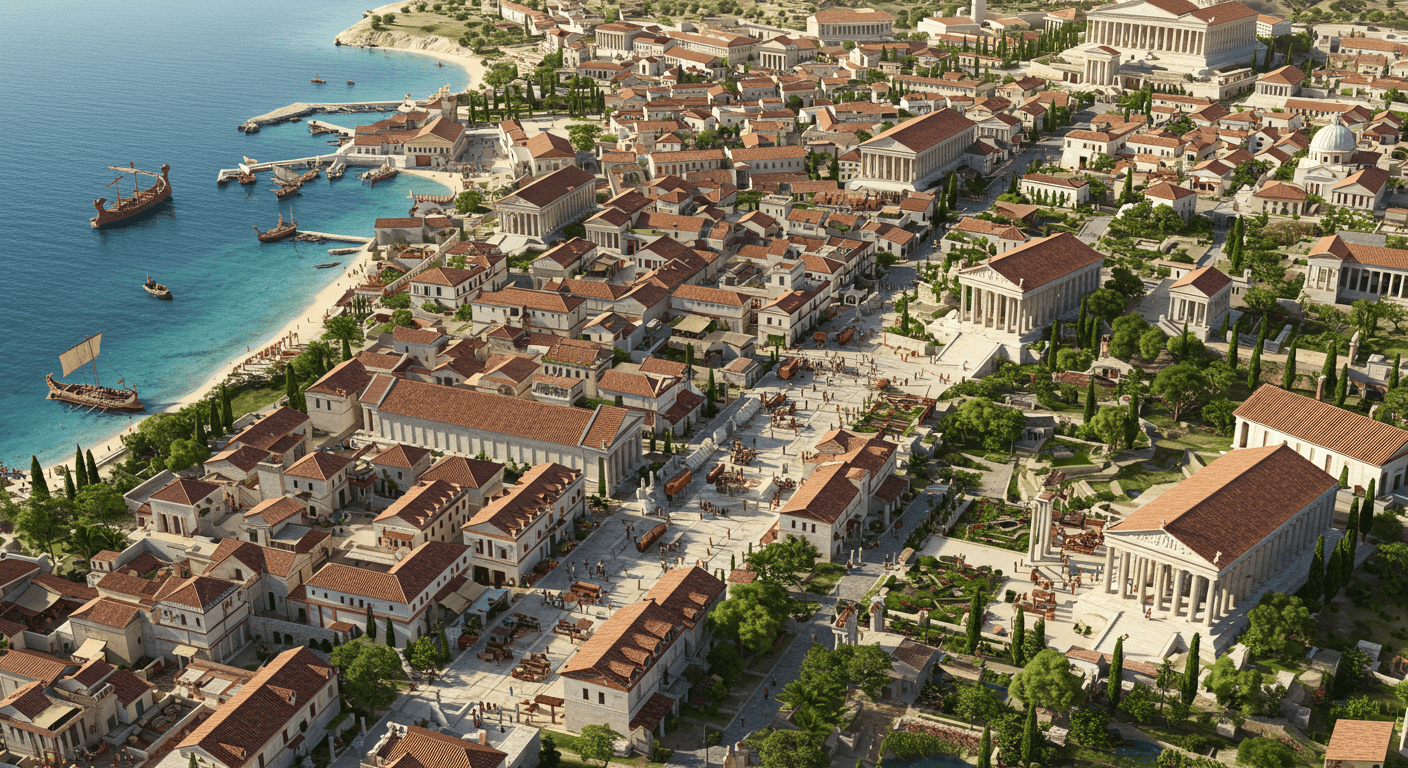
Balsa
This Roman town is renowned for it’s Garum fish paste and boxing matches. Tunisian culture in sport as well as pottery and cooking influenced the development of the town. It is only in 2022 that a geophysical survey was done to find the city.

Location

Pliny in AD 77 wrote this about Balsa
“The cities worthy of mention on the coast, beginning from the Tagus, are that of Olisipo, famous for its mares, which conceive from the west wind; Salacia, which is surnamed the Imperial City; Merobrica; and, between the Sacred Promontory, and the other known by the name of Cuneus the towns of Ossonoba, Balsa, and Myrtilis.” Pliny, Natvralis Historia, Book 4, Chap. 35 (Trans. Riley, Henry T., 1855)
Archaeological Finds at Balsa
Industrial Complexes and Fish Processing
The discovery of fish-processing facilities highlights the industrial importance of Balsa, particularly during the late Roman Empire. Excavations in 1977 by Manuel and Maria Maia uncovered part of a fish factory west of the hill where the Quinta de Torre d’Aires estate is located. This facility, situated near the Ria Formosa lagoon, reused large blocks from earlier monumental structures, indicating the adaptive reuse of materials over time. Additional excavations in 2021 and geophysical surveys in 2022 revealed more industrial structures, forming a larger network of fish-processing factories. These complexes, located along the Ria Formosa, played a crucial role in producing fish-based products such as sauces and pastes, which were exported to other parts of the Roman Empire.
The amphorae types associated with these industries—particularly African II and III amphorae from North Africa—suggest that empty containers were imported to Balsa for packaging fish products. This reflects a symbiotic trade relationship between Balsa and regions like Africa Proconsularis, with amphorae serving as both export vessels and indicators of cultural exchange.


Necropolises and Funerary Monuments
The necropolises of Balsa have provided rich archaeological insights into the city’s social structure and cultural connections. Funerary inscriptions reveal a diverse population, including individuals with origins in North Africa, Hispania Baetica, and other regions of the Roman world. The stylistic elements of funerary monuments, such as spirals, rosettes, and inscriptions between columns, display clear North African influence, linking Balsa to the artistic traditions of Africa Proconsularis.
One notable funerary decoration features a motif identical to that found on monuments in Dougga (modern Tunisia), further emphasizing these cultural ties. Additionally, the practice of detailing not just the years of the deceased but also months and days of life in inscriptions reflects North African funerary traditions.


Honorary and Votive Inscriptions
An important find at Balsa is a statue pedestal dedicated by Annius Primitivus to the goddess Fortuna. This honorary and votive inscription highlights the prominent role of wealthy individuals in sponsoring public works and events. Annius Primitivus, a freedman who rose to prominence, is recorded as having funded spectacles such as boat races (barcarum certamine) and boxing matches (pugilum sportulis). These events, unusual for Lusitania, were more common in North Africa, suggesting cultural exchanges through maritime trade networks.
The inscription also notes his generosity in distributing gifts to citizens, indicating the social responsibilities of Balsa’s elite. This aligns with broader Roman practices of civic benefaction, where wealthy individuals gained prestige by funding public events and infrastructure.


Inscription: Lucius Cassius Celer
offered, at his own expense, one hundred feet of circus podium.

Ceramics and Imported Goods
Archaeological surveys and excavations have unearthed a significant amount of ceramics, including kitchenware, tableware, and amphorae. The high proportion of African ceramics, such as African Red Slip ware and cooking pottery, highlights Balsa’s integration into Mediterranean trade networks. These ceramics, dating from the 1st to the 5th centuries CE, were likely imported from Carthage and other North African regions.
The discovery of Lusitanian amphorae in Carthage and other North African cities also suggests a reciprocal trade relationship, where Balsa exported fish products in exchange for luxury goods and everyday items.


Decorative Artifacts and Statuettes
Among the luxury items found at Balsa is a remarkable statuette of Fortuna Spes (Fortune and Hope), symbolizing commerce and good fortune. The figure, likely imported from a Hellenistic workshop, depicts the goddess with her foot resting on the prow of a ship, symbolizing maritime trade and prosperity. This artifact underscores the wealth and cultural sophistication of Balsa’s elite, who engaged in far-reaching trade and imported high-value items.

Forum and Public Buildings
Archaeological evidence points to the likely location of Balsa’s forum atop the hill where the Quinta de Torre d’Aires estate now stands. The topography and remains of monumental structures suggest this area served as the city’s administrative and social centre. The forum would have been a focal point for civic life, hosting markets, legal proceedings, and public events.


Insights from Epigraphy
One prominent example is Lucius Messius Fructus, a soldier from a neighbouring Lusitanian town who served in Carthage’s urban cohort but never returned to Lusitania, dying instead in North Africa. Another is Gaius Bossius Saturninus, who moved from North Africa to Balsa and later settled in Pax Julia (modern Beja).

References to Balsa
Before the arrival of the Romans, the Algarve was already regularly visited and occupied by Mediterranean peoples such as the Phoenicians, Greeks and Carthaginians, who, from the end of the 8th century BC, created a large and dynamic settlement on the same spot as the current city of Tavira. Cádiz was at that time the hub of this whole far western region.
The Mediterranean influence, from which the name “Balsa” derives, marked the region, to the extent that the Romans, when they arrived here in the late 3rd century BC, considered the people of Turdetania, which included Balsa, to be the most civilised of all Hispania.
Since the 1st century AD, various Roman writers refer to a Roman city located in the south of the Lusitania province (present-day Algarve) called Balsa. At the time, it was one of the main regional port cities.
In the following centuries of the Roman occupation, the mention of it disappeared, only reappearing again in the words of Renaissance writers in the 16th century. Wrongly, it was assumed at that time that the ruins of Balsa were located below the current city of Tavira.
Initially located in Cerro do Cavaco near present-day Tavira, the city was integrated into the Roman imperial network close to Luz de Tavira. By around 1000 AD, during the peak of the Islamic era and after the decline of Balsa, the population shifted to modern Tavira.
It wasn’t until 1866 that archaeologist Estácio da Veiga accurately identified the location of Balsa, linking it to ruins south of Luz de Tavira at the Torre d’Aires and Antas farms. In 2020, ground-penetrating radar provided further insights into the site and its treasures.
Sebastião Philippes Martins Estácio
Sebastião Philippes Martins Estácio da Veiga was born on 6 May 1828 in Tavira. Although he studied mining engineering, it was the knowledge of ancient civilizations, and its transmission to the public, that he was particularly passionate. He was a Postal Officer and the study of Balsa, which he identifies with Quinta das Torres d’Aires, was one of his first works.
He opened the Algarve Archaeological Museum, in Lisbon, on September 26, 1880, which closes the following year, against his will. Between 1886 and 1891 he published the four volumes of Antiguidades Monumentais do Algarve [Monumental Antiquities of the Algarve].
Pioneer of Portuguese archaeology and author of the first archaeological chart made in Portugal, died on December 7, 1891, heartbroken at not being able to bring the Museum he wanted so much to the Algarve.

References
- Non-Invasive Prospection Methods in the Roman City of Balsa (Luz de Tavira-Portugal): Revealing the Real Townscape Oct 2022
- Balsa Inscriptions Corpus Inscriptionum Latinarum (German Site)
- Traces of the dispositions in death and funus in the Roman necropolis of Balsa. (July 2024)
- Annius Primitivus and the Balsa merchant elite 2021