Roman Houses
Many forts in Scotland had small settlements next to them and there is evidence that women and children lived inside forts. Serving soldiers were not allowed to officially marry until Septimus Severus changed the law in 197AD but many had common-law wives and children. House in Scotland would have been simple and there are no recorded towns or villas as in England. No mosaic floors or plaster walls have been found in Scotland as this was a military occupation. Red roof tiles would not have been common. This page describes villas that would have been found in England
Roman House

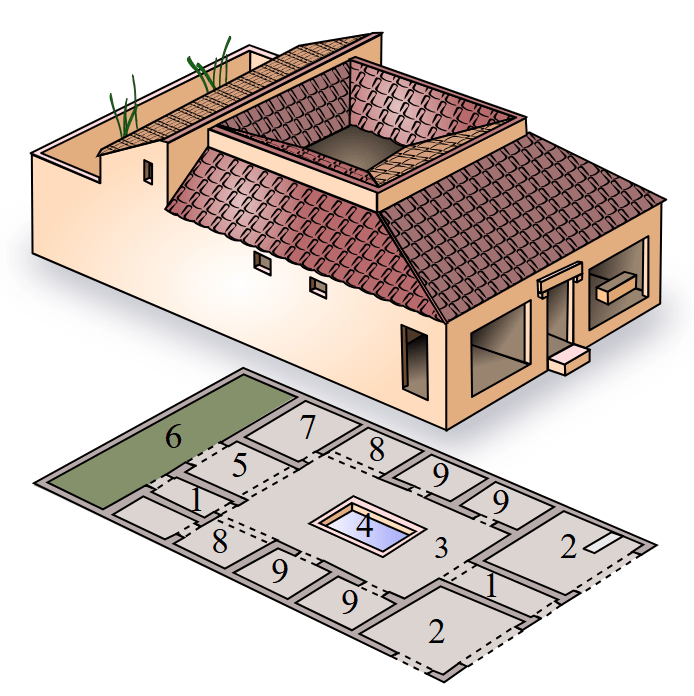
This is a typical Roman House with
- Entrance
- Shops
- Central Hall
- Rainwater basin (no roof above)
- Reception Room
- Garden
- Dining room
- Side rooms
- Bedroom
Entrance (Vestibulum)
- Description: A narrow passage or hallway that led from the street to the main door of the house.
- Purpose: Served as a transitional space, often decorated to impress visitors.


Shops
- Description: Cozy and dimly lit with wooden tables, benches, and a counter for serving wine and simple meals.
- Purpose: Functioned like modern fast-food outlets, serving hot food and drink to Romans who lacked kitchens


Central Hall and Rainwater Basin
- Description: A large, open-air room at the heart of the house with a rectangular opening in the roof (compluvium) to admit light and rainwater, which was collected in a shallow pool (impluvium) below.
- Purpose: The main reception area for guests and a place for family activities. Often decorated with mosaics, frescoes, and family statues.

Kitchen (Culina)
- Description: A small, practical room, often smoky due to open hearths. Located near the back of the house.
- Purpose: Used by slaves to prepare meals.


Dining Room
- Description: A room with three couches arranged in a U-shape around a central table.
- Purpose: Used for meals and social gatherings. Guests reclined on the couches while eating.


Bedroom
- Description: Small and simple rooms typically surrounding the atrium or peristyle. Furnished with a bed and sometimes a chest.
- Purpose: Sleeping quarters, very small


Houses in Scotland
Houses in Scotland were likely to have been built using intertwined branches and then caked with mud and a plaster white surface and were more basic. The biggest settlements for which we have evidence appear to be Trimontium near Melrose, Musselburgh/Inveresk and Camelon near Falkirk. Cramond may also have had a number of houses. More expensive and longer-term buildings used concrete and flat red bricks but these were all found in England.


