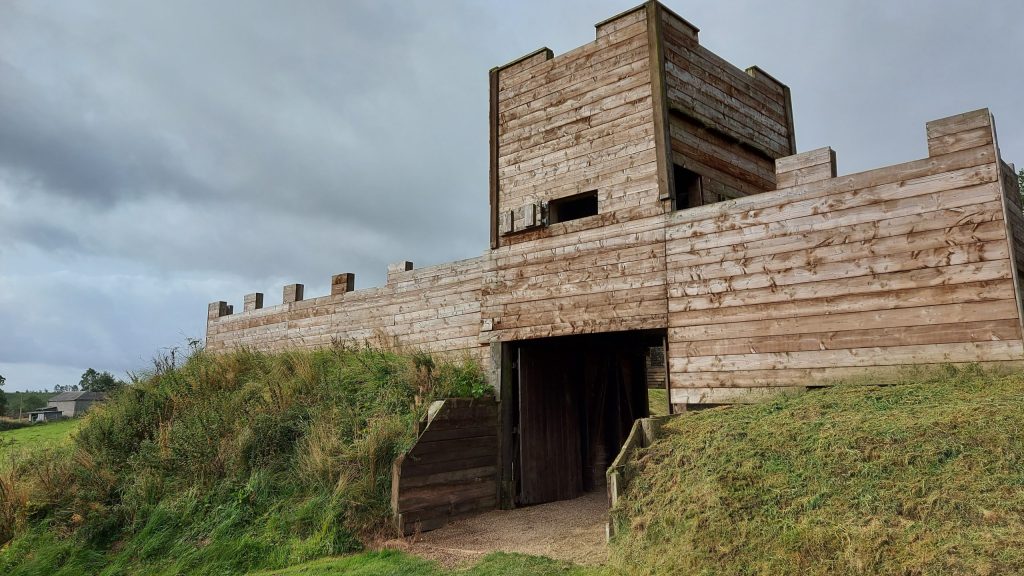
A small fort about which little is known. One piece of pottery with the stamp “asiasticus” has been found. This pottery was produced in Austria at Carnuntum.
Visit Inveravon Roman Fort
📍 Location: Inveravon, near the eastern end of the Antonine Wall
👁 What survives: Little is visible above ground; the fort is known mainly from archaeological evidence and finds.
⭐ Best for: A lesser-known Antonine fort and its place in the eastern frontier landscape.
🥾 Visit: There are few visible remains, so this is primarily a landscape and archaeology stop.
🏛 Nearby Roman places: Mumrills, Carriden and the eastern Antonine Wall
Inveravon at a glance
| Occupation | Antonine period, broadly the AD 140s–160s; exact opening and closing years remain uncertain. |
| Garrison | The resident unit has not been securely identified in the evidence summarised here. |
| Size | Not more than about 0.2 hectares (0.5 acres) internally in the 2024 geophysical interpretation; the plan remains partly inferred. |
| Troop estimate | A small detachment rather than a complete standard cohort; a numerical total is uncertain. |
Inscriptions
The pottery stamp discussed below is evidence about a maker and the movement of pottery. It does not identify the regiment stationed at Inveravon.
References
Inveravon Roman Fort (Trove NRHE)
Central Gaulish samian ware in Pannonia Institute of Archaeology, Research Centre for the Humanities, Eötvös Loránd Research Network,
Tóth Kálmán utca 4, H-1097, Budapest, Hungary ( identifies where asiasticus pottery produced)

