Marcus Cocceius Firmus
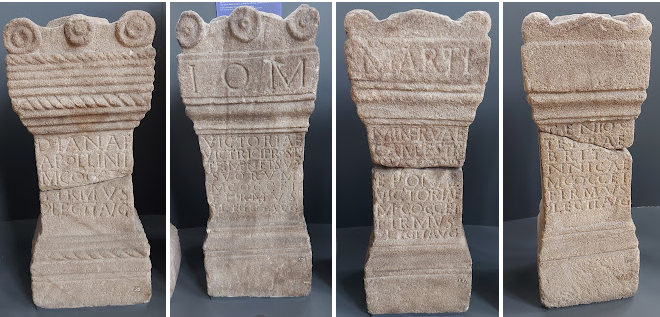
Marcus Cocceius Firmus was a centurion of Legio II Augusta. He’s best known from a cluster of altars he personally dedicated at the Roman fort of Auchendavy on the Antonine Wall.
Primary evidence (RIB numbers & gods)
RIB 2174: to Diana and Apollo.
RIB 2175: to the Genius Terrae Britannicae (the “spirit of the land of Britain”).
RIB 2176: to Jupiter Optimus Maximus and Victoria Victrix, for the welfare of the emperor and his own family.
RIB 2177: to Mars, Minerva, the Campestres (goddesses of the parade-ground), Hercules, Epona, and Victory.
A fragmentary fifth altar to Silvanus (find-group mate; attribution to Firmus is possible but not certain).


Findspot, date & where they are now
All were found together in 1771 during Forth & Clyde Canal works, just SW of Auchendavy fort; they’re now in the Hunterian Museum, Glasgow (GLAHM F.26–F.30). Context dates them to roughly AD 142–180 (Antonine period).
Why he matters
The unusually broad set of deities hints at Firmus’s background and interests—especially the Campestres and Epona, which are closely tied to cavalry training and horse culture. Eric Birley argued from these dedications that Firmus had earlier service with the equites singulares (the emperor’s horse-guard).
Possibly the same man in Roman law
A centurion Cocceius Firmus appears in Justinian’s Digest (49.15.6): the imperial fisc repaid him after he re-purchased a woman condemned to the salt-works who’d been abducted by cross-border bandits. Birley makes a careful case that this legal “Cocceius Firmus” is our man.
Name anatomy:
• Marcus — common Roman praenomen.
• Cocceius — the gens Cocceia, an Italian/northern-Italian family name; famously borne by Marcus Cocceius Nerva (Emperor Nerva).
• Firmus — cognomen meaning “steadfast/strong.”
(Onomastic points are general Roman usage; the inscriptions above give Firmus’s full tria nomina.)
Here’s what turns up for Cocceius Firmus outside Britain (beyond the four Auchendavy altars on the Antonine Wall):
- Lower Moesia (Dobruja, Black Sea coast) — Histria (Istros)
An altar dated 13 June 169 names the local quaestor Cocceius Firmus among the officials “under whose care” it was set up (alongside two magistrates), in a dedication by veterani, cives Romani et Bessi resident in a ward of the town. Birley introduced this as AE 1924, 143, arguing it likely reflects the same man later/earlier in civic life—but he admits that remains a prosopographical hypothesis, not proof. Society of Antiquaries of Scotland - Legal/literary (not an inscription) — the Digest of Justinian 49.15.6 (Pomponius)
A case mentions “the centurion Cocceius Firmus” whose enslaved woman, condemned to the salt-works (in opus salinarum), was seized and sold by bandits; when Firmus bought her back, the imperial fisc had to refund him. Scholars debate where this happened: Birley weighed Britain vs. Dacia, then marshalled evidence that the episode best fits the Lower Danube (Moesia Inferior) milieu; later writers also situate it on the Lower Danube. Either way, it’s a textual occurrence, not an epigraphic one. Society of Antiquaries of Scotland+2Brill+2 - Rome — parallels, not attestations
Birley noted that the distinctive deity cluster on Firmus’ British altars (Campestres, Epona, etc.) closely matches dedications of the equites singulares Augusti at Rome—suggesting part of his career—but none of those Roman stones name him, so they are not additional occurrences. romaninscriptionsofbritain.org - No other secure epigraphic hits
Comprehensive checks of RIB and secondary surveys show no further inscriptions naming Marcus Cocceius Firmus beyond RIB 2174–2177 in Britain; other internet claims typically recycle those same four stones. romaninscriptionsofbritain.org+1


