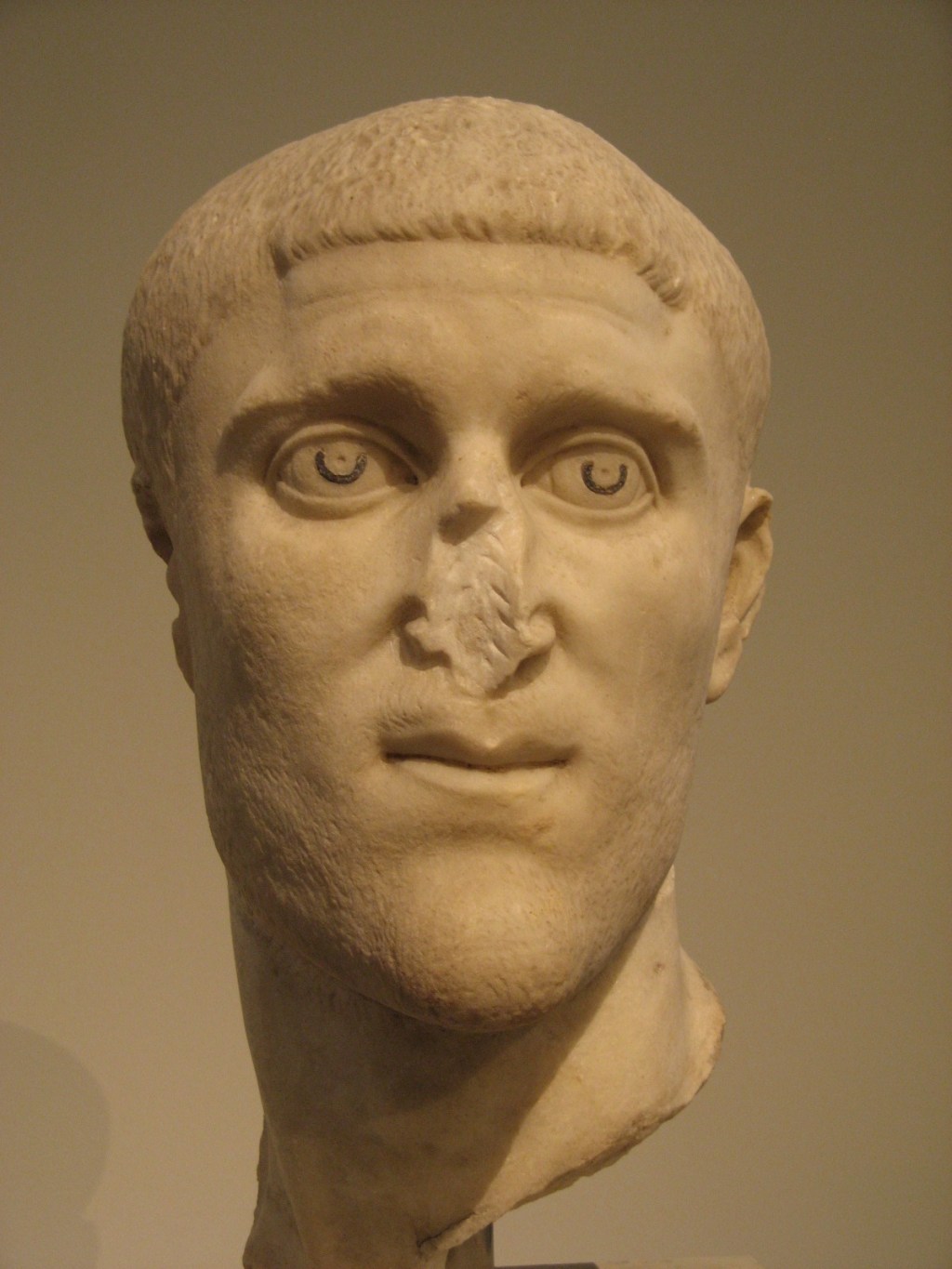
In the last years of his life, the Roman emperor Constantius I — often called Constantius Chlorus — led a campaign into northern Britain. His son Constantine, the future Constantine the Great, joined him.
The expedition is sometimes described simply as the “invasion of Scotland in AD 306”. That is too neat. The surviving evidence is limited, much of it comes from later writers or imperial praise, and we cannot reconstruct the route of the army with confidence.
What we can say is that Constantius campaigned north of the established Roman frontier in AD 305–306, probably against groups whom Roman sources called Picts. He returned to York, where he died on 25 July 306. His troops then proclaimed Constantine emperor.
Two different campaigns are often confused
Constantius had already fought a major campaign in Britain almost a decade earlier, but it was a very different operation.
AD 296 — the recovery of Britain
In the late third century Britain had broken away from the central Roman government under Carausius and then Allectus.
Constantius, then Caesar in the western empire, organised the reconquest. In AD 296 his forces crossed the Channel. His praetorian prefect Asclepiodotus landed in southern Britain, defeated Allectus and killed him. Constantius arrived separately and entered London after the decisive fighting.
This was the recovery of Roman Britain from a breakaway regime. It was not the same event as the later expedition into northern Britain.
AD 305–306 — the northern campaign
After becoming Augustus in 305, Constantius crossed to Britain again. Constantine joined him, and the imperial army campaigned in the north.
Roman and later sources present the expedition as a victory over the Picts. Modern summaries sometimes describe the army as reaching far into Scotland, but the evidence does not allow us to draw a secure campaign route or identify the places where major fighting occurred.
It is therefore safer to think of this as a northern British campaign whose exact geography remains uncertain.
What does the coin evidence show?
The map below shows Roman coin finds in Scotland associated with this broad period.
Coin distributions are useful, but they need to be treated carefully.
A coin found in Scotland does not prove that it was dropped by one of Constantius’s soldiers. Coins could remain in circulation for years and might arrive through trade, exchange, movement of people, later military activity or other processes.
Likewise, a concentration of coins at a major centre such as York does not by itself prove that an army was assembling there. York was already one of Roman Britain’s most important military and administrative centres.
The map is therefore best used as supporting evidence to compare with written sources and archaeology, rather than as a map of Constantius’s march.
How certain is the story?
Not as certain as older accounts sometimes suggest.
- Secure: Constantius recovered Britain from Allectus in AD 296.
- Secure: he became Augustus in AD 305.
- Secure: he returned to Britain and campaigned in the north with Constantine.
- Secure: he died at York on 25 July 306, after which Constantine was proclaimed emperor.
- Probable: the northern campaign was directed against peoples whom Roman sources grouped under the name Picts.
- Uncertain: the precise route, the depth of the advance into Scotland, the scale of the fighting and which archaeological sites can be connected directly with the campaign.
This uncertainty is important. Late Roman emperors were celebrated through speeches, titles and official propaganda, so claims of overwhelming victory need to be compared with archaeology rather than accepted at face value.
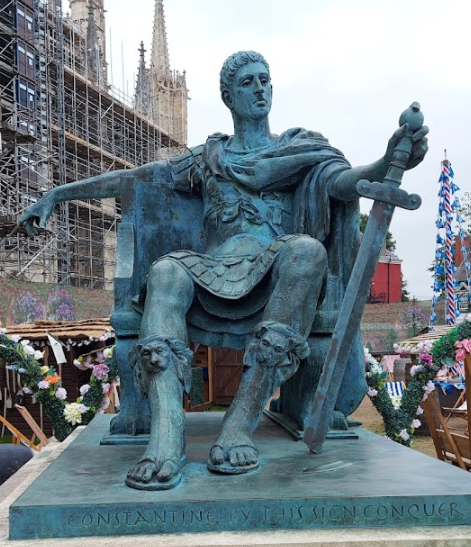
Constantius and Constantine
Constantius was born around the middle of the third century in the Balkan provinces; his exact birthplace is uncertain. He became Caesar in 293 and Augustus in 305.
He was the father of Constantine by Helena. By his later wife Theodora he had six further children.
The northern campaign mattered not only because it was one of Rome’s last major military expeditions into what is now Scotland. It also placed Constantine with the army in Britain at the crucial moment when his father died.
At York, the soldiers acclaimed Constantine. The event helped destroy the carefully balanced tetrarchic system created by Diocletian and began the long struggle that eventually made Constantine sole ruler of the Roman Empire.
Why this matters for Roman Scotland
By the early fourth century Rome was no longer trying to occupy Scotland permanently in the way it had under Agricola or during the Antonine period.
Yet northern Britain still mattered strategically. Emperors could cross the frontier, mount punitive or demonstrative campaigns and use victories in Britain as part of imperial politics.
Constantius’s expedition therefore belongs to the long story of Roman military involvement in Scotland — not as a new conquest, but as a reminder that the northern frontier remained active more than two centuries after Agricola.
Explore more
- Roman Coin Maps
- Explore Roman Coins
- Maps & GIS
- 300 Years of Military Attacks
- Romans in Scotland Official Timelines
- Caledonian Tribes
- Emperors and Governors
Sources and further reading
Ancient evidence
- Panegyrici Latini VIII (297), especially sections 11–20, for the recovery of Britain in AD 296. This is contemporary imperial praise and needs to be read critically.
- Eutropius, Breviarium 10.1–2, on Constantius’s death at York and Constantine’s accession. Read the Latin text and commentary at Dickinson College.
- Aurelius Victor, De Caesaribus 40, one of the later literary sources for Constantius and Constantine.
Modern scholarship
- Oxford Classical Dictionary: Constantius I — concise modern summary of his career, the recovery of Britain, the northern campaign and his death at York.
- The Oxford Handbook of Roman Britain — chronological overview placing the AD 296 recovery and AD 305–306 northern campaign in context.
- Anthony R. Birley, The Roman Government of Britain: Carausius and Allectus, 286–296 — detailed discussion of the breakaway regime and Constantius’s recovery of Britain.
- D. E. Eichholz, “Constantius Chlorus’ Invasion of Britain”, Journal of Roman Studies 43 — classic discussion of the literary evidence for the AD 296 campaign.
As with much of late Roman Scotland, the evidence is uneven. Where the ancient sources and archaeology do not allow certainty, this page distinguishes what is known from what is interpretation.

