From Roman Africa to Hadrian’s Wall
More than 2,000 kilometres separate the warm Mediterranean coast of Algeria from the windswept frontier of northern Britain. Yet sometime during the Roman occupation of Britain, a man born in North Africa made that journey.
His name was Gaius Cossutius Saturninus.
A tombstone at Birdoswald
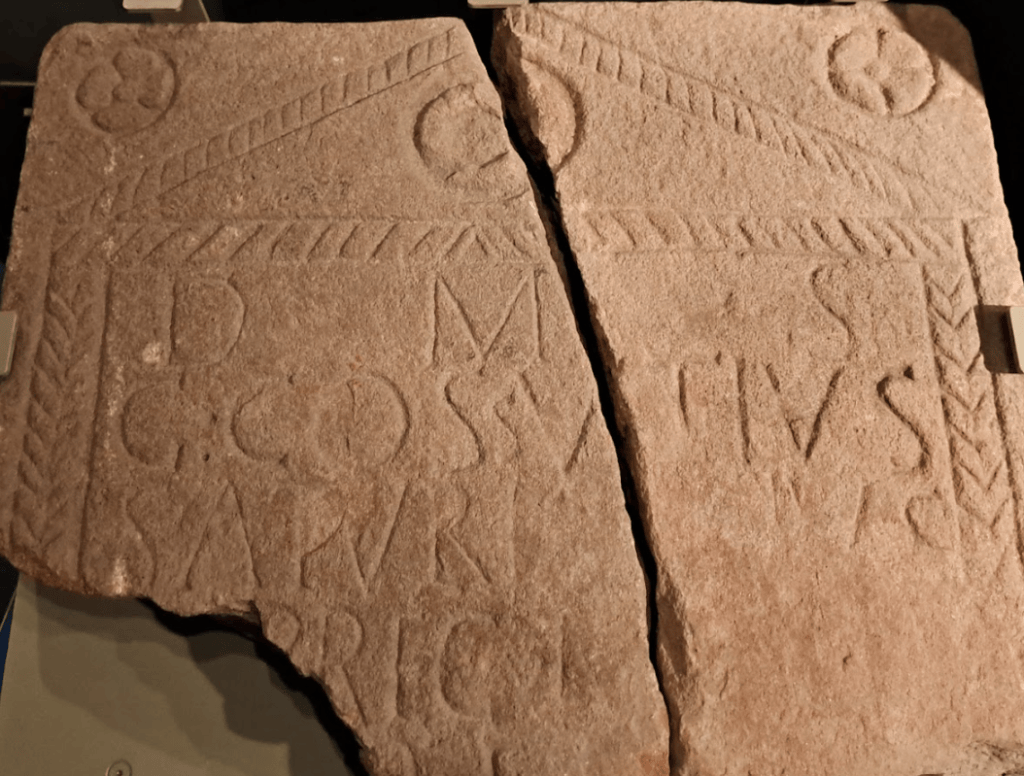
In 1961, ploughing in a field about 400 metres west of the Roman fort at Birdoswald — Roman Banna — on Hadrian’s Wall brought up fragments of a sandstone tombstone.
The field was part of the Roman cemetery outside the fort. The surviving stone measures about 76 cm by 61 cm and is decorated with a pediment, wreath and rosettes, with a herringbone border around the inscription. Today it is held by Tullie House Museum and Art Gallery in Carlisle. (Roman Inscriptions of Britain)
The surviving Latin reads:
D M S
G COSSVTIVS
SATVRNINVS
[HI]P REG M[IL]
[LEG VI VIC] P F …
The Roman Inscriptions of Britain reconstruction translates this as:
“Sacred to the shades of the dead. Gaius Cossutius Saturninus of Hippo Regius, soldier [of the Sixth Legion Victrix] Pia Fidelis …” (Roman Inscriptions of Britain)
The bottom of the tombstone is missing. It may once have recorded his age, years of service or the name of whoever erected the monument.
Those missing lines might have told us much more about him.
From Hippo Regius to Britain
He came from the Roman city of Hippo Regius on the coast of Africa Proconsularis, beside modern Annaba in Algeria.
Hippo was an established Roman municipium. The family name Cossutius is well represented there, while Saturninus, although used throughout the Empire, was particularly common in Roman Africa. His African origin is therefore unusually secure: it is not being inferred from an object, hairstyle or burial custom. His own tombstone tells us where he came from. (Roman Inscriptions of Britain)
A soldier travelling from Hippo Regius to northern Britain might have crossed the Mediterranean, travelled through Italy or Gaul, crossed the Channel and then continued north along Britain’s military road network.
Eventually, Gaius found himself close to the northern edge of the Empire.
A soldier of the Sixth Legion
Gaius served in Legio VI Victrix Pia Fidelis — the Sixth Victorious Legion, Dutiful and Faithful.
The legion was transferred from the Rhine frontier to Britain early in Hadrian’s reign and established its permanent British base at York (Eboracum). Roman tile stamps show that York remained the legion’s headquarters thereafter. (Roman Inscriptions of Britain)
Detachments were sent across northern Britain to build roads, forts and frontier works, carry out specialist engineering, and reinforce military positions.
The Sixth Legion was heavily involved in Hadrian’s Wall. Inscriptions record its men at Newcastle in about AD 122 and at numerous other points along the frontier. At Birdoswald itself, a surviving building stone simply records:
LEG VI VIC P F F
— Legio VI Victrix Pia Fidelis fecit:
“The Sixth Legion Victrix Pia Fidelis built this.” (Roman Inscriptions of Britain)
Gaius was therefore buried at a place where his legion had a documented presence. Whether he was permanently attached to Birdoswald or belonged to a temporary legionary detachment cannot now be established.
When did Gaius live?
There is an important uncertainty here.
The Roman Inscriptions of Britain database does not assign Gaius’s tombstone a precise date. Historic England, however, describes him as a third-century legionary soldier, while Vivien Swan’s important study of African soldiers associated with Legio VI concentrates particularly on movements between Africa and Britain around the end of the second and beginning of the third centuries. (Historic England)
It is therefore reasonable to place Gaius broadly around this period, but we should resist giving him an exact year.
In AD 208, the North African-born emperor Septimius Severus arrived in Britain and launched a major campaign into Scotland. York became the headquarters for the imperial campaign, and military manpower moved into northern Britain on a considerable scale.
There is growing archaeological interest in the presence of people with North African connections in northern Britain around this period. Gaius provides particularly strong evidence because, unlike some archaeological indicators, his origin is explicitly stated on his tombstone. Modern scholarship continues to cite him as clear epigraphic evidence for a North African serving with Legio VI in northern Britain. (Cambridge University Press)
But we cannot currently prove that he came to Britain specifically because of Severus.
Did Gaius ever come to Scotland?
This is the tempting question — and one for which the evidence stops short. There is no surviving inscription which places Gaius Cossutius Saturninus in Scotland. His tombstone was found at Birdoswald on Hadrian’s Wall. His legion, however, certainly operated much farther north.
Detachments of Legio VI Victrix helped construct the Antonine Wall in the AD 140s. The surviving distance slabs record sections of the Wall built by men of the Sixth Legion, whose main fortress remained at York.
So Gaius belonged to a military organisation whose soldiers repeatedly crossed what is now the Scottish border. We simply cannot say that this particular soldier did.
An African on Rome’s northern frontier
Gaius is also a useful corrective to the picture of the Roman army as consisting simply of “Romans” arriving from Italy.
By the second and third centuries, Rome’s army drew men from across an enormous geographical area.
A man born in Algeria could serve in a legion headquartered in Yorkshire and die beside a fort in Cumbria. Men from continental Europe and the Mediterranean served on Hadrian’s Wall and the Antonine Wall, while soldiers recruited in Britain could later find themselves serving elsewhere in the Empire.
Vivien Swan’s study Legio VI and its Men: African Legionaries in Britain brought together epigraphic evidence and distinctive pottery traditions to examine these movements between Roman Africa and northern Britain. The evidence extends beyond a single individual: Gaius was part of a much wider story of military mobility. (Archaeology Data Service)
Sources and further reading
The principal source is RIB 3445, Gaius’s tombstone, in the Roman Inscriptions of Britain database. RIB 3445 — Tombstone of Gaius Cossutius Saturninus Historic England’s work on the Birdoswald cemetery identifies the monument as belonging to a third-century legionary. (Historic England) The wider argument for African personnel associated with the Sixth Legion is developed by Vivien G. Swan, Legio VI and its Men: African Legionaries in Britain, Journal of Roman Pottery Studies 5, pp. 1–33. (Archaeology Data Service)
Gaius Cossutius Saturninus, late 100s AD Tullie Museum

