Tiny objects that can tell surprisingly big stories
A Roman coin can tell us far more than simply what people used as money.
On one side, there is usually the emperor, surrounded by his name and titles. On the other might be a god or goddess, a military victory or a message the emperor wanted people across the Empire to see.
In Scotland, coins are useful for another reason. They can help archaeologists date the occupation of forts and other Roman sites, and show where Roman money was circulating. Finds beyond the main areas of Roman occupation are particularly interesting. How did a Roman coin end up far from the nearest fort? Was it traded, given as a gift or payment, carried there by a traveller, or simply lost?
This is what makes coins such useful evidence. They are both written primary sources and archaeological objects.
Their interpretation does need care, however. Finding a Roman coin does not, by itself, mean that Roman soldiers were ever at that spot.
Explore Roman coin finds in Scotland (Romans in Scotland)
🪙 Start with the coin itself
Most Roman imperial coins have two sides.
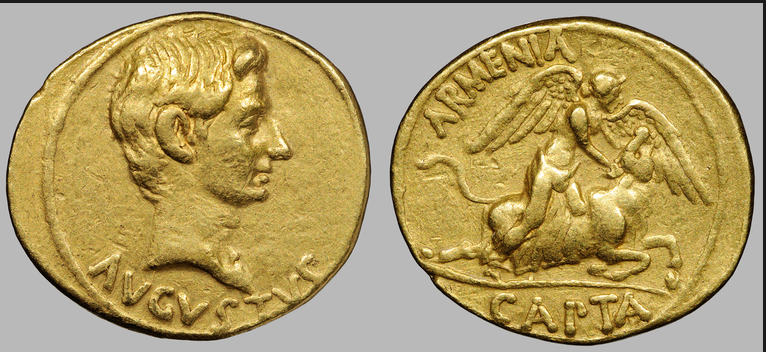
OBVERSE
Usually the “heads” side.
It commonly shows:
the emperor
or another member of the imperial family.
Around the portrait is a:
legend
giving the person’s name and titles.
REVERSE
The other side can contain an extraordinary range of images:
- gods
- goddesses
- Victory
- soldiers
- captives
- military standards
- temples
- animals
- personifications
- and political slogans.
So before asking where a coin was found, ask:
What is the coin actually saying?
👤 The emperor in your pocket
Coins were one of the most widespread objects carrying imperial portraits.The emperor could therefore be visually present throughout the Empire, including its northern military frontier. That makes a coin a particularly interesting primary source. It was not written by a historian decades later. It was produced under Roman authority at the time.
🔤 How do you read a Roman coin?
Roman coin legends can initially look baffling because words and titles are heavily abbreviated.
You might encounter something like:
IMP CAES … AVG
These are not random letters.
Common abbreviations include:
| Abbreviation | Latin | Meaning |
|---|---|---|
| IMP | Imperator | Emperor / victorious commander |
| CAES | Caesar | Caesar |
| AVG | Augustus | Augustus / emperor |
| P M | Pontifex Maximus | Chief priest |
| TR P | Tribunicia Potestas | Tribunician power |
| COS | Consul | Consul |
| P P | Pater Patriae | Father of the Country |
The combination of titles can sometimes help date a coin very closely because emperors accumulated offices and renewed some titles during their reigns.
🔎 Try identifying one yourself
One of the best free resources is Online Coins of the Roman Empire — OCRE.
Identify a Roman coin with OCRE
You can search using:
metal
portrait
letters you can still read
and the:
reverse design.
OCRE covers Roman imperial coin types from Augustus to Zeno and is based on the standard Roman Imperial Coinage classification. Its database contains tens of thousands of coin types and links them with specimens held by museums and archaeological collections. (American Numismatic Association)
That means a visitor to your site can actually investigate the primary evidence rather than simply read about it.
🪙 Gold, silver and bronze
1 aureus = 25 denarii = 100 sestertii = 200 dupondii = 400 asses
Among the coins encountered in Roman Britain are:
Aureus
A high-value gold coin, mainly used for large payments and storing wealth.
1 aureus = 25 denarii
Denarius
A silver coin and one of the most familiar Roman denominations of the first and second centuries.
25 denarii = 1 aureus
1 denarius = 4 sestertii
Sestertius
A large brass coin, commonly used in everyday transactions.
4 sestertii = 1 denarius
Dupondius
A brass coin, worth half a sestertius.
2 dupondii = 1 sestertius
As
A copper or bronze coin and one of the standard lower-value denominations.
2 asses = 1 dupondius
4 asses = 1 sestertius
📅 Coins as clocks
For archaeologists, one of the great advantages of coins is that we can usually date when they were made.
A coin of Antoninus Pius, for example, cannot have been deposited during Agricola’s campaigns several decades earlier. Its presence tells us that the archaeological layer must date from at least the reign of Antoninus Pius, or later.
Archaeologists call this a terminus post quem — literally, the earliest possible date after which something could have happened.
There is an important catch, however.
A coin minted in AD 140 was not necessarily lost or buried in AD 140. Roman coins often remained in circulation for many years, sometimes for decades. A coin can therefore tell us the earliest possible date for a deposit, but not necessarily the exact date when that deposit was formed.
🏛️ Coins and Roman forts
This makes coins particularly valuable when excavating Roman military sites. Imagine archaeologists find coins beneath, within and above different building phases at a fort.
Combined with:
pottery
inscriptions
radiocarbon dates
and:
stratigraphy
the coins can help establish when those phases were occupied. But one coin should rarely carry the entire argument. Archaeology works best when different kinds of evidence agree.
👑 Coins by emperor
One useful way to explore Roman Scotland is to map coins according to the emperor who issued them.
Your existing maps already allow visitors to explore this approach:
The page includes maps organised by:
emperor
date
coin hoards
and periods associated with Roman campaigning in Scotland. (Romans in Scotland)
Patterns can sometimes be suggestive, but they must not be read as maps of Roman conquest.
⚠️ A Roman coin does not prove Roman occupation.
A coin find means someone had a Roman coin there, not necessarily that the Roman army occupied the place. Coins can also move long after antiquity through collecting, soil movement and other processes. (Romans in Scotland)
That distinction becomes particularly important in Scotland.
🤝 Coins and diplomacy
Rome did not deal with its northern neighbours solely through warfare.
Relationships could involve:
alliances
gifts
payments
and political patronage.
National Museums Scotland describes later Roman frontier diplomacy as involving gifts, including silver coin, to friendly groups beyond the frontier. Roman material at places such as Traprain Law demonstrates that relationships between Rome and local elites could continue even when Roman armies had withdrawn south. (National Museums Scotland)
🪙 The mystery of Birnie
One particularly interesting Scottish example comes from:
Birnie in Moray.
Roman coins found there helped prompt archaeological investigation of an important Iron Age settlement.
National Museums Scotland curator Fraser Hunter’s research has included following up the scatter of Roman coins from Birnie to investigate the archaeological context of what might otherwise have been regarded simply as stray finds.
Birnie is important precisely because it lies well beyond the areas of permanent Roman military occupation.
The coins raise questions about:
contact
wealth
politics
and relationships between Rome and northern communities.
This would make an excellent future dedicated page:
→ Explore the Roman Coins of Birnie
🏺 A coin’s context matters
Imagine three identical denarii.
One is found:
- in a Roman fort barrack.
- in an Iron Age settlement.
- in a hoard of 500 coins.
They are the same type of object but archaeologically they may tell completely different stories.
That is why archaeologists record:
exact findspot
soil layer
associated objects
nearby structures
and whether the coin was:
isolated or part of a group.
The context can be more historically important than the coin itself.
💰 Why bury a hoard?
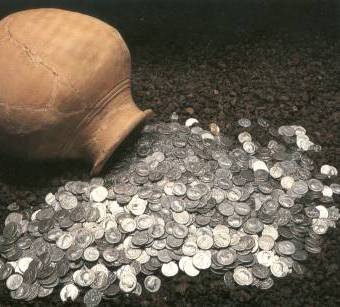
Roman coin hoards are particularly fascinating. Someone deliberately gathered a group of coins and placed them somewhere. But why?
Popular accounts often say:
“The owner buried their savings during a crisis and never returned.”
Sometimes that may be correct.
But hoards can have many explanations:
- savings
- emergency concealment
- military pay
- payments
- ritual deposition
- metal storage
- or other reasons we can no longer reconstruct.
📈 The latest coin in the hoard
One of the first things numismatists examine is the:
latest coin.
If a hoard contains coins from:
Hadrian
Antoninus Pius
Marcus Aurelius
and:
Commodus
then it cannot have been deposited before the Commodus coin was minted.
The youngest coin therefore provides the time after which it was buried. It does not give the exact burial date as the coins could have circulated for years before deposition.
🧭 Mapping coins
Individual finds become particularly powerful when hundreds of them are mapped.
We can begin looking for:
clusters
gaps
routes
chronological changes
and relationships with:
forts
roads
settlements
and:
frontiers.
The Roman Coin Maps page draws its evidence from sources including Historic Environment Scotland’s Canmore database, Treasure Trove information and academic studies.
🪙 Coins as imperial propaganda
Coins also provide a completely different type of primary evidence.
Look at the reverse. Roman emperors used coinage to communicate ideas about their reign.
Common themes included:
- VICTORIA — Victory
- PAX — Peace
- FORTVNA — Fortune
- FELICITAS — Prosperity
- SALVS — Welfare/Security
and military imagery involving:
- captives
- standards
- weapons
- conquered peoples.
A coin could therefore make a political statement every time it changed hands.
🏆 Victory on a coin
Victory appears repeatedly on Roman coinage.
She is normally represented as the winged goddess:
Victoria
often carrying:
a wreath
or:
a palm branch.
A modern observer might see an attractive classical figure.
A Roman viewer understood:
victory.
And that victory ultimately belonged to:
the emperor.
OCRE allows searches not only by emperor and denomination but also by reverse type and iconography, making it possible to explore themes such as Victory across Roman imperial coinage. (American Numismatic Association)
🔎 Investigate a Roman coin yourself
When looking at a coin, work through these questions:
1. What metal is it?
Gold, silver, bronze or an alloy?
2. Who is shown?
Can you recognise the emperor?
3. What letters survive?
Even a few letters can help.
4. What is on the reverse?
God? Victory? Soldier? Animal? Building?
5. Can OCRE identify it?
Try OCRE’s coin identification tool
6. When was it minted?
Remember this is not necessarily when it was lost.
7. Where was it found?
Fort? Camp? Settlement? Field? Hoard?
8. What else was found there?
Context changes interpretation.
And finally:
What does this coin actually prove?
That last question is the most important.
🌐 Explore the original evidence
Three resources are particularly useful.
Online Coins of the Roman Empire (OCRE)
Search Roman imperial coin types, portraits, inscriptions, reverse imagery and examples in museum collections. OCRE currently describes more than 43,000 published imperial coin types and connects them with large numbers of surviving specimens. (American Numismatic Association)
Roman Coin Maps — Romans in Scotland
Explore Scottish coin finds by date, emperor and findspot. (Romans in Scotland)
National Museums Scotland — Romans in Scotland
Explore the archaeological evidence for Rome’s changing relationship with the people of Scotland. (National Museums Scotland)
→ Next: Explore Roman Coin Hoards in Scotland.