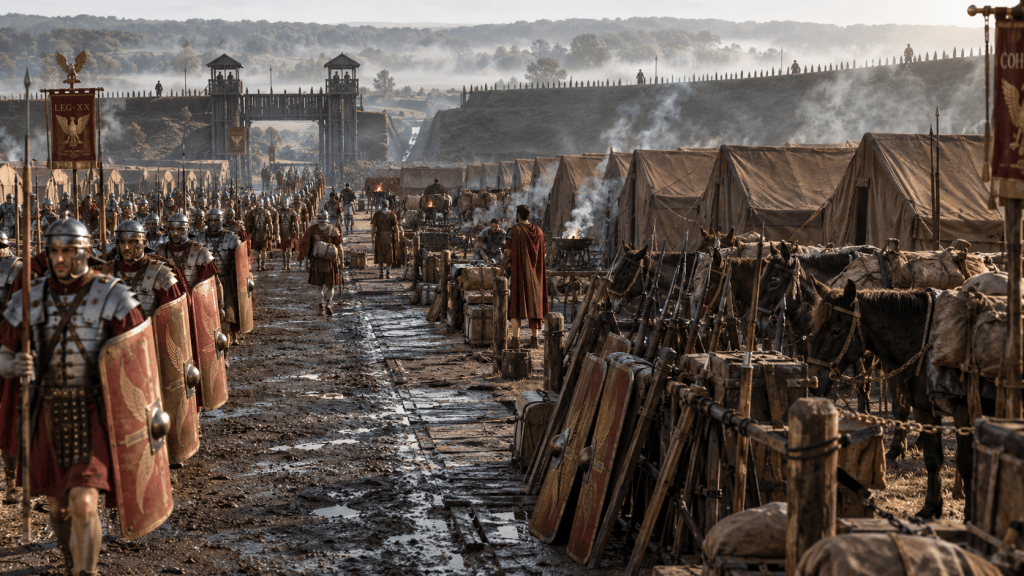
The temporary bases left behind by Roman armies
Scotland contains the largest number of Roman temporary camps in the Empire
They are very different from forts. A Roman fort was intended to accommodate a garrison for an extended period and normally contained barracks, headquarters buildings, granaries and other permanent or semi-permanent structures.
A camp could be created for a much shorter stay. Some protected an army for a night or during a campaign. Others were used while troops were carrying out construction work. Some may have been occupied repeatedly.
Their simple earthworks now provide some of the most important evidence for the movement of Roman armies through Scotland.
What did a Roman camp look like?
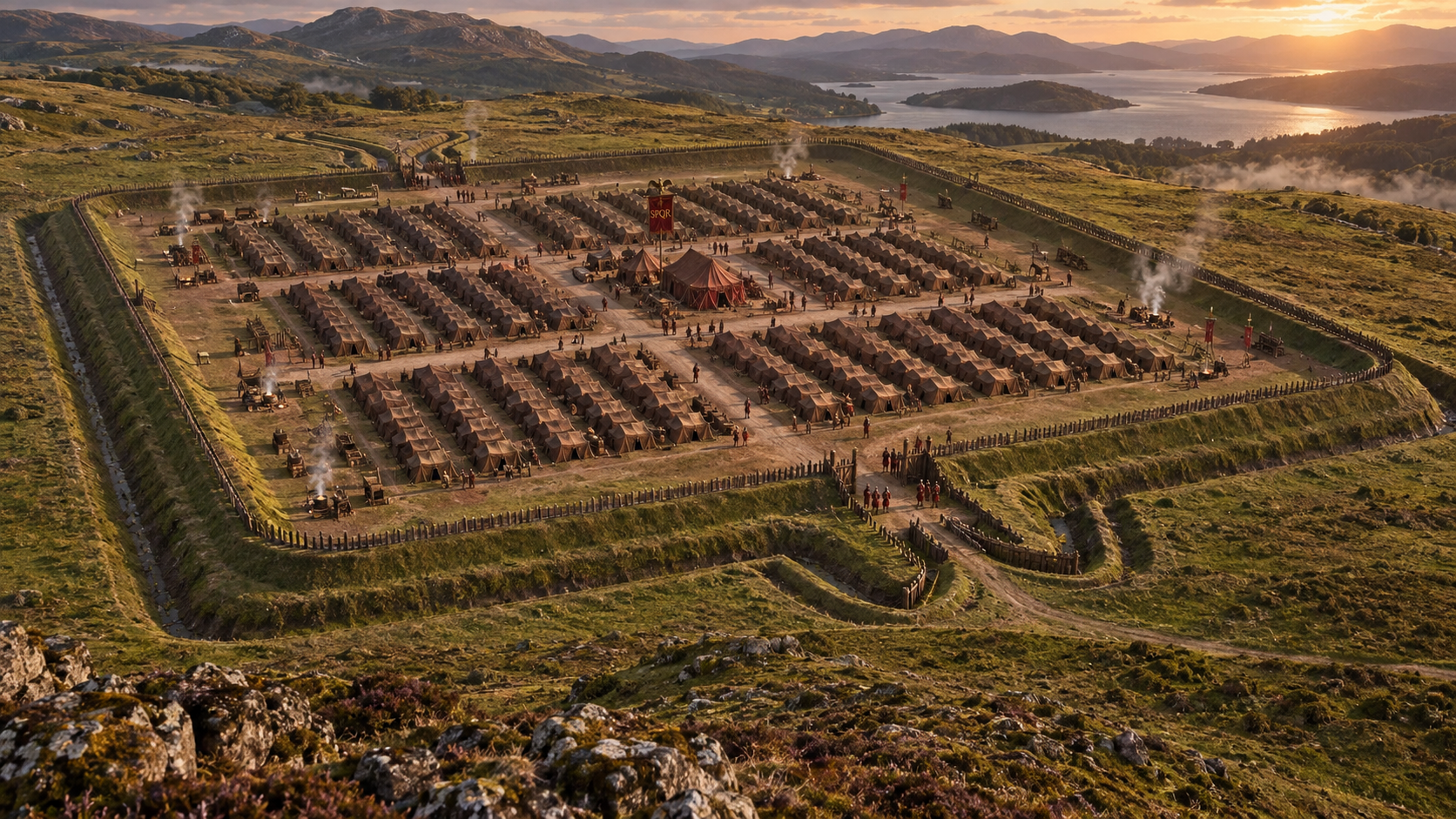
The basic principle was simple. Soldiers enclosed an area with a ditch and an earth or turf rampart. The resulting enclosure often had the rounded corners traditionally associated with Roman military planning.
Inside stood tents rather than the permanent barrack buildings of a fort. Entrances were carefully planned and could be protected by detached outworks called tituli or by curving defences called claviculae. Camps did not all have four gates: Dunning, Raedykes and Normandykes had six, while at some other sites that total is inferred from incomplete remains. Read Roman marching camps with six gates for the evidence and examples. Within a short time, an army on campaign could turn open ground into a defended base.
Read the Roman Book Concerning the fortifications of a military camp (De Munitionibus Castrorum)
Marching camps
The best-known temporary camps are often called marching camps. An army advancing through hostile territory needed somewhere defensible to spend the night. The Roman army became famous for its ability to construct such camps systematically.
In Scotland, lines of camps can help archaeologists reconstruct the routes taken by Roman forces through river valleys and across the landscape.
A camp’s shape does not automatically tell us whether Agricola, Antoninus Pius or Septimius Severus used it. Many camps contain very few objects, making precise dating extremely difficult. Several different Roman campaigns could also use the same strategically useful area.
Camps and Agricola
Temporary camps are an important part of attempts to reconstruct Agricola’s campaigns in the AD 70s and 80s.
Tacitus tells us that Agricola’s army included legionaries, auxiliary infantry and cavalry, and archaeological camps reveal something of the routes available to those troops.
Camps used to build the Antonine Wall
Not every temporary camp belonged to a marching army. Some were essentially construction camps. When detachments of the Second, Sixth and Twentieth Legions built the Antonine Wall, they needed bases close to their work.
Several temporary camps have been found beside the Wall. At Tamfourhill, for example, an aerial photograph reveals a camp whose defences protected troops working on that section of the frontier.
The distribution of other camps suggests building gangs may sometimes have worked towards one another from different directions. These camps allow us to see the construction process behind the finished monument.
How do archaeologists find camps?
Most Roman temporary camps have almost completely disappeared from the surface. Their ditches may survive underground and become visible through:
cropmarks, where buried archaeology affects crop growth;
aerial photography;
LiDAR;
geophysical survey;
and occasionally excavation.
Ovens, pottery and coins can sometimes provide dating evidence, but many camps remain frustratingly difficult to assign to a particular campaign.
Camps to explore
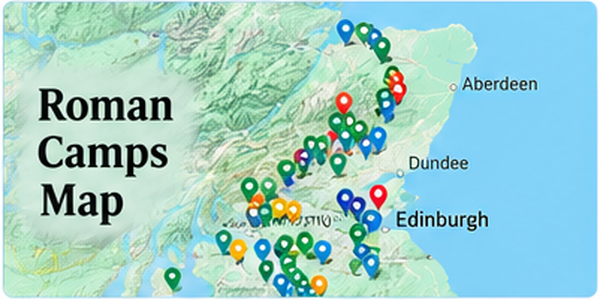
Roman Camps in Scotland
A useful starting point for exploring their distribution.
Black Hill Camp
One of the many temporary military enclosures identified in Scotland.
Lyne
The Roman complex at Lyne includes evidence for camps as well as the fort.
Inveresk
Excavation around Inveresk has produced evidence connected with temporary military occupation as well as the permanent fort and settlement.
The Lost Fairmilehead Roman Camp
This is also a useful warning about interpretation.
Antiquarian records and apparent earthworks have sometimes been identified as Roman camps only for later investigation to cast doubt on the identification.
Camp or fort?
The terms can easily become confusing. A camp was primarily a temporary defended enclosure.
A fort was intended as a longer-term military base.
A fortlet was a much smaller defended military post.
All three could use ditches, ramparts and Roman-style gateways, which is why identifying badly preserved sites can sometimes be difficult.
Together they reveal different levels of the Roman military presence:
the army moving through the landscape, the army occupying it, and the army controlling it.

