Our understanding of Roman Scotland did not appear fully formed. It has grown through 500 years of recording, argument and discovery: from scholars comparing ancient texts, to surveyors drawing earthworks, to excavators recovering objects and scientists examining what those objects are made of.
The people introduced here were not all academics, and not all worked in Scotland. Antiquaries, military surveyors, museum curators, field archaeologists and specialists have all contributed. This is a selective guide to their work, not an exhaustive list. Where interpretations remain disputed, the discoveries should be distinguished from the explanations offered for them.
The first historians and antiquaries: 1500s–1700s
Hector Boece and George Buchanan
Hector Boece’s Scotorum Historia (1527) and George Buchanan’s Rerum Scoticarum Historia (1582) helped to establish Scotland’s Roman past as a historical subject. They relied heavily on literary accounts and the political ideas of their own periods. Their stories are useful evidence for how the past was understood, but cannot simply be treated as reliable descriptions of Roman campaigns.
Sir Robert Sibbald (1641–1722)
A physician and antiquary, Sibbald collected reports of Roman remains and attempted to combine inscriptions, geography and historical writing. His descriptions helped carry information about monuments into later scholarship, even when his interpretations proved uncertain.
Sir John Clerk of Penicuik (1676–1755), Alexander Gordon (c. 1692–1754) and John Horsley (1685–1732)
Clerk collected and studied Roman antiquities and supported fellow researchers. Gordon’s Itinerarium Septentrionale (1726) and Horsley’s Britannia Romana (1732) brought together observations, inscriptions and maps. Their work is particularly important where monuments have subsequently been disturbed or lost.
William Roy (1726–1790): recording what was still visible
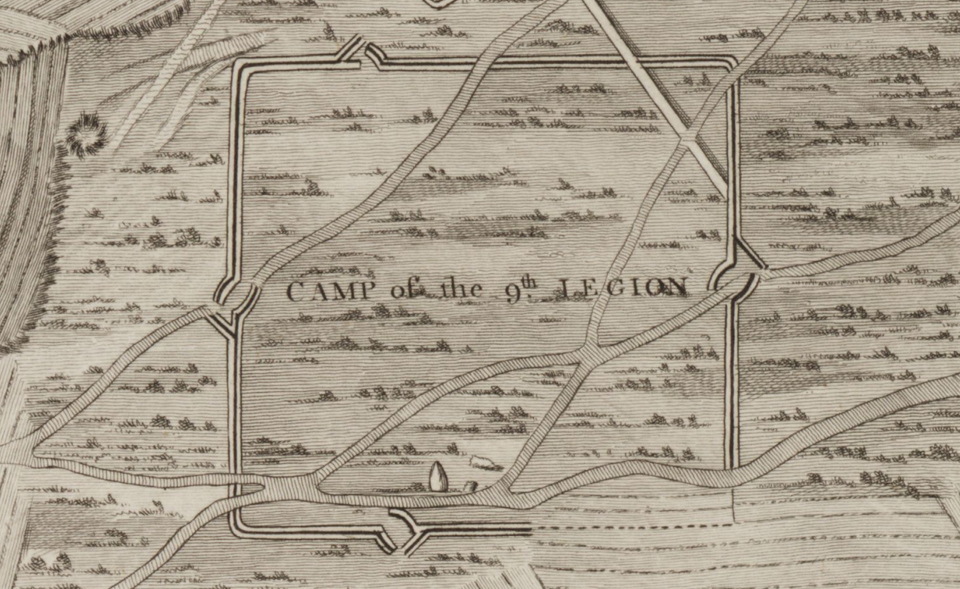
The military surveyor William Roy produced plans of forts, camps, roads and the Antonine Wall. His Military Antiquities of the Romans in North Britain was published after his death in 1793. For some sites, his drawings preserve details that later farming, building and quarrying removed. His identifications were not always correct, but the original observations remain valuable.
Nineteenth-century scholarship and the beginnings of excavation
Robert Stuart (1812–1848)
Stuart’s Caledonia Romana (1845) assembled a broad account of Roman remains in Scotland. It illustrates the change from isolated antiquarian accounts towards an attempt to assess the monuments together.
Later in the century, archaeological societies increasingly supported field investigation. Excavations and observations made during work on the Antonine Wall helped researchers to understand that the surviving banks, ditches and stone foundations represented a complex Roman construction, rather than one simple earthwork.
The early twentieth century: excavations and new evidence
James Curle (1862–1944)
Curle excavated the Roman fort at Newstead near Melrose. His A Roman Frontier Post and Its People (1911) documented buildings, weapons, armour, pottery and everyday possessions in exceptional detail. His work demonstrated how a single fort could reveal the organisation and daily experience of a Roman garrison.
Sir George Macdonald (1862–1940)
Macdonald’s surveys and excavations transformed the study of the Antonine Wall. The Roman Wall in Scotland (1911; revised 1934) combined field evidence, inscriptions and earlier records into an influential account. His conclusions have been revised in places, but his documentation remains fundamental.
Women whose work changed Roman archaeology
Anne Strachan Robertson (1910–1997)
One of Scotland’s leading Roman archaeologists and numismatists, Anne Robertson worked at the Hunterian Museum and the University of Glasgow. She directed excavations at Roman forts and on the Antonine Wall, including work at Duntocher, and published important studies of Roman coins. Her The Antonine Wall handbook first appeared in 1960 and continued to be revised by later scholars. Her career helped establish Roman archaeology as a university and museum discipline in Scotland.
Grace Simpson (1920–2007)
Simpson was an authority on Roman pottery, especially samian ware. Although much of her work concerned Roman Britain more widely, her studies helped researchers interpret pottery from northern forts and the Antonine frontier. She also drew attention to the danger of dating sites from pottery when the pottery’s own chronology had been established using those same sites.
Katharine (Kay) Hartley
Hartley’s specialist research on mortaria—Roman mixing and grinding bowls—has illuminated pottery manufacture and supply. Her analysis of potters’ stamps and clay fabrics, including finds from Bearsden, Elginhaugh and Croy Hill, has helped trace goods and craftspeople moving into Roman Scotland.
Lindsay Allason-Jones
Allason-Jones has contributed widely to research on small finds and social life in Roman Britain. With Carol van Driel-Murray and Elizabeth M. Greene, she examined evidence for women living in Roman Lowland Scotland, drawing together inscriptions, footwear and personal objects. This broadens the picture beyond officers, forts and battles. See the site’s existing profile of Lindsay Allason-Jones and Women in Roman Scotland.
Surveying Roman Scotland from the air
J. K. St Joseph (1912–1994)
St Joseph’s aerial photography revealed numerous Roman camps and other military installations that were difficult to identify from the ground. Cropmarks exposed the plans of buried ditches and helped change the map of Roman activity in northern Britain.
Gordon S. Maxwell (1938–2024)
Working with the Royal Commission on the Ancient and Historical Monuments of Scotland, Maxwell developed aerial archaeological reconnaissance from 1976 onwards. His discoveries of forts, fortlets and temporary camps added substantially to the known evidence. Raised in Corstorphine, Edinburgh, he also published widely on Roman Scotland. William Hanson’s obituary gives a useful account of his life and work.
Roman frontiers, forts and the northern campaigns
David J. Breeze
Breeze has contributed extensively to the archaeology of the Roman army and its frontiers. He excavated Bearsden fort and has written widely on the Antonine Wall and Hadrian’s Wall. He also played a leading part in the Antonine Wall’s World Heritage inscription in 2008. See the site’s profile of David Breeze and his Bearsden excavation report.
Lawrence Keppie
Formerly of the Hunterian Museum, Keppie has researched Roman inscriptions, military history and the Antonine Wall through excavation, publication and the study of antiquarian records. His The Antiquarian Rediscovery of the Antonine Wall (2012) is particularly relevant to the subject of this page. Read the digitised book.
William S. Hanson
Formerly Professor of Roman Archaeology at the University of Glasgow, Hanson has researched the Roman occupation of Scotland, frontier construction, field excavation and aerial and geophysical survey. With Breeze, he edited The Antonine Wall: Papers in Honour of Professor Lawrence Keppie (2020), a substantial collection of new research.
David Woolliscroft and Birgitta Hoffmann: the Roman Gask Project
The Roman Gask Project, directed by David Woolliscroft and Birgitta Hoffmann, investigates Roman activity north of the Forth–Clyde line, including forts, roads and watchtowers. Its mixture of excavation, survey and landscape study has generated important new evidence and fresh interpretations. Some arguments about chronology and the purpose of the Gask installations remain debated; the project’s interpretations should not be mistaken for settled agreement.
National Museums Scotland: women studying Roman Scotland today
Researchers at National Museums Scotland care for collections that span the Iron Age, Roman occupation and the periods which followed it. Their work includes original research, assessing finds from excavations, maintaining archaeological archives and helping others use those collections. The following are selected staff whose responsibilities or research relate directly to Roman Scotland or its wider context.
Dr Fraser Hunter — Principal Curator of Prehistoric and Roman Archaeology
Hunter’s work provides an essential complement to research focused on Roman armies. His studies of finds from sites such as Birnie and Traprain Law explore exchange, contact and the impact of Rome on indigenous communities. NMS profile.
Dr Rebecca Jones — Keeper of Scottish History and Archaeology
Rebecca Jones joined National Museums Scotland in 2024, having previously worked at Historic Environment Scotland and elsewhere. Her research includes Roman camps and campaigns, the Antonine Wall, the history of frontier scholarship and World Heritage management. Her Roman Camps in Scotland (2011) and Roman Camps in Britain (2012) are major contributions to the study of temporary military installations. She also researches the often-overlooked history of women in Roman archaeology. NMS profile.
Bethany Simpson — Assistant Curator, Prehistoric and Roman Archaeology
Bethany Simpson supports the care and documentation of Iron Age and Roman finds, including the registration of archaeological assemblages. Her research interests include religious practice in Roman Britain and how encounters between Roman and Iron Age communities affected religious objects and customs. NMS profile.
Leanne Demay — Post-excavation Officer
Leanne Demay coordinates specialist archaeological work and contributes to excavation reports. Her interests include Iron Age and Roman personal ornaments from north-east Scotland and the part such objects may have played in the emergence of Pictish identities. This offers a way of exploring continuity and change across the Roman and post-Roman periods. NMS profile.
Dr Gemma Cruickshanks — Post-excavation Officer
Gemma Cruickshanks manages the museum’s post-excavation analysis service and reports on archaeological objects. Her research concentrates on ironworking and iron artefacts across the period from around 1000 BC to AD 1000. Such specialist work is important to understanding technology and material culture, including contexts contemporary with the Roman presence. NMS profile.
Dr Alice Blackwell — Senior Curator, Medieval Archaeology and History
Alice Blackwell primarily studies early medieval material rather than Roman military archaeology. She is included because her work on early Scottish silver helps explain how Roman material moved into, and was transformed by, the societies which followed. She co-authored Scotland’s Early Silver: Transforming Roman Pay-offs to Pictish Treasures (2017). NMS profile.
New methods and new questions
Dr Louisa Campbell — University of Glasgow
Campbell uses techniques including portable X-ray fluorescence and Raman spectroscopy to investigate ancient materials, notably pigments preserved on Roman sculpture and Antonine Wall distance slabs. Her work shows why monuments that now look like bare stone should not automatically be imagined that way in antiquity. See the University of Glasgow research profile and the site’s guide to Roman pigments.
Richard E. Jones and Nick Hannon
Jones has specialised in archaeological geophysics, while Hannon’s work at Historic Environment Scotland includes LiDAR and geophysical survey. With William Hanson, they published Exploring the Antonine Wall with Terrestrial Remote Sensing (2024), re-examining survey results across the frontier. This approach can reveal buried features without excavating them and can also expose the limits of what surveys can tell us.
How has the study of Roman Scotland changed?
The central questions have gradually widened. Early scholars often sought to reconcile ancient accounts, particularly Tacitus’s Agricola, with the visible remains and to identify places such as Mons Graupius. Antiquaries recorded earthworks and inscriptions. Excavators examined the construction and occupation of forts, while aerial photography showed that Roman activity extended far beyond the best-known frontier monuments.
Today, archaeology increasingly includes the experiences of soldiers’ families, civilians, traders and local communities. Finds analysis, scientific techniques, environmental evidence, GIS and remote sensing all contribute. None removes the need for care: many temporary camps cannot yet be closely dated, and evidence for the lives and choices of local populations remains incomplete.
Explore related material on Romans in Scotland
- Roman Camps in Scotland — the camp evidence studied by Roy, St Joseph and Rebecca Jones.
- How Do We Know Where Roman Roads Ran? — an introduction to the methods used to identify roads.
- Maps & GIS — exploring the Roman landscape.
- Explore the Antonine Wall Distance Slabs — inscriptions and sculpture.
- Women in Roman Scotland — evidence for the people who lived here in the Roman period.
- Books on the Romans in Scotland — further reading and original publications.
References and further reading
- Scottish Archaeological Research Framework: Antiquarian research.
- ScARF: Early archaeological work, 1890–1945.
- ScARF: The modern era and its research strategies.
- Keppie, L. (2012), The Antiquarian Rediscovery of the Antonine Wall.
- Curle, J. (1911), A Roman Frontier Post and Its People; Macdonald, G. (1911; 1934), The Roman Wall in Scotland.
- Breeze, D. J. (2016), Bearsden: A Roman Fort on the Antonine Wall.
- Breeze, D. J. and Hanson, W. S. (eds) (2020), The Antonine Wall: Papers in Honour of Professor Lawrence Keppie (especially the chapters by Louisa Campbell, Rebecca Jones and Lindsay Allason-Jones with colleagues).
- Hanson, W. S., Jones, R. E. and Hannon, N. (2024), Exploring the Antonine Wall with Terrestrial Remote Sensing.
- National Museums Scotland: Scottish History and Archaeology staff (current responsibilities).
- Society of Antiquaries of Scotland: Hidden Voices (recognising women in Scottish archaeology).
Research note: This guide distinguishes the researcher’s contribution from the historical interpretation of a site. Institutional posts and research interests reflect information supplied by the relevant organisations when the page was prepared (October 2026). Researchers outside Scotland are included where their work has materially shaped the study of Roman Scotland.


