Meet the people who lived in Roman Scotland
Roman historians tell us about emperors, governors, invasions and battles.
Inscriptions tell us about people.
Across Scotland, words written nearly 2,000 years ago survive on altars, tombstones, building stones, distance slabs and everyday objects.
They preserve the names of soldiers and commanders, military units, gods and goddesses, emperors, civilians and occasionally women and children.
Sometimes an inscription consists of only a few letters.
Sometimes it tells us an extraordinary amount about an individual: their name, where they came from, their military unit, their rank, how long they served and even how old they were when they died.
These are some of the closest things we have to voices from Roman Scotland.
🪨 What is a Roman inscription?
The Romans were surrounded by writing.
Official inscriptions celebrated emperors and military achievements. Soldiers erected altars to their gods. Tombstones commemorated the dead. Military units recorded construction work.
Writing also appeared on much smaller objects — pottery, jewellery, military equipment and personal possessions.
For Roman Scotland, inscriptions are especially valuable because the surviving ancient writers tell us surprisingly little about what was happening here.
An inscription can sometimes provide information found nowhere else.
🔎 Roman Inscriptions of Britain — RIB
The starting point for investigating inscriptions from Roman Scotland is Roman Inscriptions of Britain, usually abbreviated to RIB.
RIB is the standard scholarly catalogue of inscriptions from Roman Britain. Its online database lets you search by inscription number, findspot, text, person, military unit and other terms.
Search Roman Inscriptions of Britain (RIB Online)
The database includes photographs and drawings for many inscriptions, together with the original Latin, translations, find circumstances and references to academic publications.
Try searching for:
Cramond • Inveresk • Newstead • Birrens • Mumrills • Auchendavy • Bar Hill • Castlecary • Bearsden
Or search for a legion:
LEG II AVG • LEG VI VICTRIX • LEG XX VV
This allows you to investigate the evidence rather than simply accepting somebody else’s interpretation of it.
🧩 How do you read a Roman inscription?
Roman inscriptions can initially look almost impossible to understand.
The reason is that Roman stonecutters used abbreviations everywhere.
Imagine finding:
D M
NECTOVELIVS VINDICIS F
BRIGANS
ANN XXIX
It looks cryptic.
But expand the abbreviations and suddenly a person begins to emerge.
D M = Dis Manibus — “To the spirits of the departed”
F = filius — son
ANN = annorum — aged
The inscription records Nectovelius, son of Vindex, a Brigantian who died aged 29.
A handful of abbreviated Latin words has preserved someone’s identity for almost two millennia.
🧑 Who were the Romans in Scotland?
This is where inscriptions become particularly powerful.
The Roman army in Scotland was not simply an army of men from Rome or Italy.
Inscriptions reveal people and military units whose origins stretched across the Empire.
They include men associated with:
Gaul • Germania • Thrace • the Low Countries • Spain • Syria • North Africa • other parts of Britain
A soldier could therefore have been born hundreds or thousands of miles away before eventually serving on Rome’s northern frontier.
That makes inscriptions one of our best sources for understanding the extraordinary movement of people created by the Roman Empire.
→ Explore the People of Roman Scotland
→ Explore Roman Military Units
🪦 Tombstones — individual lives
Tombstones give us some of the most personal evidence from Roman Scotland.
They can record:
Name
Age
Place or people of origin
Military unit
Rank
Years of service
Family relationships
Nectovelius — Mumrills
Nectovelius was a Brigantian serving with the Second Cohort of Thracians.
He died aged just 29, after nine years of military service.
His tombstone is particularly interesting because his ethnic origin and the origin of his military unit were different.
He wasn’t Thracian simply because he served in a Thracian cohort.
That is an important warning when interpreting Roman military unit names.
→ Nectovelius: a Brigantian soldier at Mumrills
Flavius Lucianus — near Auchendavy
Another tombstone records Flavius Lucianus, a soldier of Legio II Augusta.
The inscription gives us an individual behind one of the legions involved in constructing and garrisoning Rome’s northern frontier.
🏛️ Altars — people talking to their gods
Some of Scotland’s most revealing inscriptions are religious dedications.
A typical Roman altar might contain a formula such as:
V S L M
That expands to:
Votum Solvit Libens Merito
Usually translated approximately as:
“Willingly and deservedly fulfilled his vow.”
This tells us something important about Roman religion.
The worshipper had made a promise or vow to a god and was recording that the obligation had been fulfilled.
Marcus Cocceius Firmus
One of the most remarkable individuals known from inscriptions in Roman Scotland is Marcus Cocceius Firmus.
He was a centurion of Legio II Augusta.
At Auchendavy, he dedicated altars involving an extraordinary collection of deities, including:
Jupiter • Victory • Mars • Minerva • Diana • Apollo • Hercules • Epona • the Campestres • the Genius of the Land of Britain
Without his inscriptions, we wouldn’t know his story.
They allow us to investigate one individual Roman officer’s religious world on the Antonine frontier.
→ Explore Marcus Cocceius Firmus
→ Explore Roman Altars in Scotland
🌍 Gods from across the Empire
Religious inscriptions also reveal how internationally connected Roman Scotland was.
Soldiers did not necessarily abandon their gods when they joined the Roman army.
Religious ideas travelled with people.
Consequently, Roman Scotland contains evidence for traditional Roman gods alongside deities and cults associated with other parts of the Empire.
The extraordinary discoveries at Inveresk, for example, provide evidence for the worship of Mithras.
Elsewhere we encounter deities such as Epona and Hercules Magusanus.
Religion therefore becomes another way of tracing movement, identity and cultural connections.
→ Gods & Religion in Roman Scotland
→ Mithras at Inveresk
🧱 Building inscriptions — who built Roman Scotland?
Roman military units frequently recorded construction work.
These inscriptions can tell us which units built or repaired:
forts • headquarters buildings • bathhouses • defensive works • frontier installations
This is particularly useful because the presence of a building inscription can provide direct evidence connecting a military unit with a particular site.
But there is an important caution.
The unit that built something wasn’t necessarily the unit that lived there.
Legionaries could be detached for specialist construction work before moving elsewhere.
An inscription saying that Legio XX built something therefore doesn’t automatically mean that Legio XX permanently garrisoned that site.
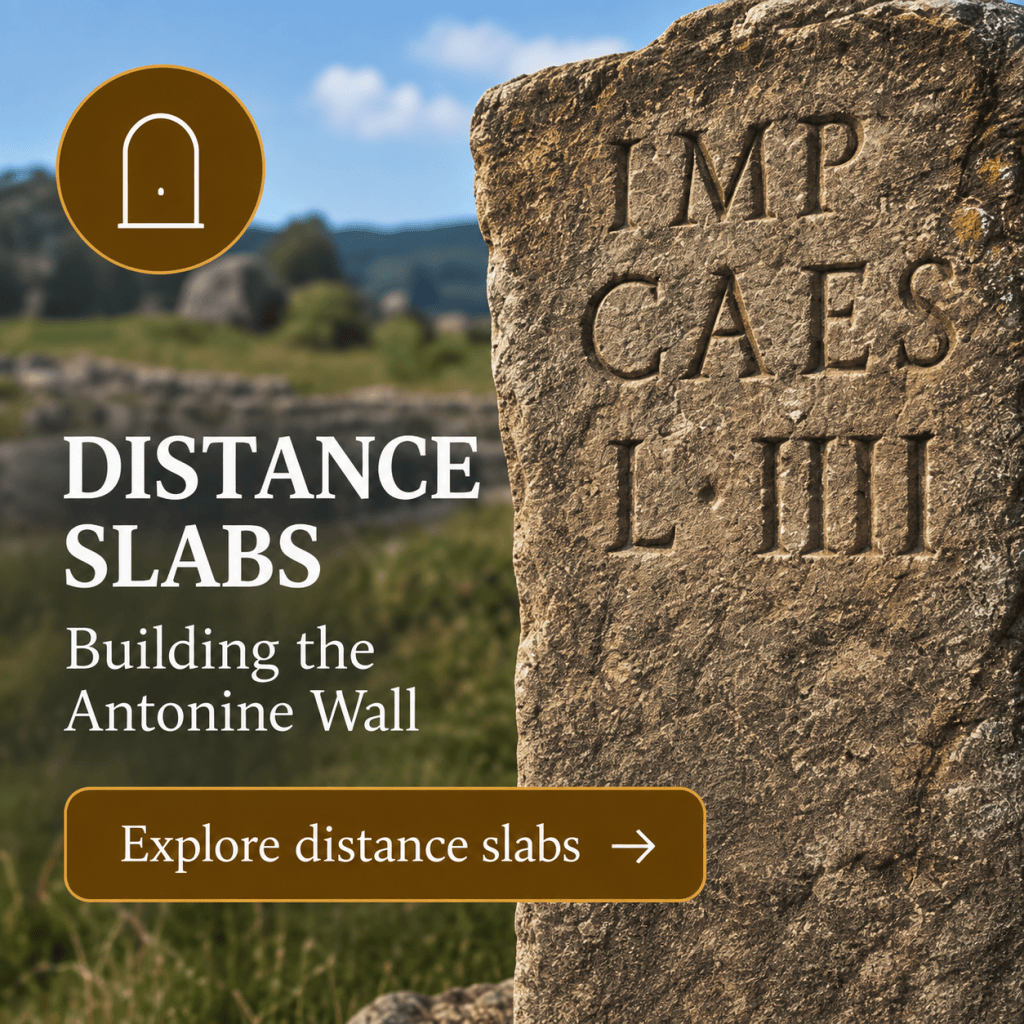
🧱 The Antonine Wall Distance Slabs
Scotland possesses an extraordinary group of Roman inscriptions unlike anything found elsewhere in the Empire.
The Antonine Wall distance slabs recorded sections of frontier constructed by Rome’s legions.
The three legions involved were:
Legio II Augusta
Legio VI Victrix
Legio XX Valeria Victrix
The inscriptions give distances for sections of work.
This means archaeologists can use them to investigate how construction of the Wall was divided between different legionary work parties.
But the slabs were far more impressive than ordinary construction records.
They carried elaborate images of Victory, legionary emblems, Roman soldiers and defeated enemies.
They were both records and propaganda.
→ Explore all 18 Antonine Wall Distance Slabs
👑 Emperors carved in stone
Official inscriptions can also help date Roman activity.
An inscription might give an emperor’s titles in painstaking detail. Those titles changed during a reign. That means the particular combination of titles can sometimes allow an inscription to be dated surprisingly closely.
There is another complication. Emperors could be erased.
After an emperor was condemned by the Roman state, their name could sometimes be deliberately removed from inscriptions — a practice conventionally associated with damnatio memoriae.
The missing words can therefore themselves become historical evidence.
👩 Can inscriptions tell us about women?
Yes — although considerably fewer women than men appear in the surviving epigraphic record of Roman Scotland.
That imbalance partly reflects the nature of the evidence.
Military inscriptions overwhelmingly commemorate men because the Roman army was male.
But women lived in and around forts and settlements, travelled with military communities and participated in religious and family life.
When a woman’s name does survive, an inscription can therefore be exceptionally valuable.
It can reveal family relationships, movement across the Empire, social status and religious activity.
→ Women Named in Roman Scotland
✍️ Not every inscription was monumental
Writing wasn’t restricted to carefully carved stone.
People scratched or stamped words onto everyday objects.
Pottery can preserve:
makers’ stamps • owners’ names • scratched marks • numbers and abbreviations
Military equipment and personal possessions can also carry inscriptions.
These smaller inscriptions can bring us surprisingly close to everyday life.
A monumental inscription tells us what an emperor or military unit wanted everyone to see.
A name scratched onto a pot might tell us who owned someone’s dinner bowl.
Both are primary sources — but they answer very different questions.
🧠 What can an inscription really prove?
Inscriptions are powerful evidence, but they need to be interpreted carefully.
If an altar says:
Marcus dedicated this altar to Jupiter
we can reasonably conclude that Marcus made—or commissioned—the dedication.
We cannot automatically conclude:
Everyone at the fort worshipped Jupiter in exactly the same way.
Similarly:
A building inscription proves construction activity, not necessarily permanent garrisoning.
A tombstone records how someone was commemorated, not their complete biography.
A military unit’s ethnic name doesn’t necessarily tell us where its individual soldiers were born.
And:
An inscription found at a Roman site wasn’t necessarily originally erected exactly where archaeologists found it.
Stones were reused.
Context matters.
🕵️ Investigate an inscription yourself
Here is a simple way to approach any Roman inscription.
- Where was it found?
Was it discovered inside a fort, settlement, bathhouse, cemetery or somewhere else? - What kind of object is it?
Altar, tombstone, building stone, distance slab or something portable? - What does the Latin actually say?
Look at the expanded Latin as well as the translation. - Who is named?
Person, emperor, military unit or deity? - What can we learn about that person?
Rank, origin, unit, age, family? - When was it made?
Can an emperor, military unit or archaeological context provide a date? - What doesn’t it tell us?
This is often just as important.
🔎 Search the evidence yourself
The best place to begin is:
Roman Inscriptions of Britain Online
Try entering the name of a Scottish Roman site.
Antonine Wall
Bearsden
Bar Hill
Auchendavy
Castlecary
Mumrills
Rough Castle
Southern Scotland
Birrens
Newstead / Trimontium
Forth
Cramond
Inveresk
Then try searching by military unit:
LEG II AVG
LEG VI VICTRIX
LEG XX VV
You can begin to reconstruct the Roman military presence in Scotland directly from the surviving evidence.
Useful abbreviations
I would include this as a small reference box on the page:
| Abbreviation | Latin | Meaning |
|---|---|---|
| D M | Dis Manibus | To the spirits of the departed |
| V S L M | Votum solvit libens merito | Willingly and deservedly fulfilled his vow |
| LEG | Legio | Legion |
| COH | Cohors | Cohort |
| CENT / > | Centuria | Century |
| F | Filius / filia | Son / daughter |
| ANN | Annorum | Aged … years |
| H S E | Hic situs est | Here lies |
| AVG | Augustus/Augusta | Imperial/Augustan; meaning depends on context |
| IMP | Imperator | Emperor/commander |
| COS | Consul | Consul |
| P P | Pater Patriae | Father of the Fatherland |
→ Next: Explore the People of Roman Scotland