School topics · Teacher guide and download · CfE Second Level · P5–P7
Bring Roman Scotland into the classroom through objects, stories, maps and practical challenges. This page brings together our teaching series and selected museum and heritage resources to help you plan a topic, find an activity or organise a visit.
Looking for a particular activity? Browse the activity gazetteer by topic — 72 resources with individual links.
The central enquiry is simple: what happened when Rome reached the land we now call Scotland? Explore the people already living here, the changing frontier and the evidence left behind. The Romans occupied parts of Scotland at different times, but never brought the whole of it under lasting control.
Start with the teaching series
Our Romans in Scotland for schools series is designed for Curriculum for Excellence Second Level, usually P5–P7. Follow the four topics in order or choose one to support your class enquiry.
- Who lived here before the Romans? — Meet Iron Age communities and investigate homes, farming and the evidence for everyday life.
- Life on the Antonine Wall — Explore a turf-built frontier and imagine life for soldiers and local people.
- Roman campaigns and engineering — Investigate roads, marching camps and what we can—and cannot—know about Mons Graupius.
- Everyday life, trade and withdrawal — Use objects to explore contact, exchange and the changing Roman presence.
The teacher guide brings together curriculum links, learning intentions, success criteria, differentiation and assessment. Activities connect Social Studies with literacy, drama, STEM, expressive arts and numeracy.
Download the editable teaching pack (Word, 10 pages, 54 KB)
The pack includes four lessons, pupil sheets, teacher answers and enquiry questions.
Teaching a younger class? Our primary school interdisciplinary topic overview shares a First Level example from Gylemuir Primary School. Select and adapt activities to suit your learners.
Activity gazetteer: choose a topic
72 individual resources, including 59 PDFs. Browse activities from the Antonine Wall team, Trimontium Museum, the Hunterian, National Museums Scotland and LatinNow. Instructions, templates and answer sheets are listed separately so you can choose exactly what you need.
Select a title to open the resource. PDFs can be viewed, saved or printed; videos, games and online presentations are labelled. These are the providers’ resources, hosted on their own websites. The descriptions suggest classroom uses rather than certify a CfE level: choose and adapt for your learners. Simple colouring tasks can support younger pupils; enquiry, codebreaking and debate can extend P5–P7 learning.
- Iron Age people and jewellery
- The Roman army, equipment and drill
- Walls, forts, roads and engineering
- Archaeology, objects and coins
- Food and cooking
- Children, women, clothing and everyday life
- Gods, beliefs and journeys
- Literacy, Latin, news and codebreaking
- Roman numerals, maps and places
- Games, art, movement and historical debate
- Museum trails, heritage and teacher packs
Quick starting points: try “The Archaeologist” for evidence, “Building the Wall” for engineering, “Growing up on the Antonine Wall” for writing, or the LatinNow codebreaking lesson for a group challenge.
Directory compiled from provider resource pages on 25 September 2026. Online services may require JavaScript or access through your school’s network. Preview resources before teaching; see the specific notes beside older worksheets.
Iron Age people and jewellery
Explore local material culture alongside the Roman story. “Celtic” is retained where it appears in the provider’s resource title.
- Celtic armlet: card-making instructions — Antonine Wall / Historic Environment Scotland · PDF, 1 page.
Make a wearable model from card. - Celtic armlet: clay-making instructions — Antonine Wall / Historic Environment Scotland · PDF, 1 page.
Model an armlet using clay. - Celtic armlet: black-and-white template — Antonine Wall / Historic Environment Scotland · PDF, 1 page.
A printable design to colour. - Celtic armlet: colour template — Antonine Wall / Historic Environment Scotland · PDF, 1 page.
A ready-coloured alternative.
The Roman army, equipment and drill
Compare legionaries and auxiliaries, make classroom props and try a movement activity.
- Auxiliary soldier: colouring sheet — Antonine Wall / Historic Environment Scotland · PDF, 1 page.
A line drawing for labelling or colouring. - Auxiliary soldier: colour picture — Antonine Wall / Historic Environment Scotland · PDF, 1 page.
An illustration for comparison and discussion. - Legionary: colouring sheet — Antonine Wall / Historic Environment Scotland · PDF, 1 page.
A line drawing for labelling or colouring. - Legionary: colour picture — Antonine Wall / Historic Environment Scotland · PDF, 1 page.
Compare equipment with the auxiliary illustration. - Make a legionary badge — Antonine Wall / Historic Environment Scotland · PDF, 1 page.
Create a badge for a classroom legion. - Roman soldier drill practice — Antonine Wall / Historic Environment Scotland · PDF, 1 page.
Follow a sequence of drill commands. - Roman helmet: making instructions — Antonine Wall / Historic Environment Scotland · PDF, 1 page.
Instructions for assembling a paper helmet. - Roman helmet: black-and-white template — Antonine Wall / Historic Environment Scotland · PDF, 2 pages.
Print and colour the helmet pieces. - Roman helmet: colour template — Antonine Wall / Historic Environment Scotland · PDF, 2 pages.
Print the coloured helmet pieces. - Legionary sword: making instructions — Antonine Wall / Historic Environment Scotland · PDF, 1 page.
Make a card prop for role play. - Legionary sword: A3 black-and-white template — Antonine Wall / Historic Environment Scotland · PDF, 1 page.
Larger template to colour. - Legionary sword: A4 black-and-white template — Antonine Wall / Historic Environment Scotland · PDF, 1 page.
Standard-size template to colour. - Legionary sword: A3 colour template — Antonine Wall / Historic Environment Scotland · PDF, 1 page.
Larger ready-coloured template. - Legionary sword: A4 colour template — Antonine Wall / Historic Environment Scotland · PDF, 1 page.
Standard-size ready-coloured template.
Walls, forts, roads and engineering
Connect construction, planning and design with the evidence for Roman Scotland.
- Building the Wall — Antonine Wall / Historic Environment Scotland · PDF, 2 pages.
Identify building tasks and tools; act out the work. - The Wall Builders — Antonine Wall / Historic Environment Scotland · PDF, 2 pages.
Investigate legion symbols and design a distance slab. - Plan of a Roman fort — Antonine Wall / Historic Environment Scotland · PDF, 1 page.
Use a fort plan for discussion or model-making. - Roman Roads & Route Planning — Trimontium Museum · PDF, 3 pages.
Explore road cross-sections and plan routes across Roman Britain.
Archaeology, objects and coins
Practise observing first, then explaining what the evidence might mean.
- The Archaeologist — Antonine Wall / Historic Environment Scotland · PDF, 3 pages.
Reassemble distance slabs and report on the discovery. - Hunt the object: colour sheets — Antonine Wall / Historic Environment Scotland · PDF, 5 pages.
Use illustrated objects for a classroom or museum hunt. - Roman objects: black-and-white sheets — Antonine Wall / Historic Environment Scotland · PDF, 5 pages.
Printable object images for colouring and close observation. - Make a Roman coin hoard — Antonine Wall / Historic Environment Scotland · PDF, 2 pages.
Create model coins and discuss a hoard.
Food and cooking
Compare ingredients and explore the practical work of preparing a meal. Check ingredients and allergies before cooking.
- Roman army bread — Trimontium Museum · PDF, 3 pages.
A practical bread-making recipe. - Roman recipe cards — Antonine Wall / Historic Environment Scotland · PDF, 3 pages.
Printable recipe cards for food activities. - Roman Recipes e-book — Trimontium Museum · Online e-book · Canva.
Browse Trimontium’s recipe collection.
Children, women, clothing and everyday life
Use creative responses to explore different experiences on the frontier. Distinguish imagined details from evidence.
- Growing up on the Antonine Wall — Antonine Wall / Historic Environment Scotland · PDF, 3 pages.
Respond to character prompts through a letter or drawing. - Roman Women — Antonine Wall / Historic Environment Scotland · PDF, 1 page.
A resource for exploring women on the frontier. - Bath Time! — Antonine Wall / Historic Environment Scotland · PDF, 3 pages.
Investigate the rooms and activities of a bathhouse. - Roman sandals — Trimontium Museum · PDF, 4 pages.
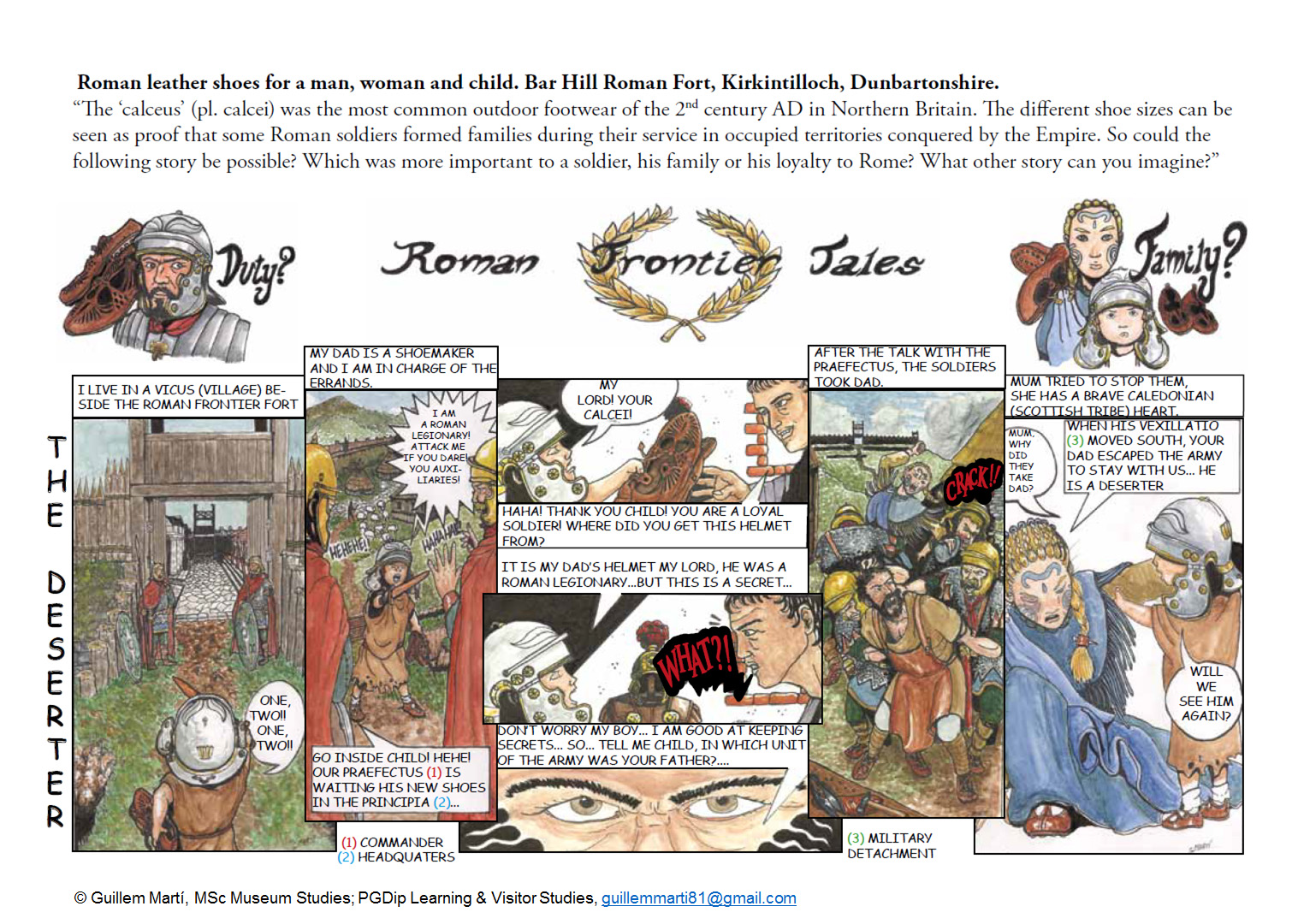
Make a sandal model inspired by surviving footwear. - Roman shoes comic strip — The Hunterian · Image · JPG.
Read a short story inspired by shoes in the collection. - Hunterian stories: Ebutius and Verecunda — The Hunterian · Interactive stories.
Choose a story inspired by the museum’s objects. - Finding Fabius — Trimontium Museum · Video · YouTube.
A film co-created with UPMO, for discussion and creative responses.
Gods, beliefs and journeys
Explore how people expressed beliefs and hopes through objects and words.
- Roman Gods and Goddesses on the Antonine Wall — Antonine Wall / Historic Environment Scotland · PDF, 2 pages.
Explore deities associated with the frontier. - Blessings for Travellers — Antonine Wall / Historic Environment Scotland · PDF, 2 pages.
Consider journeys and create a blessing.
Literacy, Latin, news and codebreaking
Choose vocabulary work, imaginative writing or a structured codebreaking lesson. LatinNow’s military examples use Vindolanda in northern England as a comparison.
- Latin words and numbers — Antonine Wall / Historic Environment Scotland · PDF, 3 pages.
A reference sheet for Roman vocabulary and numerals. - Roman cartoons and Latin words — Antonine Wall / Historic Environment Scotland · PDF, 4 pages.
Illustrated colouring sheets. - Salve, Ebutius! Learn Latin — The Hunterian · Video · YouTube.
An introduction to simple Latin greetings. - Roman News — The Hunterian · PDF, 3 pages.
Create an imagined news sheet for the frontier. - Romans in Scotland acrostic poem — National Museums Scotland · PDF, 2 pages.
Record topic vocabulary through poetry. - Romans in Scotland word search — National Museums Scotland · PDF, 2 pages.
Find Roman-related vocabulary. - Romans in Scotland word search: answers — National Museums Scotland · PDF, 2 pages.
Answer sheets for the NMS word search. - Roman wordsearch 1 — Trimontium Museum · PDF, 1 page.
A printable vocabulary puzzle. - Roman wordsearch 2 — Trimontium Museum · PDF, 1 page.
A second printable vocabulary puzzle. - Antonine Wall word search — Antonine Wall / Historic Environment Scotland · PDF, 2 pages.
A vocabulary puzzle from the Wall’s activity collection. - Military codebreaking: teacher’s lesson plan — LatinNow · PDF, 3 pages.
Plan a teacher-led session of about 45 minutes. - Military codebreaking: presentation — LatinNow · PDF, 11 pages.
Slides supplied as a PDF for the lesson. - Old Roman cursive: decoding key — LatinNow · PDF, 1 page.
Use the letter key with the military message. - Military message in three parts — LatinNow · PDF, 3 pages.
Printable message sheets for the group task. - Decode a Roman military message: independent worksheet — LatinNow · PDF, 2 pages.
A two-sided alternative for individual or paired work.
Teacher note: Roman News is an imaginative writing task, not an example of a surviving frontier newspaper. Its background statements about paper and the Latin alphabet are oversimplified; use the writing prompts with teacher guidance.
Roman numerals, maps and places
Combine number work with journeys, location and the wider Roman world.
- Roman Numerals — The Hunterian · PDF, 2 pages.
Try numeral reading and calculations; see the correction below. - Mapping the Walls — Antonine Wall / Historic Environment Scotland · PDF, 2 pages.
Compare and locate the Roman frontiers. - Antonine Wall community map — Antonine Wall / Historic Environment Scotland · PDF, 1 page.
A printable map for locating places along the Wall. - Where in the Empire? — Antonine Wall / Historic Environment Scotland · PDF, 2 pages.
Locate provinces and connect them with modern places.
Teacher note: The Hunterian numerals sheet mixes up some worked-example rule labels and gives AD 211 for the Wall’s final abandonment. Use the number exercises with corrections: the Antonine frontier was abandoned in the AD 160s. Roman provinces also do not match modern national borders exactly. See the Antonine Wall history and timeline.
Games, art, movement and historical debate
Use these as starting points for discussion, creative work or a short extension activity.
- Design a Roman mosaic — National Museums Scotland · PDF, 1 page.
Create a coloured mosaic design; a wider Roman-world comparison. - How to play Ludus Latrunculorum — Antonine Wall / Historic Environment Scotland · Word document · DOCX.
Instructions for a Roman board-game activity. - Snakes and Ladders — Antonine Wall / Historic Environment Scotland · PDF, 1 page.
A printable game activity. - Roman dance workshop — Trimontium Museum · Video playlist · YouTube.
A playlist of short workshop videos co-created with UPMO. - Antonine Wall interactive timeline — The Hunterian · Interactive timeline · Sutori.
Explore the Wall in the wider history of Roman Britain. - Go Roman — Historic Environment Scotland / Glasgow School of Art · Game · app download page.
Explore a reconstructed fort; check device compatibility before the lesson. - Why study the Romans? — Trimontium Museum · Online presentation · Canva.
A presentation to start a topic or discuss its relevance. - Stories, Stones and Bones: film 1 — Trimontium Museum · Video · YouTube.
Compare a proposed explanation for Trimontium’s evacuation. - Stories, Stones and Bones: film 2 — Trimontium Museum · Video · YouTube.
Compare a proposed explanation for Trimontium’s evacuation. - Stories, Stones and Bones: film 3 — Trimontium Museum · Video · YouTube.
Compare a proposed explanation for Trimontium’s evacuation.
Teacher note: The three Trimontium films present competing interpretations. Ask pupils what evidence would support each account; do not present any one film as a settled explanation.
Museum trails, heritage and teacher packs
Prepare a visit, select tasks from a larger pack or investigate why archaeological places matter.
- Romans Trail: pupil booklet — National Museums Scotland · PDF, 4 pages.
An object trail for the National Museum of Scotland. - Romans Trail: group leader’s notes — National Museums Scotland · PDF, 10 pages.
Directions, answers and background for accompanying adults. - Antonine Wall museum resource kit — The Hunterian · PDF, 12 pages.
Materials for a teacher-led Hunterian visit. - Antonine Wall teachers’ resource pack — The Hunterian · PDF, 43 pages.
A larger collection of pre-visit, museum and follow-up activities; provider age range 8–10. - World Heritage Sites — Antonine Wall / Historic Environment Scotland · PDF, 2 pages.
Explore the meaning of heritage and protecting places.
Teacher note: The World Heritage worksheet’s Scottish site count is dated. Use the current UNESCO list for any extension task. Check gallery arrangements before using museum trails.
Provider collections and further downloads
If a file moves, use the organisation’s resource collection to find its latest version. These collections may include further activities and new additions.
- Antonine Wall: primary school resources
- Trimontium Museum: resources for schools
- The Hunterian: Antonine Wall resources
- National Museums Scotland: Roman classroom resources
- National Museums Scotland: Romans Trail
- LatinNow: teaching and learning
For storytelling material from this site, see Antonine Wall comics for schools.
Handle objects and meet the past
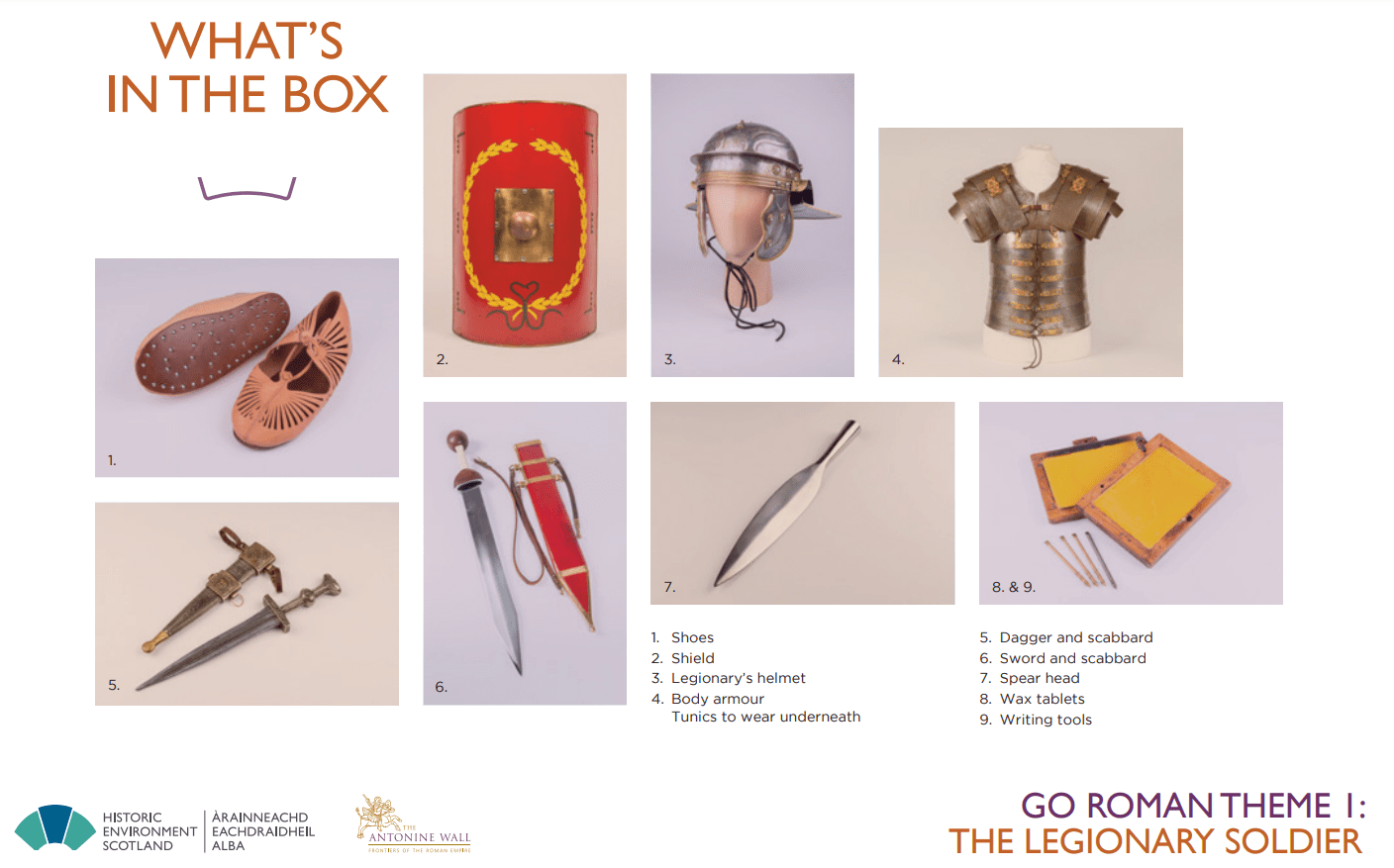
Go Roman handling boxes contain replica objects for exploring Roman life. Use them to practise observing, describing and making evidence-based suggestions. Follow the provider’s current instructions for borrowing a box.
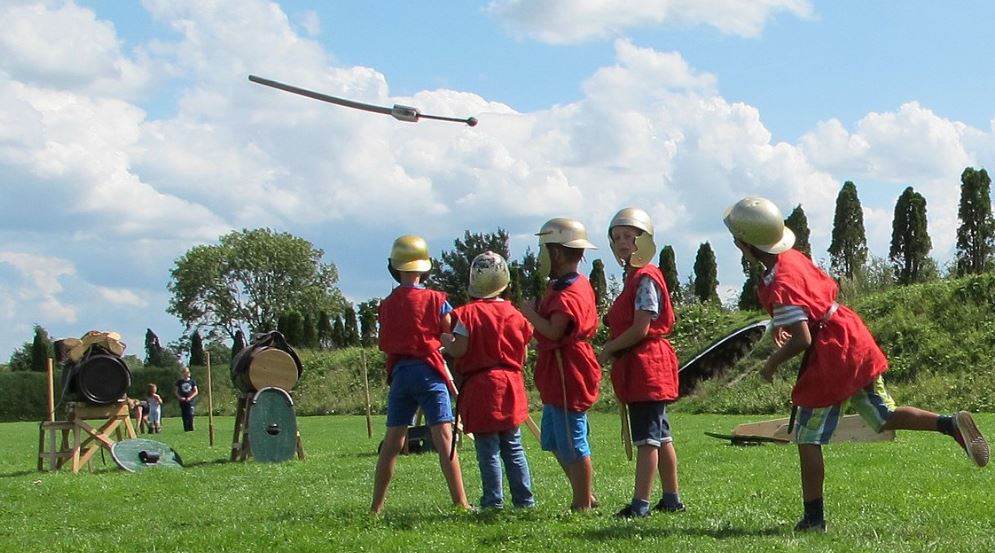
Re-enactment can also prompt lively questions about clothing, equipment and daily routines. The Antonine Guard has previously offered school visits; contact the group to check current availability, suitability and charges.
Try this: ask pupils to record one thing they observed, one interpretation and one question they still need to investigate. A replica or re-enactment helps us imagine the past, but is not an original ancient source.
Plan a museum or site visit
Use our museums map to find collections near you. Build the visit around a question such as “What can objects tell us about the people who lived on the frontier?”
- Antonine Wall — Ideas for classroom preparation and activities at the frontier.
- National Museum of Scotland, Edinburgh — Use the Romans Trail to focus an object enquiry.
- The Hunterian, Glasgow — Learning information and arrangements for educational visits.
- Trimontium Museum, Melrose — Enquire about school learning and visits.
- Perth Museum — Contact the learning team about opportunities relevant to your topic.
Check booking requirements, accessibility, transport and any admission or workshop charges with the venue. Before the visit, let pupils choose a question; afterwards, ask them to use an object or observation to support their answer.
Extend the enquiry
For older learners, explore the Antonine Wall secondary resources. For a wider comparison, the British Museum’s Ancient Rome resources can help pupils consider how life elsewhere in the Roman world differed from life on the Scottish frontier.
For teacher background reading, start with National Museums Scotland’s introduction to Roman Scotland. Keep returning to two questions: What is our evidence? Whose point of view is missing?
Ready to begin? Open the four school topics or go straight to the teacher guide and downloadable pack.
More activities from Roman Corstorphine
Explore the local Corstorphine enquiry and ask pupils to distinguish evidence from interpretation.
A Roman Frontier Fort in Scotland — Trimontium Museum’s digital learning resource. Trimontium is at Melrose in the Scottish Borders.
National Geographic Kids: Romans primary resource — an additional classroom resource; select and adapt it for your class.
Antonine Wall comics · Games to try · Roman clothing and colouring sheets · Roman numerals and birth years