Wives, mothers, servants, worshippers and local women on Rome’s northern frontier
The traditional story of Roman Scotland is overwhelmingly male. It is a story of emperors, governors, legionaries, auxiliary soldiers, forts, battles and frontiers. But the communities created by the Roman presence in Scotland were not communities of men alone.
Women lived beside soldiers, travelled with military families, raised children, worshipped their own gods, commemorated relatives and formed part of the settlements around Roman forts. Other women belonged to the communities already living in Scotland long before the first Roman soldier arrived.
The difficulty is finding them.
Most surviving inscriptions from Roman Scotland were created by the army, and consequently name men. Many everyday objects cannot reliably be identified as belonging to either a man or a woman.
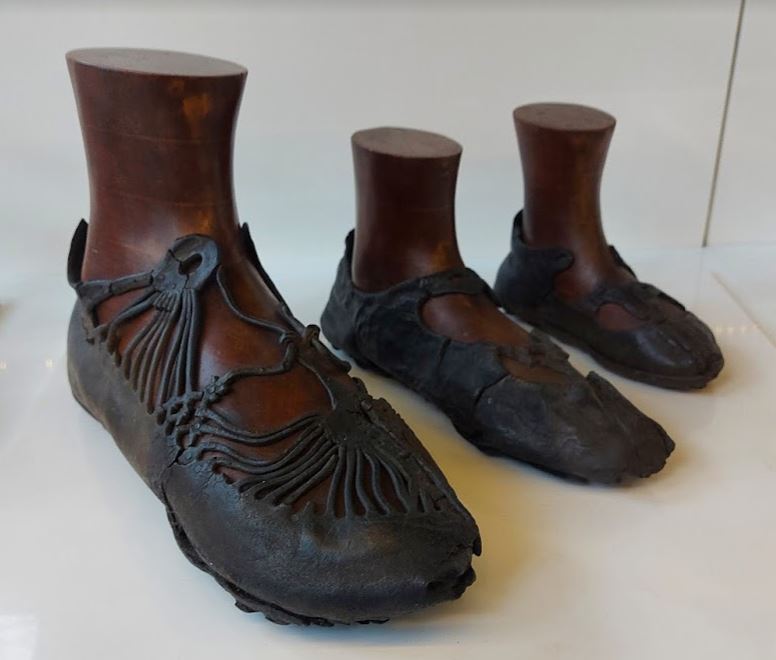
But occasionally the evidence changes dramatically. At several Scottish forts, shoes survived. And among those shoes are footwear belonging to women, children and even very young children. The result is increasingly clear:
Women were not unusual visitors to Roman Scotland.
They were part of its population.
A frontier of families, not just soldiers
The Antonine Wall was a military frontier, but a Roman fort did not exist in isolation. Around many forts developed settlements containing the people and services required by hundreds of soldiers. There were traders, craftspeople, servants and families.
Roman law complicated family life. For much of the first and second centuries ordinary serving soldiers were formally prevented from contracting a recognised Roman marriage. That did not mean they lived without partners or children.
Soldiers formed relationships and raised families despite the legal restrictions. Officers and centurions occupied a rather different social position, and some certainly had their households with them.
This matters because an older picture of the Roman frontier imagined: soldiers inside the fort; women and children outside it. The archaeology is not quite so simple.
At Rough Castle, Balmuildy and other Antonine sites, discarded footwear may have come from inside the forts themselves. The evidence raises the possibility that at least some families lived within the military enclosure, not merely in settlements outside.
The shoes change the story
One of the most important studies of women in Roman Scotland examined leather footwear from sites including:
- Bar Hill
- Camelon
- Castlecary
- Balmuildy
- Rough Castle
- Birrens
- Newstead
- Inveresk
Leather survives only under particular archaeological conditions. Where it does survive, however, shoes provide something that stone inscriptions rarely do: evidence for ordinary people.
At Bar Hill, shoes belonged to adult women, children and even very young children. At Camelon, the footwear included large numbers of shoes in sizes associated with women.
There is even a tiny shoe from Bar Hill with a sole only about 15.5 cm long. It was not a crude child’s slipper. It was carefully made in essentially the same fashion as adult Roman footwear and had a heavily nailed sole.
Someone had also repaired it. That small shoe represents a child growing up on Rome’s northernmost frontier. And behind that child was a family.
Women may have been far more numerous than the inscriptions suggest
This creates an important archaeological lesson. If the leather had rotted away, many of these forts would appear overwhelmingly male.
Weapons survive. Military inscriptions survive. Stone altars survive. Women’s shoes usually do not. This is why the absence of women from much of the traditional history of Roman Scotland should not be confused with their absence from Roman Scotland itself.
The evidence is uneven. At Camelon, preserved footwear creates a picture of a community containing substantial numbers of women and children. At Bearsden, where comparable leather did not survive, the small finds provide almost no secure evidence for either.
The difference may be preservation rather than population.
The women whose names survived
Only a handful of women connected with Roman Scotland are known by name.
That makes each one particularly valuable.
Magunna — worshipping at Birrens
At Birrens, a woman called Magunna dedicated an altar to Jupiter Dolichenus.
This is important because Magunna was not merely mentioned as someone’s wife or daughter.
She made the dedication herself.
Her name appears to have Celtic origins, while Jupiter Dolichenus was a god whose cult ultimately originated in the eastern Mediterranean.
One woman and one altar therefore capture something of the extraordinary cultural mixture created around Roman military communities.
Magunna also reminds us that women participated directly in religious life.
Vibia Pacata — worship and family at Westerwood
One of the most remarkable female inscriptions in Roman Scotland was discovered near Westerwood on the Antonine Wall. Vibia Pacata dedicated an altar to the celestial Silvanae and Quadriviae.
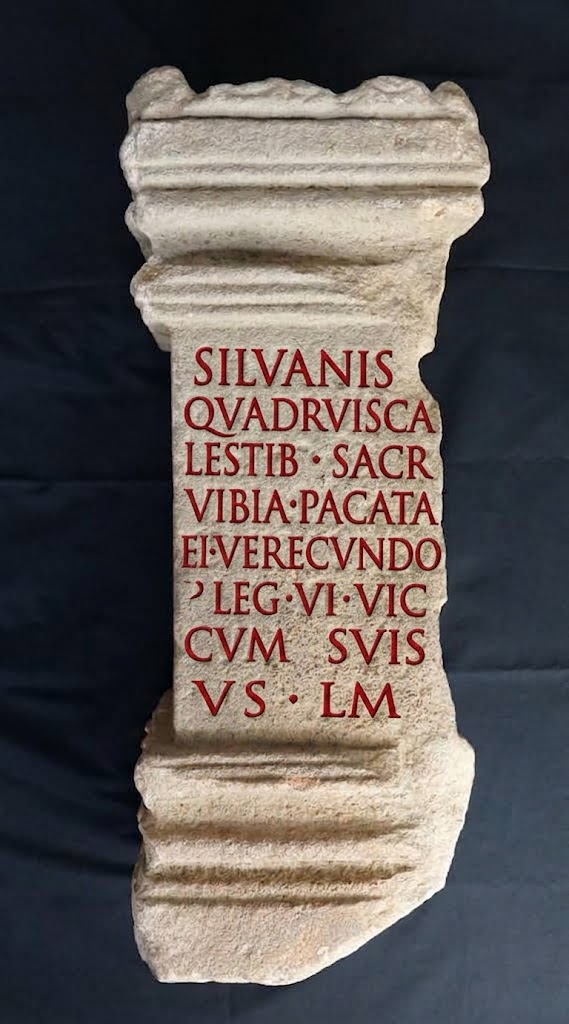
The Silvanae were associated with woodland, while the Quadriviae were goddesses of crossroads. The inscription connects Vibia with Flavius Verecundus, a centurion of the Sixth Legion Victrix, and says that she fulfilled her vow with her family.
She is usually interpreted as his wife or partner, although the inscription does not actually use the Latin word uxor, meaning wife. Her origins are equally interesting — and uncertain.
Her names and the word Caelestis have encouraged suggestions of a connection with Roman North Africa. Her choice of deities, however, has particularly strong parallels in Pannonia on the Danube frontier. We should therefore resist giving her a definite birthplace.
What the altar does establish is more interesting than speculation over where she was born: Vibia Pacata was the principal person making a religious dedication on the Antonine frontier, accompanied by her family.
That gives her agency in her own right.
Flavia Baetica — remembering her husband at Birrens
Another inscription from Birrens gives us Flavia Baetica. Her husband was Afutianus, son of Bassus, a centurion of the Second Cohort of Tungrians. When Afutianus died, it was Flavia who arranged for his memorial to be erected.
Her cognomen, Baetica, is the name of the Roman province covering much of southern Spain.
It is therefore tempting — and quite plausible — to imagine a woman or family originating in Spain eventually reaching southern Scotland through the movements of the Roman army. But the name cannot by itself prove her birthplace.
What the inscription does prove is that Flavia occupied a recognised position within a military household and took responsibility for commemorating her husband. She was not simply an anonymous appendage to a Roman officer. She organised the monument through which we know both their names.
Verecunda — almost nothing but a name
At Shirva, close to Auchendavy, a tombstone preserves one of the most haunting inscriptions from Roman Scotland:
D M
VERECVNDAE
“To the spirits of the departed, for Verecunda.”
That is essentially everything the stone tells us.
It does not give her age.
It does not tell us who erected it.
It does not identify her husband, parents or children.
And it does not say where she came from.
Verecunda has sometimes been reconstructed as an enslaved woman or a local Caledonian woman given a Roman name. Both are possible. Neither is proven.
The name Verecunda occurs elsewhere in Roman Britain among free provincial women as well as others of uncertain status. Her tombstone therefore illustrates the central problem of studying women in Roman Scotland beautifully:
We know she existed, but almost everything else has disappeared.
Julia of Strageath — a name scratched on a pot
At Strageath fort, the rim of a large Dressel 20 amphora carried the scratched name:
IVLIA
Julia.
Dressel 20 amphorae carried olive oil from southern Spain across the Roman Empire. A woman’s name scratched onto one is unusual. But we need to be careful about what this proves.
It does not necessarily mean that a woman called Julia owned the amphora or even that the inscription was scratched at Strageath. Containers travelled and were reused.
Nevertheless, at some point in the vessel’s life somebody thought the name Julia important enough to scratch onto it. It is another tantalising female name surviving where we might least expect it.
Women, worship and religion
Magunna and Vibia Pacata are particularly important because their inscriptions show women acting as worshippers in their own names. This was a frontier populated by soldiers recruited from Britain, Gaul, Germany, Spain, the Balkans, Syria and elsewhere.
Their families could be just as mobile. Religion travelled with them. A woman living in central Scotland might therefore worship deities whose closest parallels lay hundreds or thousands of miles away.
The religious life of the frontier was not simply something conducted by male commanding officers on behalf of their units. Women made vows. Women erected altars. Women brought their own religious traditions into Scotland.
Mothers and children
The names of mothers rarely survive, but their children sometimes leave traces. Footwear is again crucial. Shoes from Antonine forts range from adult sizes down to those of very young children.
This means these were not simply groups of soldiers accompanied by a few adult women. There were families. Some children’s shoes were carefully made versions of adult Roman styles, complete with decorative features and nailed soles.
It has been suggested that dressing children in recognisably Roman footwear helped military families maintain a sense of identity on a distant frontier. Whether or not every parent consciously thought in those terms, the shoes show children growing up wearing the same broad fashions as the adults around them.
Roman culture was being reproduced around the family as well as on the parade ground.
What work did women do?
This is one area where we need to be particularly careful. It is very tempting to find a spindle whorl and say: a woman was weaving here. Or to find jewellery and assume: a woman lived in this building. Modern archaeology increasingly avoids doing this.
Men could undertake textile work. Women could own objects traditionally labelled masculine. Jewellery, pottery, glass vessels, rings and domestic equipment cannot normally be assigned to one sex simply from their appearance. So we know much less about the exact occupations of women in Roman Scotland than we might like.
There is, however, one extraordinary exception.
The unnamed servant of Marcus Cocceius Firmus
The centurion Marcus Cocceius Firmus is well known from his numerous altars at Auchendavy. A much stranger source tells us about a woman in his household.
She is never named. At some point she committed an offence serious enough for her to be sentenced to work with convicts at saltworks, where her task included cooking.
While serving her sentence, she was captured by people described in the surviving Roman legal text as outsiders or bandits. She was subsequently sold — apparently through legal trade — back to Marcus Cocceius Firmus.
Firmus then successfully claimed the purchase price back from the Roman authorities on the grounds that they had failed to protect her while she was in state custody.
The incident eventually became preserved in the Roman Digest, the great compilation of Roman law. It is an extraordinary story. It also gives us rare direct evidence that an officer’s household in Roman Scotland could include female servants, and that women’s work might include domestic and food preparation.
Her story also reminds us that Roman society contained profound inequalities. Some women were wealthy enough to commission monuments and altars. Others were enslaved or unfree.
Rich women and poor women
There was no single experience of being a woman in Roman Scotland. The surviving evidence ranges from:
Vibia Pacata, associated with a legionary centurion and able to commission an altar; to Flavia Baetica, arranging a stone memorial to her husband; to women wearing carefully decorated fashionable footwear; to women whose shoes were repeatedly repaired and worn until the soles were virtually gone; to the unnamed servant whose life became the subject of a Roman legal dispute.
The women of the frontier therefore came from very different social levels.
Some were Roman citizens. Others probably were not. Some were free. Others were enslaved. Some had travelled enormous distances. Others had been born among the communities the Roman army had invaded.
What about local Scottish women?
This is one of the biggest gaps in the evidence.
When Roman armies first entered Scotland, they encountered an established landscape of farms, roundhouses and local communities. Women had lived and worked in those communities for generations.
They did not suddenly disappear when a fort was constructed nearby. Roman soldiers and local people traded, negotiated, fought and inevitably formed personal relationships. But archaeology has difficulty identifying the sex of the people who used an Iron Age roundhouse, cultivated a field or handled an object.
We should therefore be cautious about creating a list of supposedly female Iron Age jobs. Women undoubtedly participated in the household and economic life of these communities, but the Scottish evidence rarely allows a particular activity to be assigned securely to women rather than men.
It is another case where absence of evidence is not evidence of absence.
A Caledonian woman answers an empress
One unnamed Scottish woman appears in Roman literature.
During the campaigns of Septimius Severus, the historian Cassius Dio records an encounter involving Julia Domna, wife of the emperor, and the wife of a Caledonian man called Argentocoxus.
According to Dio, Julia questioned her about the sexual customs of British women. The Caledonian woman supposedly replied with a sharp criticism of Roman sexual morality.
It is a wonderful story. But it is a story written by a Roman male author. We cannot know whether the conversation happened as described, let alone whether Dio preserves the woman’s actual words.
Even so, the passage is interesting because the Caledonian woman is not presented as silent or submissive.
She is allowed to answer the Roman empress on equal terms — and gets the better line.
Julia Domna — the most powerful woman connected with the Scottish campaigns
At the opposite end of the social scale stood Julia Domna. Born at Emesa in Syria, she married Septimius Severus and became one of the most influential imperial women in Roman history.
She accompanied Severus and their sons to Britain during the great northern campaign of AD 208–211. Whether Julia herself travelled with the campaigning army deep into Scotland is not securely known, so she should not simply be pictured marching through Caledonia beside the legions.
But she formed part of the imperial court from which the Scottish campaigns were directed. Her presence also demonstrates how mobile the Roman elite could be: a Syrian-born woman at the centre of an imperial dynasty governing a campaign at the opposite end of the Roman world.
Claudia Severa — a useful comparison from Vindolanda
Claudia Severa did not live in Scotland.
She lived at or near Vindolanda, south of Hadrian’s Wall. But her surviving correspondence gives us something that Scotland has not yet produced: a woman’s own handwriting from a northern military community.
Her famous invitation to a birthday celebration shows elite military wives visiting one another, corresponding, organising social occasions and maintaining friendships across the frontier landscape. We should not simply assume every woman at Bar Hill or Newstead lived like Claudia Severa.
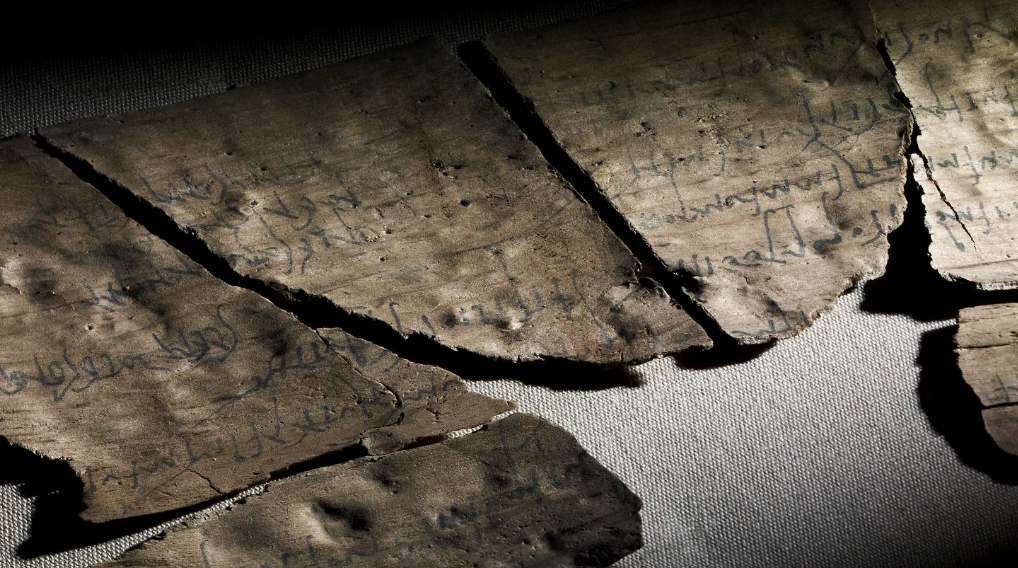
But her letters show what was possible within the wider military society to which Roman Scotland belonged.
Women inside the forts?
For a long time the Roman fort was imagined as an exclusively male space.
The women lived outside. The soldiers lived inside. The footwear evidence increasingly makes that distinction difficult to maintain. At some Antonine forts, dumps containing women’s and children’s shoes likely contained rubbish originating inside the fort.
That does not prove that every soldier had his family living in a barrack room. But it does suggest that the boundaries between military and civilian life were much less rigid than older reconstructions imply.
A Roman fort was an army base. It was also part of a community.
Fashion on the edge of the Empire
The shoes tell us something else. Women on the Antonine frontier were not cut off from fashions elsewhere in the Empire. Some styles found in Scotland occur widely across Roman Europe.
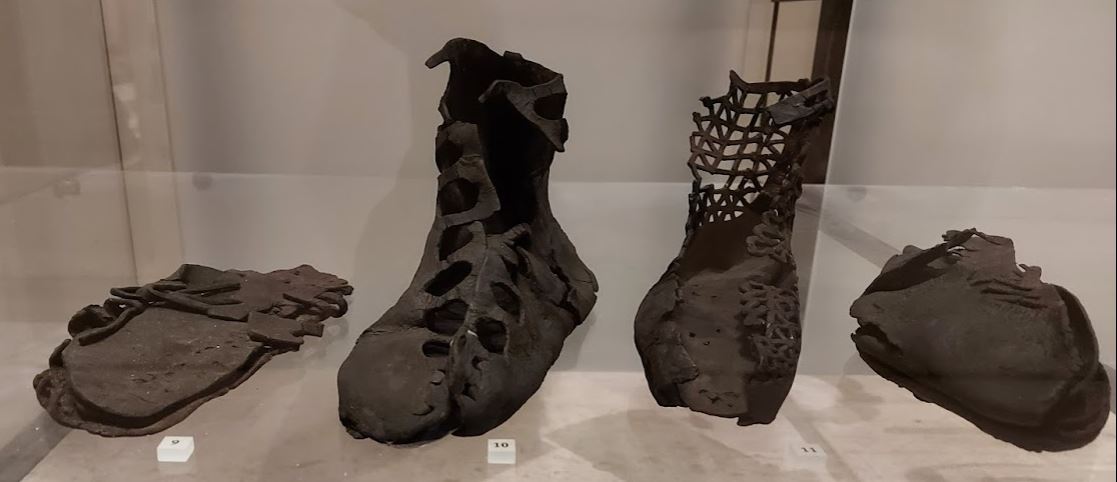
They wore decorated shoes, openwork designs, and carefully chosen fastenings.
A woman living beside a turf fort on a windswept Scottish hill could still participate in styles recognisable elsewhere in the Roman world. The frontier was geographically remote. It was not culturally isolated.
Why are so few women named?
Across Roman Britain, only a small proportion of surviving inscriptions refer to women.
The reason is partly the nature of the evidence.
Inscribing stone was particularly associated with:
- the army
- official building works
- military units
- commanding officers
- public religious dedications
Those activities disproportionately preserve men’s names.
Everyday family life normally left no inscription.
A woman could live for decades beside a Roman fort, raise children, work, worship, trade and die there without her name ever being carved onto stone.
This is why archaeology is so important.
An altar may give us one named woman.
A ditch full of shoes may reveal dozens of unnamed ones.
Women were part of Roman Scotland
The image of Roman Scotland as an almost entirely male military world is no longer sustainable.
Women were there as:
- wives and partners
- mothers
- daughters
- servants
- enslaved women
- worshippers
- members of military households
- members of local Scottish communities
- immigrants from elsewhere in the Roman Empire
- and, in Julia Domna’s case, members of the imperial household
What we cannot usually do is give each woman a neat occupation or biography.
The evidence does not allow it.
But perhaps the most important lesson from the archaeology is simpler.
For centuries we concentrated on the things that survived best:
forts, weapons, inscriptions and soldiers.
Then archaeologists looked at the shoes.
And Roman Scotland suddenly contained women and children again.
Read more about individual women
Flavia Baetica — a Spanish wife
Julia Domna — an emperor’s wife
Claudia Severa — a comparison from Vindolanda
Further reading
The most important modern study is:
Lindsay Allason-Jones, Carol van Driel-Murray and Elizabeth M. Greene, “Roman Women in Lowland Scotland”, in David J. Breeze and William S. Hanson (eds), The Antonine Wall: Papers in Honour of Professor Lawrence Keppie (2020), pp. 346–365.
It examines the evidence from inscriptions and sculpture, leather footwear and small finds, and demonstrates just how differently each type of evidence represents the women of Roman Scotland.

