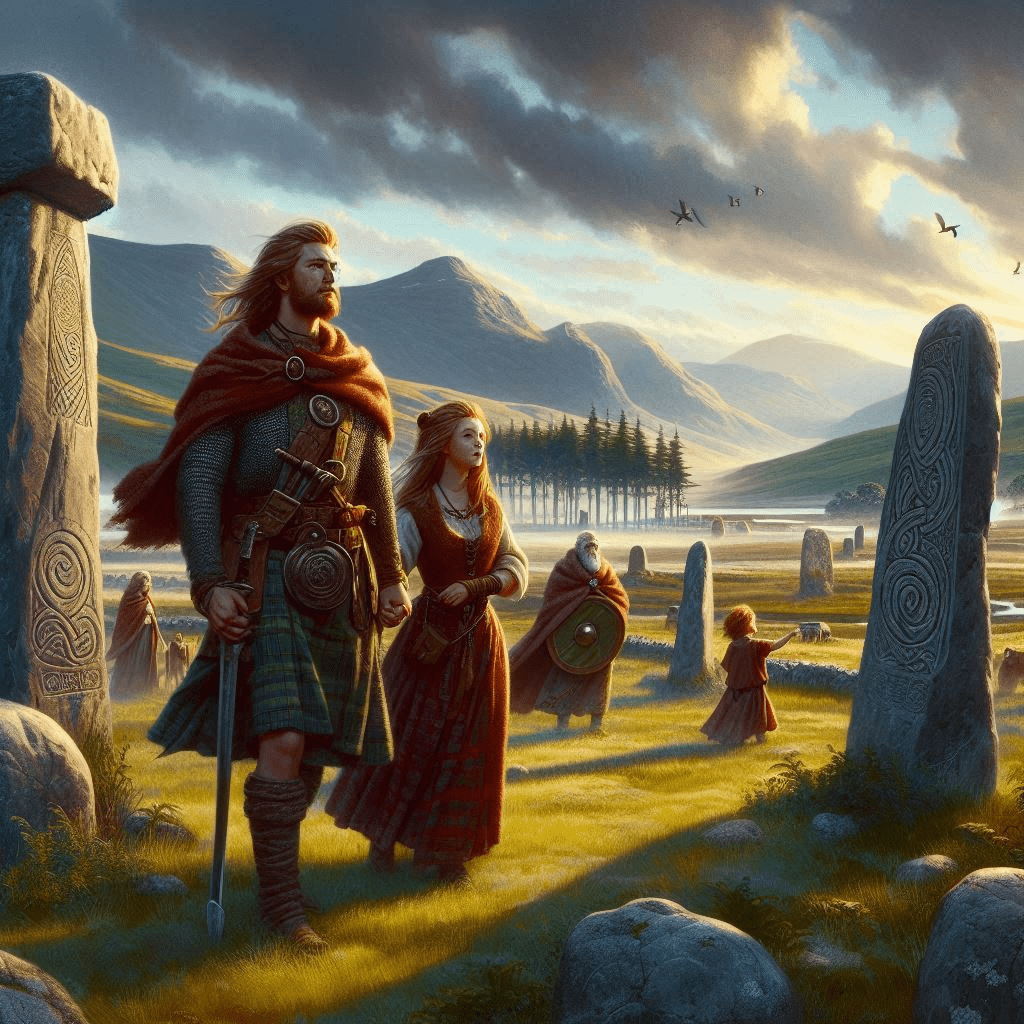
When Roman armies first entered what is now Scotland, they did not encounter a country called Scotland or a single people called the Caledonians.
They encountered numerous communities occupying different parts of northern Britain.
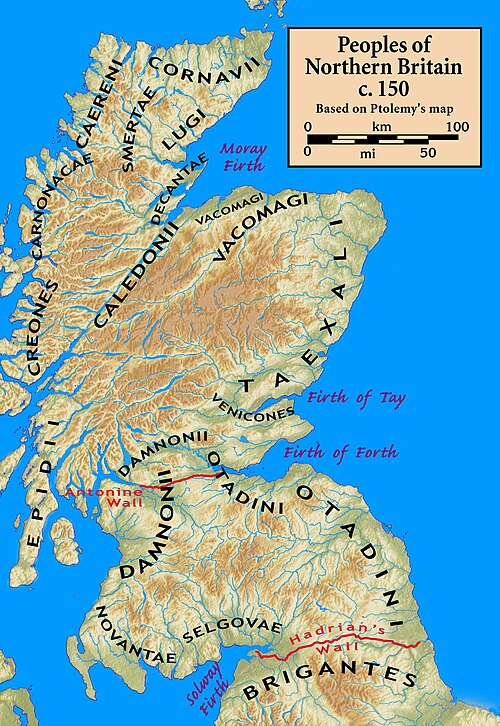
Over the next three centuries, Roman writers used a changing collection of names for them: Caledonians, Caledoni, Maeatae, Picts, Dicalydones and Verturiones, as well as the names of at least sixteen smaller peoples recorded by the geographer Ptolemy.
Some of these changes may reflect real political change as smaller groups formed larger alliances. Others may simply reflect the way Roman writers chose to describe people beyond the frontier.
That distinction is important.
“Caledonian” can mean both a particular people called the Caledoni and, more loosely, the inhabitants of much of northern Scotland.
Who were the Caledonians?
Our earliest detailed written account comes from Tacitus, whose Agricola describes the campaigns of his father-in-law Gnaeus Julius Agricola in northern Britain in the AD 80s.
Tacitus refers to Caledonia and to its inhabitants. He famously claimed that their reddish hair and large limbs suggested German ancestry. That tells us more about Roman attempts to classify peoples by appearance than it does about the actual origins of the inhabitants of Scotland. It should not be treated as evidence that the Caledonians came from Germany.
Tacitus describes a society capable of bringing considerable military forces together. During Agricola’s northern campaigns, a night attack nearly overwhelmed part of the Roman army, and at Mons Graupius in AD 83/84 he says that more than 30,000 Britons assembled to resist Agricola.
Tacitus places a great speech in the mouth of Calgacus, whom he describes as outstanding among the leaders. Calgacus is therefore the first individual associated by name with the resistance to Roman expansion in Scotland, although we should be cautious about turning him into a “King of the Caledonians”. Tacitus does not tell us that.
Agricola’s invasion of Scotland
The names changed over time
A useful way of understanding the peoples of Roman Scotland is to follow the names used by Roman writers.
| Date | Names used | What the source suggests |
|---|---|---|
| AD 80s | Peoples of Caledonia / Caledonians | Tacitus describes a number of northern communities capable of combining against Agricola. |
| c. AD 150 | At least 16 named peoples | Ptolemy provides our most detailed tribal geography of northern Britain. |
| late AD 190s–211 | Maeatae and Caledonians | Cassius Dio says the names of the other peoples had become absorbed into these two larger groupings. |
| AD 297 | Picti — Picts | First surviving Roman use of the name Picts. |
| AD 310 | Caledonians and other Picts | A Roman panegyric appears to regard the Caledonians as one component of a broader Pictish population. |
| AD 367 | Dicalydones and Verturiones | Ammianus says the Picts were divided into these two peoples. |
| AD 367 | Attacotti and Scotti | These also attacked Roman Britain, but Ammianus lists them separately from the Picts. |
| 5th century onwards | Picts | Pict becomes the principal external name for much of the population of northern and eastern Scotland. |
The progression should not be read as one people disappearing and another arriving. There is no evidence for a mass replacement of Caledonians by Picts around AD 300. The terminology used by Roman authors changed, while native society itself was also changing. Modern scholarship increasingly treats Picti as a broad late-Roman designation that came to encompass groups which earlier writers had known by other names.
Ptolemy’s tribes of Scotland
Around AD 150 the Alexandrian geographer Claudius Ptolemy recorded the peoples and places of Britain.
His geography gives us the fullest surviving list of named peoples in what is now Scotland.
Ptolemy’s map is distorted — northern Scotland is effectively turned towards the east — and his information probably drew upon material accumulated over earlier decades. The locations below should therefore be regarded as broad areas rather than fixed tribal boundaries.
| Ptolemy’s people | Approximate modern area |
|---|---|
| Novantae | Galloway and south-west Scotland |
| Selgovae | Southern Uplands and western Borders |
| Damnoni / Damnonii | Clyde valley and western Central Belt |
| Otalini, usually associated with the Votadini | Lothians and eastern Borders, extending into northern England |
| Epidii | Kintyre and parts of Argyll |
| Cerones / Creones | Western Highlands |
| Carnonacae | North-west Highlands |
| Caereni | Far north-west / Sutherland |
| Cornavi | Far north, probably Caithness — not to be confused with the Cornovii farther south in Britain |
| Caledoni | Central and northern Highlands; their exact territory remains debated |
| Decantae | Northern Scotland, probably around Easter Ross |
| Lugi | Northern/eastern Highlands |
| Smertae | Sutherland and the far north |
| Vacomagi | Moray, Speyside and adjoining parts of the Highlands |
| Venicones | Fife and Tayside |
| Taezali / Taexali | North-east Scotland, particularly Aberdeenshire |
Ptolemy specifically places the Caledoni between named geographical features and refers to the Caledonian Forest. He also gives towns or centres for several peoples, including Trimontium among the Selgovae, Orrea among the Venicones and Devana among the Taezali.
From many peoples to two: Caledonians and Maeatae
By the beginning of the third century the picture had changed.
Cassius Dio says:
“There are two principal races of the Britons, the Caledonians and the Maeatae, and the names of the others have been merged in these two.”
This is one of the most important passages for understanding the development of northern Britain.
It may suggest that the numerous communities known to Ptolemy had coalesced into two much larger political confederations.
The Maeatae apparently lived nearer the Roman frontier, while the Caledonians were beyond them. The precise “cross-wall” meant by Dio has been debated, but evidence from names such as Dumyat, overlooking the Forth near Stirling, strongly associates the Maeatae with the Forth–Stirling region.
The two confederations were sometimes enemies of Rome and sometimes negotiated with it. Roman governors could use money, hostages and diplomacy as well as armies. Dio records Virius Lupus buying peace from the Maeatae around AD 197.
Septimius Severus versus the Caledonians and Maeatae
In AD 208, Emperor Septimius Severus came to Britain and launched the last great Roman attempt to force northern Britain into submission.
Cassius Dio describes an exhausting campaign through forests, rivers and wetlands rather than a conventional series of pitched battles. Native forces avoided the Roman army, attacked vulnerable groups and attempted to wear it down.
Peace followed, but the Maeatae revolted again, and the Caledonians joined them. Severus died at York in AD 211, and his son Caracalla abandoned the campaign and returned to the existing Roman frontier.
Caledonians and Maeatae versus Septimius Severus
Septimius Severus invades Scotland
When do the Caledonians become Picts?
The first surviving Roman text to use the name Picti — Picts — dates to AD 297.
Only thirteen years later, a panegyric of AD 310 refers to the forests and marshes of the “Caledonians and other Picts”. The natural reading is important: to this Roman writer, the Caledonians could now be considered one of the peoples encompassed by the broader name Picts.
There is therefore no clear historical moment when:
Caledonians disappeared → Picts arrived.
A better picture is:
many Iron Age communities → larger confederations → peoples increasingly described by Roman writers collectively as Picts.
The archaeology of native settlements across Perthshire and elsewhere also demonstrates continuity across this period rather than evidence for an invading population replacing the earlier inhabitants.
Caledonians to Picts – Cradle of Scotland
Dicalydones and Verturiones
By the late fourth century, Roman terminology had changed again.
Writing about the events of AD 367, Ammianus Marcellinus says that the Picts were divided into two gentes:
Dicalydones
and
Verturiones.
The resemblance between Dicalydones and the older Caledoni/Caledonians is unlikely to be accidental, and some historians treat them as a continuation of the Caledonian name.
The Verturiones are particularly interesting because their name has often been connected with Fortriu, an important Pictish political region in later centuries. Exactly where the Verturiones were based remains debated, so they should not be pinned too precisely onto a modern map.
Ammianus also mentions Attacotti and Scotti in the attacks of this period. These are not two more Pictish tribes: his wording distinguishes them from the Dicalydones and Verturiones.
Count Theodosius and the invasion of AD 367
What was Caledonian life really like?
Roman authors give colourful descriptions of the northern peoples: chariots, small horses, shields, spears, hunting, cattle and extraordinary endurance in difficult terrain.
These accounts are valuable, but they were written by outsiders and often deliberately emphasised the supposed wildness of peoples beyond the Roman frontier. Cassius Dio’s claim that they lacked agriculture, for example, sits uneasily with archaeological and environmental evidence for substantial farming communities.
Archaeology gives a different and much richer picture.
People lived in roundhouses and other timber buildings, farmed, raised livestock, worked iron, manufactured objects and maintained exchange networks.
At Lochinver Quarry near Elgin, archaeologists have uncovered a substantial Iron Age settlement associated with unusually intensive iron production. Buildings and industrial installations appear to have ended violently, possibly during the period of Agricola’s campaigns, although there is not enough evidence to say that Roman troops were responsible.
Did Agricola destroy a Caledonian metalworking site?
Chariots and warfare
Chariots were not simply a Roman literary invention.
The remarkable Iron Age chariot burial at Newbridge near Edinburgh demonstrates that chariot technology formed part of elite life in southern Scotland before the Roman occupation.
Tacitus also describes northern communities combining their forces during Agricola’s campaigns, while Dio still describes chariot warfare during the Severan period more than a century later.
The Roman army nevertheless had one enormous advantage: it could maintain permanent forts, roads, supply systems and frontier installations. The Gask Ridge and its watchtowers were constructed in precisely the landscape in which Roman forces and native communities interacted.
What language did they speak?
We have no surviving book, letter or inscription written by a Caledonian in their own language.
Linguistic and place-name evidence suggests that much of northern Britain spoke languages belonging to the Brittonic or P-Celtic family, related to the ancestor of Welsh.
This should not be confused with Gaelic, which belongs to the separate Goidelic or Q-Celtic branch. Gaelic became increasingly important in western Scotland in the post-Roman period.
What languages did people speak?
Caledonians we can actually name
For a people who occupy such an important place in Roman accounts, remarkably few individual Caledonians have names that survive.
Calgacus appears in Tacitus’ account of Mons Graupius.
Argentocoxus was a Caledonian whose unnamed wife appears in Cassius Dio’s account of the peace negotiations with the Severan imperial family.
More remarkable is an inscription from Colchester, dated to AD 222–235, erected by Lossio Veda, grandson of Vepogenus, who explicitly describes himself as a Caledonian. It shows that Caledonian identity could still be expressed inside the Roman Empire after Severus’s campaigns.
And the evidence now stretches much farther.
Caledonians across the Roman Empire
Caledonian identity did not remain confined to northern Britain.
An inscription from Carnuntum in Austria, on the Danube frontier, commemorates a man explicitly identified as a Caledonian. Another Carnuntum tombstone records two women, one described as Maria Caledonia, aged sixty, together with a younger Maria.
In Santo Tomé in Jaén, Spain, another inscription commemorates Quintus Fulvius, described as the son of a Caledonian.
These inscriptions are particularly valuable because they take us beyond Roman descriptions of an anonymous hostile population. They reveal individual people carrying a Caledonian identity hundreds or thousands of kilometres from Scotland.
Caledonians, Picts — or both?
Trying to turn all these names into a neat family tree is tempting:
Ptolemy’s tribes → Caledonians and Maeatae → Picts → Dicalydones and Verturiones
Reality was probably considerably messier.
Tribal identities could expand, disappear, merge or be renamed. Roman administrators and historians could also lump several communities together under a convenient label.
The most useful conclusion is therefore not that the Romans repeatedly encountered completely new peoples.
Rather, over nearly three centuries the societies of northern Britain changed, their political alliances changed, and the names used by Roman observers changed with them.
The people whom Tacitus encountered as inhabitants of Caledonia formed part of the population from which the later Pictish world developed.
Explore further
- The Caledonians – Culture. Read
- The Maeatae — the other great northern confederation of the Severan period. Read
- Agricola Invades Scotland — Calgacus, the Ninth Legion and Mons Graupius. Read
- Caledonians and Maeatae versus Septimius Severus — the last major attempt at conquest. Read
- Caledonian man in Spain. Read
- A Caledonian in Austria. Read
- Caledonian women in Austria. Read
- Caledonian metalworking in Moray. Read
- What languages did people speak? Read
- Caledonians to Picts – Cradle of Scotland. Read
- All posts tagged Caledonians. Browse the archive

