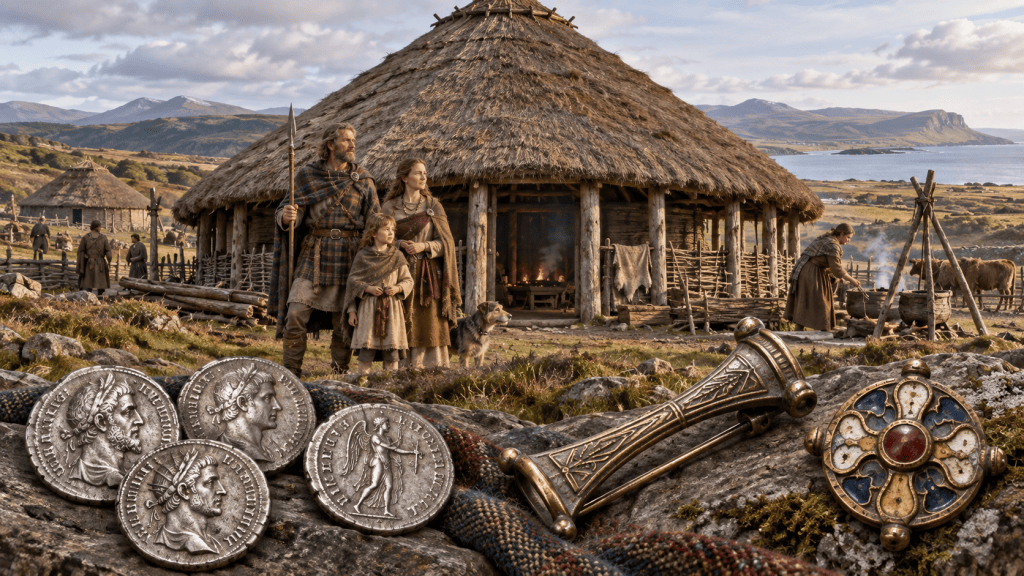
The Roman army never permanently occupied Moray in the way that it occupied parts of southern and central Scotland. Yet finds from Birnie, near Elgin, show that Roman influence reached far beyond the forts and frontier lines.
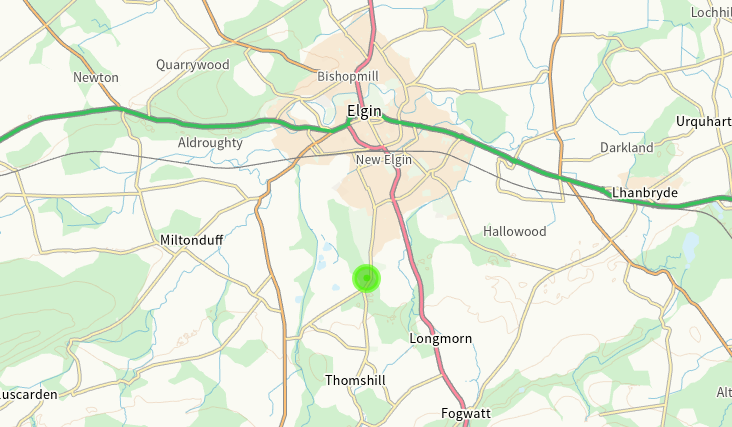
At Birnie archaeologists uncovered an Iron Age settlement containing a substantial roundhouse. Nearby, metal detecting produced a remarkable group of Roman silver coins and Roman brooches.
The excavator, Fraser Hunter, suggested that this may have been the home of a powerful local leader who maintained contacts with the Roman world. One possibility is that the silver was not simply trade, but a diplomatic payment — perhaps a gift or even a bribe intended to secure the cooperation of someone whose support mattered to Rome.
A settlement at Birnie
The site had first been recognised from aerial photographs, which revealed cropmarks indicating prehistoric settlement. Trial excavation in 1998 identified an Iron Age roundhouse. Work continued in 1999, exposing about half of the building and investigating the surrounding settlement.
The house was substantial.
It measured about 14 metres across, with its roof supported by a ring of large timber posts roughly 8 metres in diameter. Some of the postholes were between 0.6 and 1 metre deep.
The building had also been rebuilt at least once, suggesting that it stood for a considerable period rather than representing a short-lived occupation. Charcoal associated with the structure produced a radiocarbon date suggesting that it was probably built around AD 130–250. That makes the house broadly contemporary with the Roman material found nearby.
A hoard of Roman silver
The discovery which originally drew attention to Birnie was a group of Roman silver denarii found by Hamish Stuart while metal detecting. The coins did not come from a Roman fort or marching camp but from an Iron Age settlement well beyond Rome’s formal frontier.
Further searching in 1999 brought the known total to 28 coins, although one was lost before it could be properly recorded. The 27 identifiable coins ran from Vespasian in the first century to Septimius Severus around the beginning of the third.
| Emperor | Coins recorded |
|---|---|
| Vespasian | 4 |
| Domitian | 1 |
| Trajan | 3 |
| Hadrian | 2 |
| Antoninus Pius | 4 |
| Marcus Aurelius | 3 |
| Lucius Verus | 2 |
| Commodus | 6 |
| Septimius Severus | 2 |
The latest identifiable coin was dated to about AD 194–195.
The date a coin was minted is not necessarily the date at which it was buried. Older silver coins could continue circulating for many years.
Hunter therefore raised the possibility that the collection reached Birnie somewhat later, perhaps in connection with the political upheavals surrounding the northern campaigns of Septimius Severus in AD 208–211.
Roman money, where Roman money was of little use
Perhaps the most intriguing question is why someone in Moray possessed a quantity of Roman silver in the first place.
Birnie was far outside the normal monetary economy of the Roman province.
Hunter suggested that the denarii may therefore have been valued more as silver bullion than as everyday money.
Evidence from the site may support this. A lump of melted silver was also discovered close to the coin concentration, and the report raises the possibility that silver-working was taking place there.
Some of the Roman coins may eventually have been destined for melting rather than spending.
A payment to a local chief?
The most striking interpretation offered in the excavation report is that the hoard may have been a payment from Rome to an important local leader.
The report describes the original discovery as probably:
a gift or bribe to a powerful local chieftain
intended to persuade him to keep the peace.
This should not be treated as something that can be proved from the coins alone. But it provides an important way of thinking about Roman power in northern Scotland.
Rome did not have to occupy a territory permanently to influence what happened there.
Relationships could also be maintained through diplomacy, gifts, payments and personal alliances.
If the interpretation is correct, the man living at Birnie may have been important enough for Roman officials to want him as a friend rather than an enemy.
Two Roman brooches
Metal detecting in the same general area produced two Roman copper-alloy brooches.
One was a type of trumpet brooch, dating to the late first or second century AD. Hunter considered it to have been manufactured somewhere within Roman Britain.
The second was much more unusual. It was an enamelled plate brooch, probably made in the Rhineland or northern France during the second or early third century. It originally carried small coloured enamel spots around the edge of the main plate, with concentric rings of enamel in its centre.
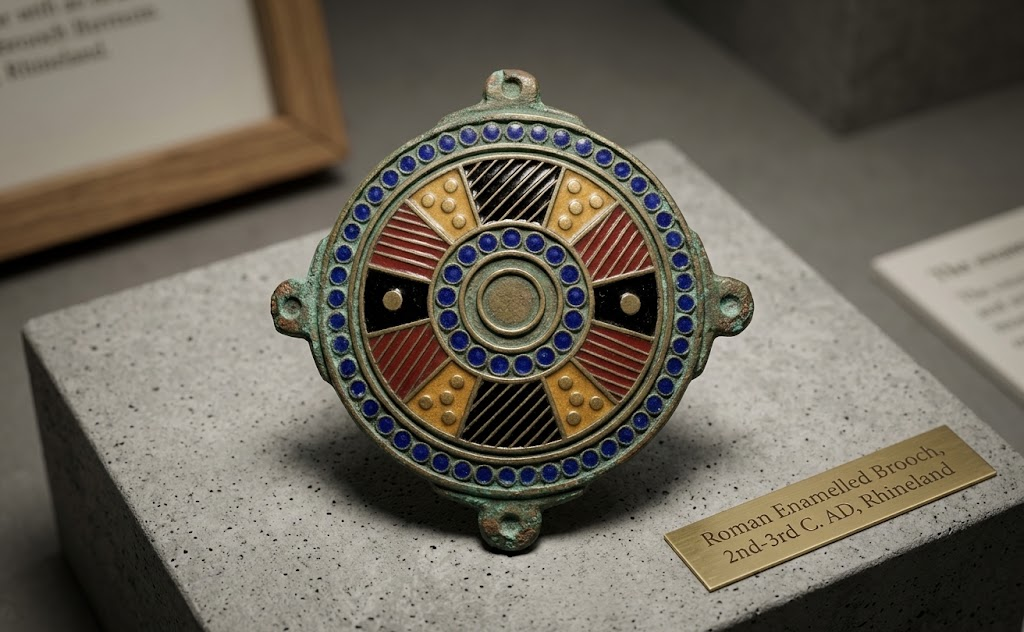
The report describes it as an unusual object and one which was probably regarded as a valued possession.
The drawings of the two brooches on page 16 of the report make their very different character clear: one belongs to a relatively familiar British Roman tradition, while the enamelled brooch points much further into continental Europe.
Contact with Rome over generations
This is one of the most important aspects of Birnie. The coins and brooches do not all belong to the same moment. The trumpet brooch is probably earlier than the coin hoard. The continental brooch could be broadly contemporary with it.
Hunter therefore argued that the Roman material was unlikely to represent a single isolated encounter. Instead, it appears to show repeated contacts with the Roman world over a longer period.
The people at Birnie — or perhaps successive generations of an elite family — may have dealt with Romans on several occasions. Hunter suggested that these contacts could have involved Romans themselves or intermediaries, perhaps chiefs living farther south who already had established relationships with the Roman authorities.
What happened to the roundhouse?
The house itself had an unusual end.
Large quantities of charcoal and burnt material survived over much of its interior. The destruction appears to have taken place when the building was still standing. Hunter thought the evidence suggested that the house may have been deliberately destroyed by fire at the end of its life.
Some objects found inside make the story even more interesting.
They included a copper-alloy mount and part of an iron sword. The sword blade appears to have been deliberately snapped. The report raises the possibility that these objects had been deliberately deposited as part of ceremonies associated with the abandonment of the house. An intact finger ring discovered during the previous season may possibly have served a similar purpose.
This remains an interpretation rather than a certainty, but the combination of deliberate destruction and apparently selected objects suggests that the end of the house may have involved more than simply moving out.
Not a Romanised settlement
Birnie did not become a Roman settlement. Its inhabitants continued to live in an Iron Age roundhouse, using a fundamentally local form of architecture and settlement. Roman objects entered that world selectively. Coins, brooches and other prestigious objects could be acquired without the people who owned them becoming culturally Roman.
Indeed, Roman silver may have meant something completely different at Birnie from what it meant in a market at York or London.
A denarius which represented money to a Roman soldier might represent silver, prestige, political favour or a relationship with a distant imperial power to somebody in Moray.
A later chapter at Birnie
The 1999 excavations also uncovered a much later feature: a well-preserved medieval blacksmith’s workshop.
It contained quantities of slag and metalworking debris and appears to have been used repeatedly over a considerable period. The excavator suggested that it might have been associated with the community living around nearby Birnie Kirk.
The discovery means that the site preserves traces of two very different communities separated by roughly a thousand years — an Iron Age settlement interacting with Rome and a medieval community centred on an important church.
Source
Fraser Hunter, Excavations at Birnie, Moray, 1999, Department of Archaeology, National Museums Scotland, 2000. DOI: 10.34908/9.

