An international religion on Rome’s northern frontier
Religion in Roman Scotland was extraordinarily diverse.
Roman soldiers did not arrive carrying one fixed set of religious beliefs.
Instead, the frontier brought together gods and traditions from:
Rome, Britain, Gaul, the Rhine, the Danube, Spain, North Africa and the eastern Mediterranean.
Some gods were recognisably Roman.
Others were local.
Some were combinations of both.
The result was a religious landscape as international as the army itself.
How do we know?
Our strongest evidence comes from altars and inscriptions.
A Roman altar might record:
the god being honoured, the person making the dedication, their military unit or rank and sometimes why the altar was erected.
Many end with a formula stating that the worshipper willingly and deservedly fulfilled a vow.
An altar is therefore both a religious object and a fragment of someone’s biography.
Jupiter — the supreme god
Jupiter Optimus Maximus, Jupiter Best and Greatest, was the supreme god of the Roman state.
Dedications to Jupiter are widespread at Roman military sites.
For soldiers, honouring Jupiter could express loyalty to Rome as well as personal religious devotion.
Mars
Mars was the Roman god most obviously associated with warfare and military power.
At Auchendavy the centurion Marcus Cocceius Firmus included Mars in a remarkable dedication alongside Minerva, Hercules, Epona, Victory and the Campestres.
Minerva and Victory
Minerva represented wisdom, skills and crafts as well as aspects of warfare.
Victoria, Victory, personified military success.
Both appear naturally in the religious world of a frontier army.
Diana and Apollo
The twin deities Diana and Apollo also appear in Scotland.
Marcus Cocceius Firmus dedicated an altar to both at Auchendavy.
Mercury
Mercury was associated with travel, trade and communication — particularly appropriate on a military frontier connected by roads and long-distance trade.
An inscription records a shrine to Mercury outside the fort at Castlecary.
Neptune
Roman Neptune was not simply a sea god.
He could also be associated with freshwater.
Dedications in Britain demonstrate that soldiers and travellers could invoke him in places far from the Mediterranean.
Silvanus
Silvanus was associated with woodland, countryside and boundaries.
He must have had particular resonance for soldiers stationed within Scotland’s rural frontier landscape.
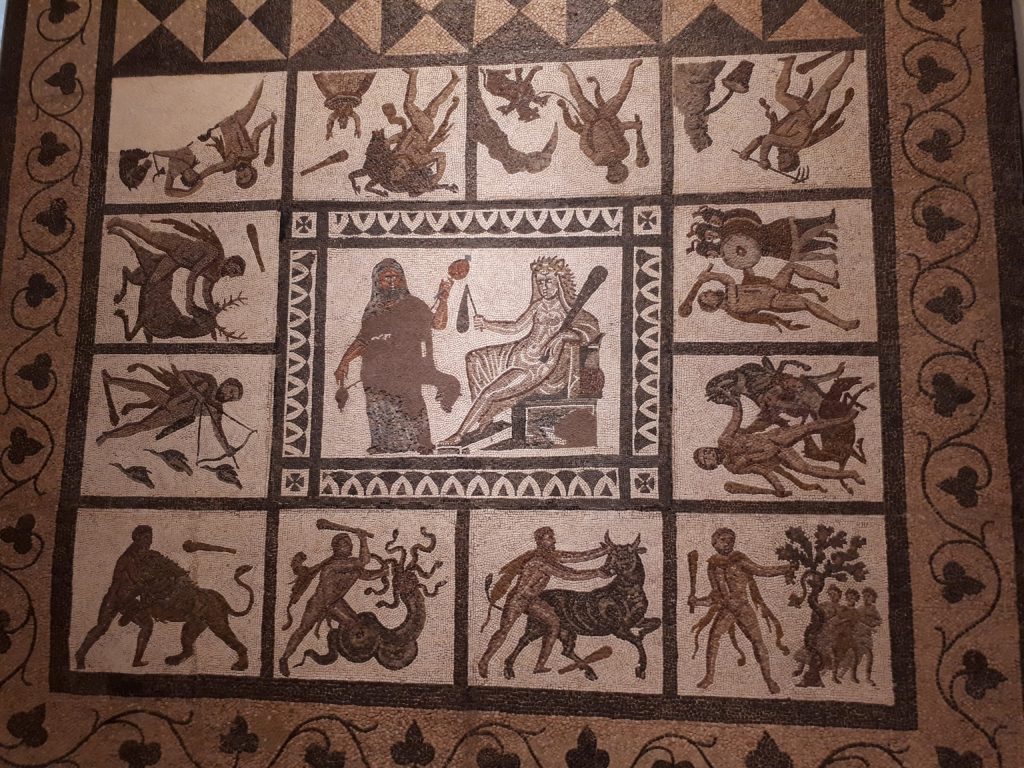
Hercules
Hercules embodied strength, endurance and courage.
He was particularly popular among soldiers.
Hercules Magusanus — Roman and Germanic traditions meet
A dedication near Mumrills honours Hercules Magusanus.
The name combines the Roman Hercules with a deity particularly associated with communities around the lower Rhine.
The altar was erected by the cavalryman Valerius Nigrinus, serving in the First Ala of Tungrians.
Here a soldier on the Antonine frontier worshipped a god whose identity had been created by mixing Roman and north-west European traditions.
Apollo Grannus — Roman and Celtic
Apollo could similarly be joined with the Celtic healing deity Grannus.
A dedication to Apollo Grannus is known at Inveresk.
Jupiter Dolichenus — from Syria to Scotland
Jupiter Dolichenus originated from the religious traditions surrounding Doliche in modern Turkey.
His cult spread particularly through the Roman army.
An altar at Birrens was erected by a woman named Magunna, giving us the unusual combination of a female dedicator with an eastern military cult on Britain’s northern frontier.
Mithras
The cult of Mithras became particularly associated with groups of men in the Roman military and administrative world.
Its rituals were conducted away from public view in specialised shrines known as mithraea.
Women and religion
Women were active worshippers too.
Vibia Pacata dedicated an altar near Westerwood.
Magunna dedicated her own altar at Birrens.
This is important.
Women were not simply present in military households; some acted independently within the religious life of frontier communities.
Other gods
Explore:
Juno — Goddess of Marriage and Women
Religion reveals movement
Religion can tell us where people had come from — or where their military unit had previously served.
A god from the Rhine appears beside a Scottish fort.
An eastern cult reaches Birrens.
Roman and Celtic deities merge.
Local landscapes acquire Roman spirits and names.
The gods of Roman Scotland therefore tell the same story as its soldiers and pottery:
this frontier was connected to an Empire stretching thousands of miles beyond Scotland.

