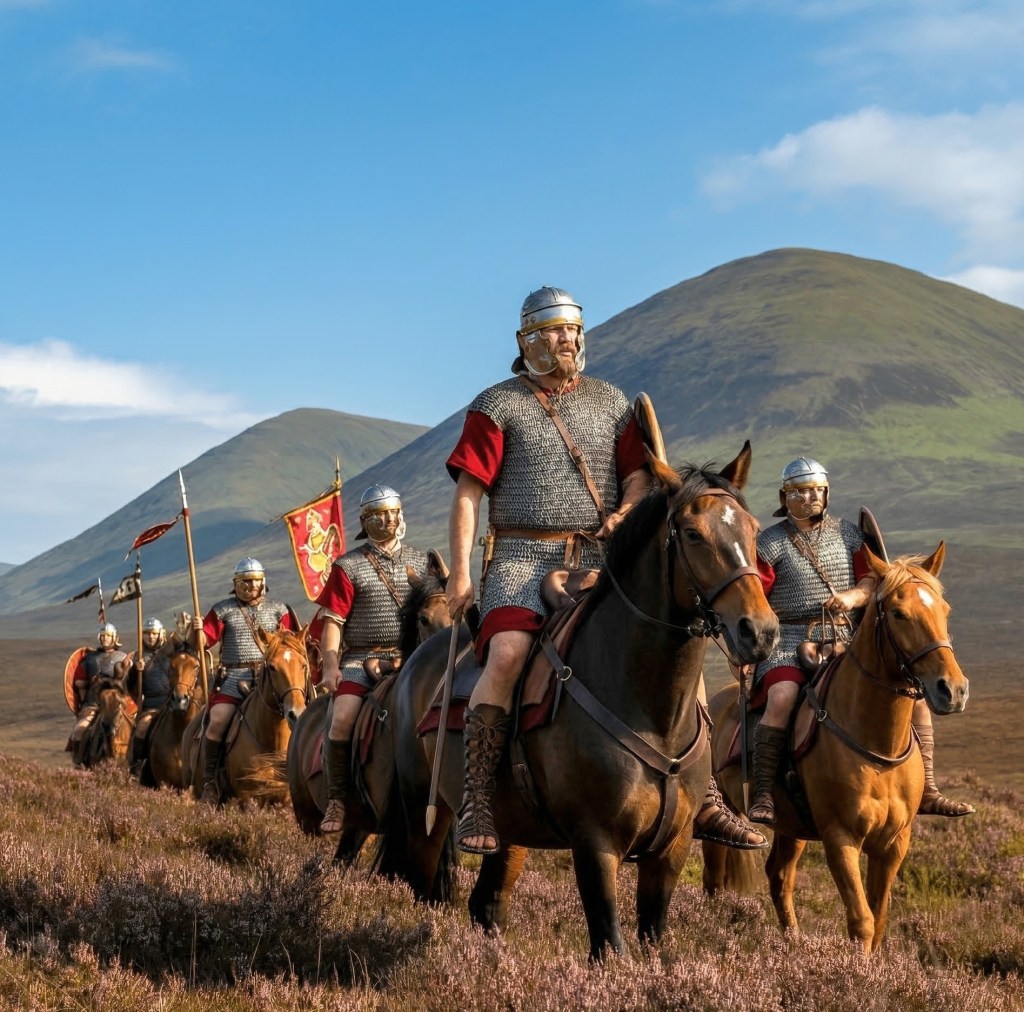
Rome never permanently conquered all of what is now Scotland.
Instead, Roman armies came north again and again. They invaded, built roads and forts, fought battles, created frontiers, withdrew — and returned.
For more than 300 years, the peoples of northern Britain lived with the presence of the Roman Empire to the south. At times Roman soldiers occupied large areas of Scotland. At other times, the frontier lay at Hadrian’s Wall in northern England.
The result is an extraordinary archaeological landscape of forts, marching camps, roads, walls, inscriptions, coins and objects stretching from the Borders to the north of Scotland.
Here is the story in five minutes.
Before Rome: Scotland before the Romans
There was no country called Scotland when Roman armies first arrived.
Northern Britain was occupied by many different communities, living in farms, roundhouses and settlements across the landscape. Roman writers later gave them names including the Caledonians, Maeatae and eventually Picts, while the geographer Ptolemy recorded numerous different peoples across what is now Scotland.
These were not simply isolated groups waiting for Rome to arrive. They farmed, traded, worked iron, built impressive settlements and maintained contacts across Britain and beyond.
Then, during the first century AD, the world’s most powerful empire began moving north.
Explore: Scotland before the Romans | Caledonians and the peoples of Roman Scotland
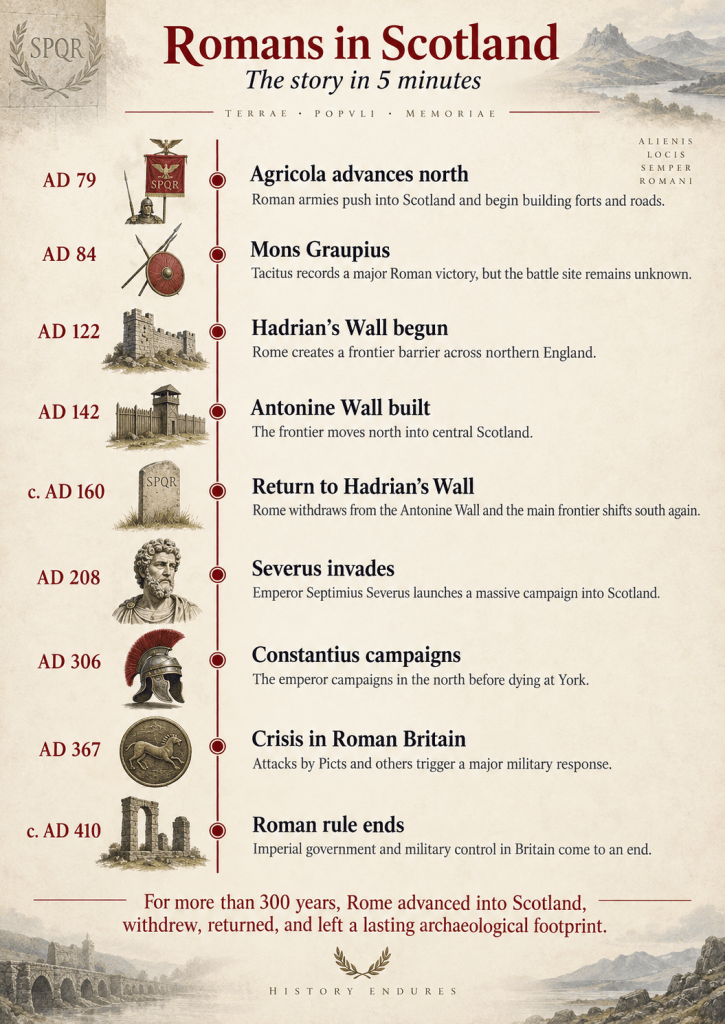
AD 70s–80s: Rome moves north
Rome invaded southern Britain in AD 43, but it took several decades for Roman armies to reach Scotland in force. The best-known campaigns began under the governor Gnaeus Julius Agricola, who governed Britain from AD 77/78.
From around AD 79, Agricola’s armies advanced north through southern and central Scotland. Forts, roads and temporary marching camps followed the soldiers. Roman forces reached the River Tay and probably campaigned considerably farther north.
One of the most remarkable Roman military systems was created along the Gask Ridge in Perthshire, where forts and watchtowers helped the army control movement through the landscape.
At Inchtuthil, near Dunkeld, the Romans even began constructing a huge legionary fortress intended to house thousands of soldiers.
The Battle of Mons Graupius
Tacitus, Agricola’s son-in-law, tells us that around AD 83 or 84, a Roman army fought a major battle against northern peoples commanded by a man he calls Calgacus.
Tacitus called the battlefield Mons Graupius. The Romans won — but more than 1,900 years later, we still do not know where the battle took place. Agricola was recalled to Rome, troops were required elsewhere in the Empire, and many of the northern forts were abandoned.
Rome had reached deep into Scotland. It had not conquered it permanently.
Explore: Agricola’s campaigns | Mons Graupius | Calgacus | Gask Ridge | Inchtuthil
AD 120s–160s: walls, forts and a new frontier
Roman strategy changed. In AD 122, the emperor Hadrian ordered the construction of Hadrian’s Wall across northern England. But Rome had not given up its interest in Scotland.
Around AD 142, during the reign of the emperor Antoninus Pius, Roman forces advanced north again. This time they constructed a new frontier across central Scotland: the Antonine Wall.
Running for about 37 miles from the Firth of Forth to the Firth of Clyde, it became the most northerly major frontier barrier of the Roman Empire. It was not simply a wall.
A chain of forts and fortlets housed thousands of soldiers. Roads connected the military installations, while bathhouses, settlements and other buildings developed around some forts.
The soldiers stationed here reflected the enormous geographical reach of the Roman Empire. Auxiliary regiments carried names associated with peoples from areas corresponding to parts of the modern Netherlands, Belgium, France, Germany, Spain, the Balkans and Syria.
For a generation, the frontier of one of the greatest empires of the ancient world ran through central Scotland. Then the Romans withdrew south again. By the later second century, Hadrian’s Wall had once more become the principal northern frontier.
Explore: Antonine Wall | Roman forts | Auxiliary units | Roman roads
AD 160s–200s: Rome withdraws — but does not disappear
The abandonment of the Antonine Wall did not mean that Rome lost interest in Scotland.
Armies continued to operate north of Hadrian’s Wall. Forts were sometimes reoccupied. Roman goods and coins crossed the frontier. There was warfare, diplomacy, trade and probably payments made to maintain peace.
Roman writers increasingly describe larger northern groupings, particularly the Maeatae and Caledonians. Relations periodically broke down.
Then, at the beginning of the third century, one of Rome’s most powerful emperors decided to settle the northern problem personally.
AD 208–211: Septimius Severus comes to Scotland
In AD 208, the emperor Septimius Severus arrived in Britain with a huge army.
Severus had been born at Leptis Magna in Roman North Africa, in what is now Libya. He came north with his sons Caracalla and Geta and launched a major campaign against the peoples beyond the Roman frontier.
Roman armies again moved deep into Scotland. Old forts and supply routes were used, marching camps were constructed, and the Roman fleet supported operations along the coast. But this was not another attempt to build a permanent province across all of Scotland.
The northern peoples avoided the kind of decisive battle Rome wanted, while the landscape, supply requirements and continuing resistance made campaigning difficult.
Severus became ill and withdrew to York, where he died in AD 211. His son Caracalla abandoned the campaign. Once again the Roman army moved south.
Explore: Septimius Severus | Maeatae | Roman marching camps
The fourth century: Picts, emperors and the northern frontier
Rome remained in Britain for almost another two centuries. By the fourth century, Roman writers increasingly used the name Picts for peoples living north of the frontier. Conflict continued.
In AD 306, the emperor Constantius I campaigned in northern Britain before returning to York, where he died. His son was proclaimed emperor there and became Constantine the Great.
In AD 367, Roman Britain suffered a major crisis involving attacks by the Picts, Scots from Ireland, Attacotti and other enemies. The Roman commander Theodosius was sent to restore order.
These campaigns show that Scotland remained part of Rome’s strategic world long after the Antonine Wall had been abandoned. But Roman power in Britain was weakening.
In the early fifth century, Roman government and military control in Britain came to an end. The Romans were gone. Their landscape was not.
Who were the Romans in Scotland?
It is tempting to imagine a Roman army made up entirely of men from Rome or Italy. It was nothing like that. The army in Scotland included legionaries and auxiliary soldiers drawn from across the Roman Empire.
Among the units known in northern Britain were Batavians, Tungrians, Nervians, Gauls, Thracians and Hamians.
There were also commanders, engineers, traders, craftspeople, families, enslaved people and local inhabitants whose lives became connected with the Roman military presence.
Some individuals can even be identified by name through inscriptions and objects they left behind. Roman Scotland was a meeting place between local communities and people whose origins stretched across Europe, North Africa and the Middle East.
Explore: Roman Army | Legions | Auxiliary units | Named people | Women in Roman Scotland
What did the Romans leave behind?
Roman occupation of Scotland was overwhelmingly military. Scotland did not develop the network of Roman towns found farther south in Britain.
But the archaeological footprint is enormous.
Across Scotland you can still find evidence of:
- the Antonine Wall
- forts and fortlets
- hundreds of temporary marching camps
- Roman roads
- bathhouses
- watchtowers
- altars and inscriptions
- coins and pottery
- military equipment and personal possessions
Some Roman routes continued to influence travel for centuries after the Empire disappeared.
Many sites are still visible today — and others survive only as cropmarks, earthworks or archaeology beneath modern towns and fields.
How do we know all this?
Roman Scotland is a puzzle assembled from many different kinds of evidence.
Ancient writers such as Tacitus, Cassius Dio and Ammianus Marcellinus give us the Roman version of events — but they had their own agendas and limitations.
Archaeology gives us another perspective. Forts, camps, coins, pottery, inscriptions, altars and objects can confirm parts of the written story, challenge others and reveal people whom the ancient historians never mentioned.
New discoveries continue to change our understanding of Roman Scotland. That is part of what makes the subject so fascinating.
The story in one sentence
For more than three centuries Rome repeatedly tried to conquer, control or contain the peoples of northern Britain — advancing into Scotland, withdrawing, building frontiers and returning again, but never permanently absorbing all of Scotland into the Roman Empire.
Where would you like to go next?
New to the subject?
→ Explore the full Roman Scotland timeline
Want to see what survives?
→ Find Romans Near You
Interested in the soldiers?
→ Explore the Roman Army in Scotland
Want to meet the people?
→ Explore named Romans, women and the peoples of northern Britain
Want to investigate the evidence yourself?
→ Explore Primary Sources
Prefer maps?
→ Explore Maps & GIS

