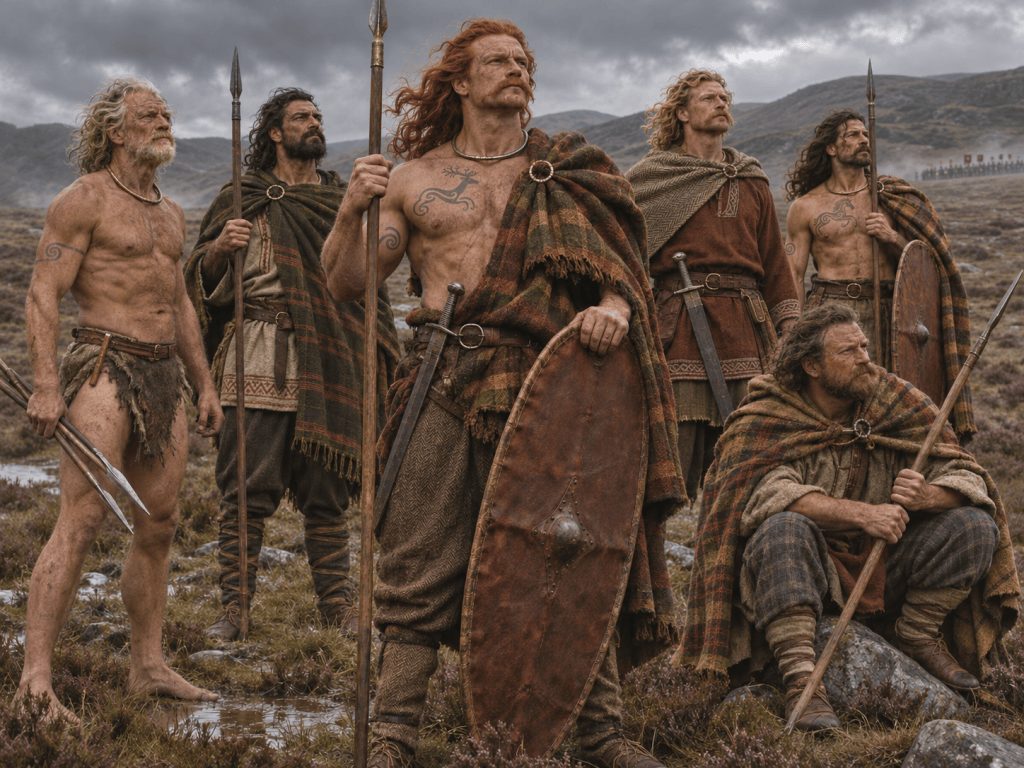
What did the men of northern Scotland look like when they faced the Roman army? We have descriptions written by Romans, traces of Iron Age equipment, and remarkable textiles preserved elsewhere in northern Europe. But we do not have a complete Caledonian outfit—or a contemporary portrait of a Caledonian warrior. Reconstructing their appearance means distinguishing evidence from interpretation.
What did the Romans actually say?
In Agricola 11, written around AD 98, Tacitus describes the inhabitants of Caledonia as having reddish hair and large limbs. He speculates that these characteristics imply a Germanic origin. That is his interpretation, not evidence of a proven ancestry, and there is no reason to assume that every Caledonian resembled his description. In his account of the battle generally called Mons Graupius, Tacitus describes infantry, chariots and cavalry, and refers to swords and shields (Agricola 35–37).
A later writer, Herodian, describes the northern Britons encountered during Septimius Severus’s campaigns in AD 208–211 (History of the Roman Empire 3.14). His account speaks of minimal clothing, coloured animal designs on the body, iron ornaments at neck and waist, and fighters armed with a spear, narrow shield and sword but without helmets or body armour. These details partly explain the figures in our reconstruction. Yet Herodian was writing over a century after Agricola, and his account of supposedly exotic peoples should not be treated as a literal description of every person or every season.
Clothes: what can archaeological finds tell us?
Scottish Iron Age textiles survive only fragmentarily. Bog deposits in Denmark and northern Germany preserve much more, allowing us to see how wool was woven, patterned, cut and worn. These finds are comparisons, not proof of precisely what Caledonian warriors wore.
Huldremose: checks, colour and carefully made clothing
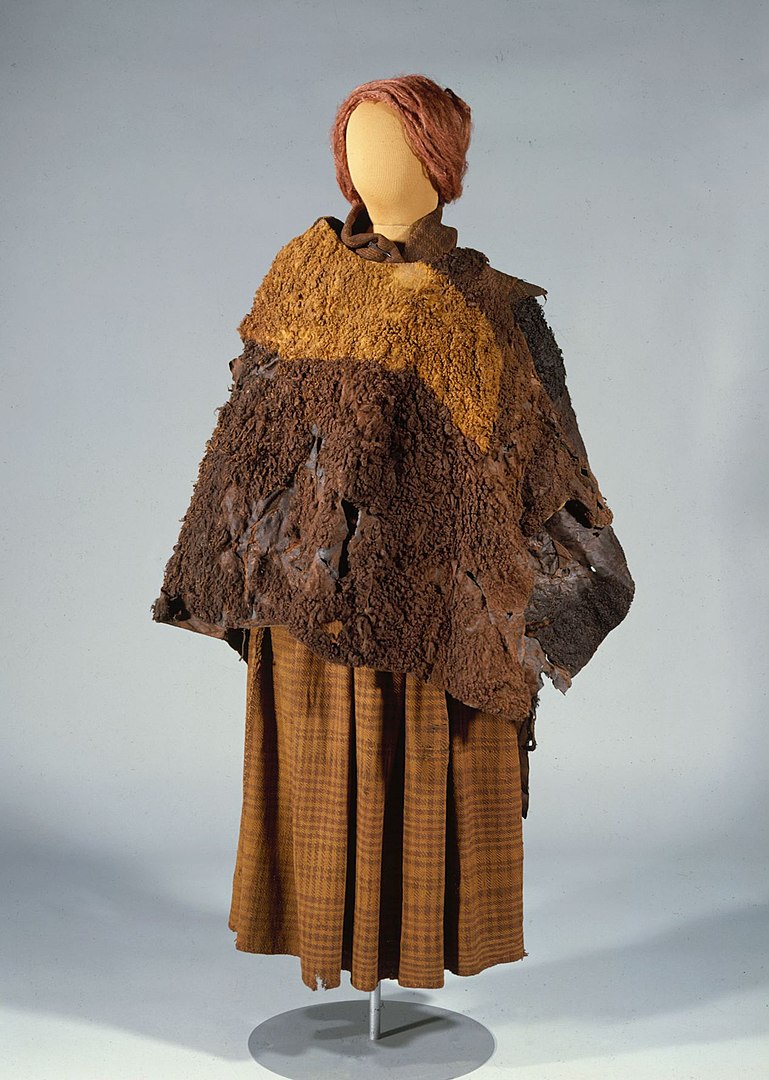
The Huldremose woman, from Denmark, was buried in the second century BC. Her remarkably preserved outfit included a checked wool skirt, checked wool scarf and skin capes. Modern analysis reveals that the surviving brown fabrics were originally coloured: the museum reports blue for the skirt and red for the scarf. Huldremose is earlier than Agricola and concerns a woman’s clothing, but it demonstrates sophisticated textiles, colour and checks well before the Roman conquest of northern Britain. Checked wool does not mean later Scottish clan tartan.
Thorsberg: trousers and northern European tailoring
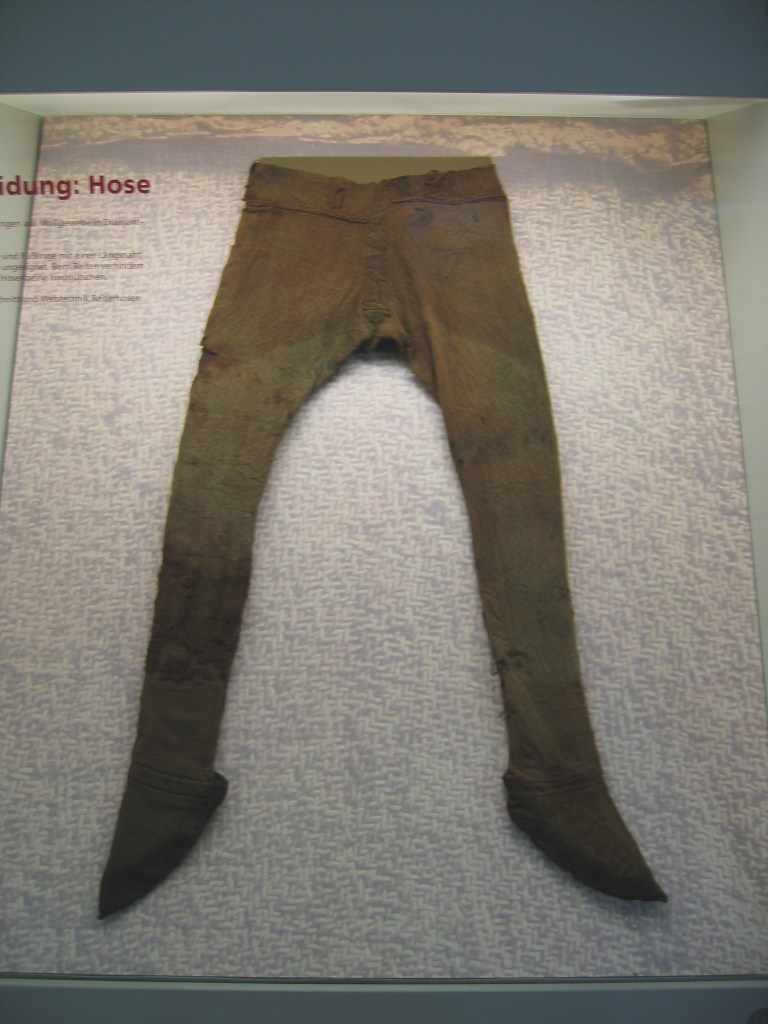
Finds from the Thorsberg bog in Schleswig-Holstein include well-preserved Roman Iron Age clothing, among it tailored wool trousers. The pictured trousers date to approximately the middle of the fourth century AD—roughly 250 years after Mons Graupius. They show that carefully constructed legwear existed in northern Europe, but should not be presented as a recovered Caledonian garment. Research on textiles from Thorsberg, Nydam, Vimose and Illerup Ådal has also widened our understanding of fabrics deposited with military equipment.
The Falkirk ‘tartan’: checked wool from Roman-period Scotland
Unlike Huldremose and Thorsberg, the Falkirk ‘tartan’ comes from Scotland itself. The small woollen textile fragment was found at Bell’s Meadow, Falkirk, on 9 August 1933, in the mouth of a pot containing a hoard of Roman coins. National Museums Scotland dates the cloth and its context to around AD 230, well over a century after Agricola’s campaigns.
The wool is woven in a simple check of contrasting natural shades. It shows that checked cloth existed in Roman-period Scotland, but it is not evidence for modern clan tartan or proof of the dress of any particular warrior. Nor can we tell exactly how the original fabric was worn: it survived because it was placed over the hoard vessel.
The Falkirk fragment is a particularly valuable comparison for our illustration, because it comes from Scotland rather than Denmark or Germany. The checked cloaks in the reconstruction remain imaginative, however. See the National Museums Scotland catalogue entry, X.FR 483 and National Records of Scotland’s history of tartan.
Jewellery, power and identity in Iron Age Scotland
Clothing was only one element of someone’s appearance. Neck rings, bracelets, pins and brooches could display wealth, personal identity, craftsmanship and wider contacts. Yet their meanings varied: not every torc was a warrior’s ornament, and we cannot assume that every piece of jewellery had a spiritual purpose.
The Stirling torcs: four gold neck rings
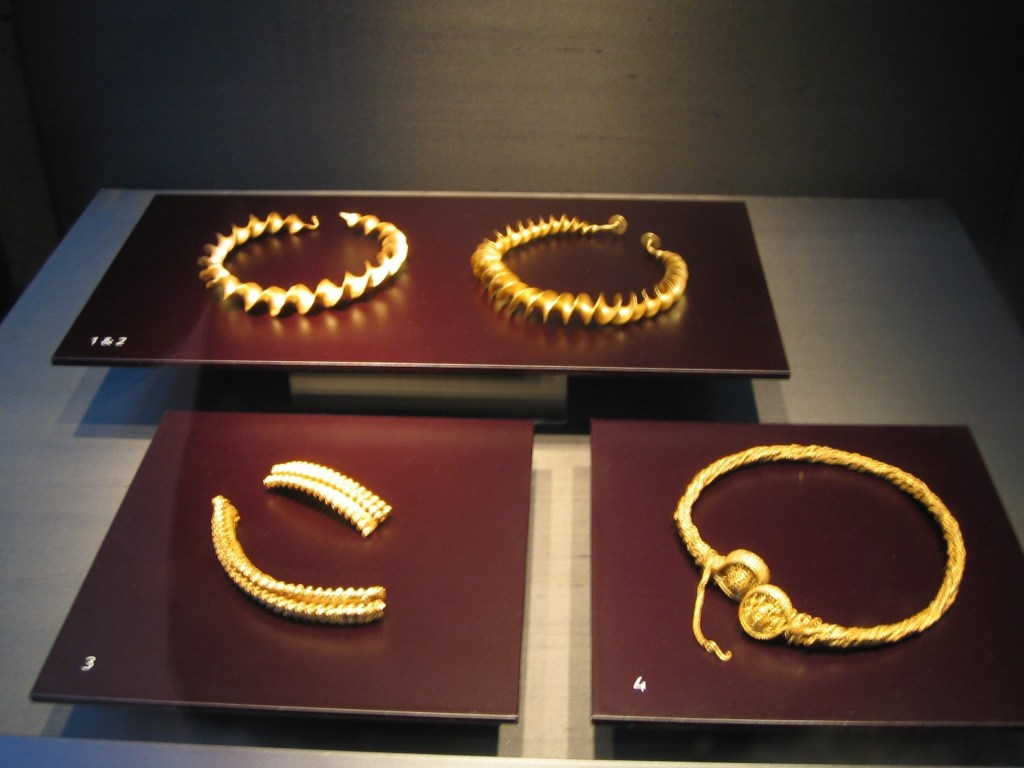
In 2009, David Booth discovered four spectacular gold torcs at Blair Drummond near Stirling. Dating to approximately 300–100 BC, they belong to the centuries before the Roman campaigns in northern Scotland. Their twisted, braided and intricately worked designs show remarkable goldsmithing. National Museums Scotland observes that the group combines British, continental European and Mediterranean styles. They are evidence of wealth and far-reaching cultural connections, rather than proof that Caledonian warriors in AD 80 wore these exact ornaments.
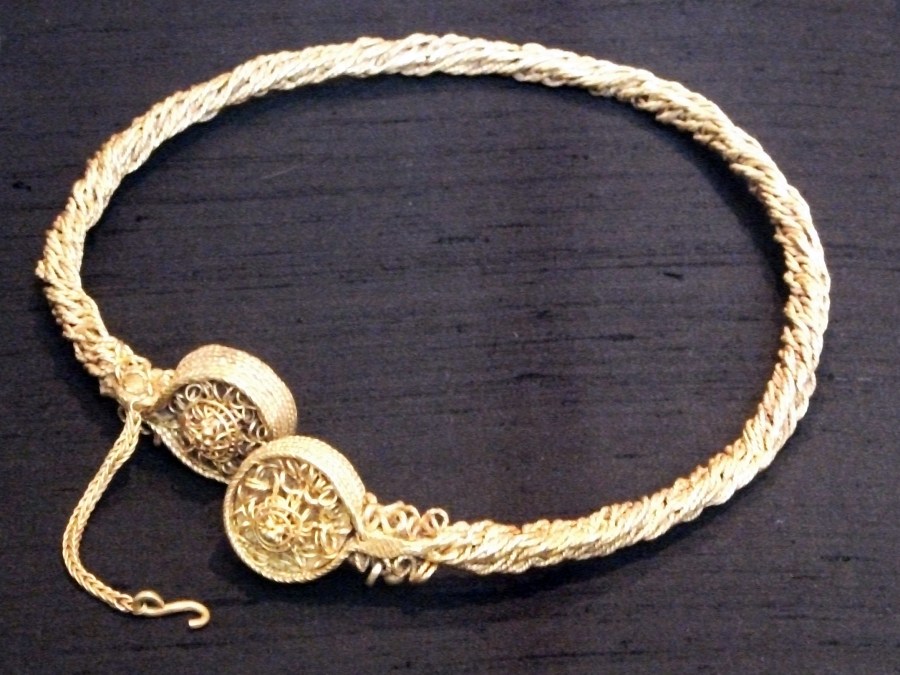
Iron Age torcs across Europe were made in gold, bronze, silver and sometimes iron, from relatively simple neck rings to highly complex objects with cast or decorated terminals. Expensive examples could express status and influence. In Roman tradition, the soldier Titus Manlius earned the name Torquatus after taking a neck ring from a defeated Gaul; in continental Celtic religious imagery, divine figures may also wear torcs. Both associations are informative, but neither establishes the function of a particular Scottish find.
Armlets, brooches, pins and beads
Armlets and bracelets. During the later first and second centuries AD, communities in northern and eastern Scotland made distinctive heavy cast copper-alloy ornaments known as massive armlets. They could carry bold curved decoration and colourful enamelled-glass roundels. Spiral bracelets and finger rings are also found. These regional traditions are described in the Scottish Archaeological Research Framework.
Brooches and pins. Besides decoration, these were practical dress fasteners for cloaks and tunics. Elaborate enamelled brooches are known from the Roman Iron Age, including a substantial brooch discovered with a torc near Auldearn. But regional differences matter: in some Highland contexts, bone, antler and metal pins seem to have been more common than brooches.
Beads and other ornaments. Glass, amber and metal jewellery illustrate the exchange of objects and materials, sometimes over long distances. For example, the National Museums Scotland discussion of Scottish and European contacts includes amber and metal ornaments from Scottish hoards. These objects were not exclusively male or military possessions. Claims that particular beads warded off evil spirits, or that particular torcs conferred divine favour, should be treated as interpretations rather than established facts.
For our reconstruction: a neck ring worn by an individual of distinction is plausible, but dressing every Caledonian warrior in elaborate gold jewellery would misrepresent the evidence. The Stirling torcs show the skill and connections of pre-Roman communities; later Scottish armlets and brooches are closer in date to the men who faced Rome.
Further sources: National Museums Scotland: Twisted Gold and Alpine Axeheads; Prehistoric crafts and identities; Adams and colleagues: Pulborough Gold Torc (comparative study including the Blair Drummond hoard); Highland Archaeological Research Framework: material culture.
Did Caledonians wear blue tattoos or Pictish symbols?
Herodian describes coloured animal markings, but does not provide a picture of their designs, and does not establish that they were universally blue, permanent tattoos rather than paint, or worn by all Caledonians. The stylised stag- and horse-like curves on our illustration are therefore artistic interpretations inspired by wider Iron Age curvilinear art, not copied ancient body designs.
Nor should the familiar later Pictish symbol stones simply be projected backwards onto Agricola’s opponents. Research by Gordon Noble, Martin Goldberg and Derek Hamilton dates the emergence of the characteristic Pictish symbol system to around the third or fourth centuries AD, significantly later than Agricola’s campaigns. The Picts and earlier northern communities belong to a connected history, but the symbols are not a secure visual template for an AD 80 warrior.
What is reliable—and what remains guesswork?
- Direct Roman testimony: Tacitus’s reddish-haired, strong-limbed Caledonians; accounts of shields and swords; Herodian’s later description of animal markings, iron adornments, spears and scant clothing.
- Comparative material evidence: skillfully woven wool, checks, capes, tunics and trousers from Iron Age northern Europe.
- Artistic reconstruction: the exact mix of garments on a particular group of warriors, the shapes and colour of their body designs, hairstyles, and individual faces.
The most plausible reconstruction is therefore not a uniform army of bare-chested, blue-painted warriors. We should expect variation in age, build, clothing, status and personal appearance. The image at the top is one possible visual interpretation of that evidence, not a photograph of the past.
Sources and further reading
- Tacitus, Agricola, particularly chapters 11 and 35–37.
- Herodian, History of the Roman Empire, Book III, especially chapter 14.
- National Museum of Denmark, ‘The Huldremose woman’s clothes’.
- University of Copenhagen, ‘Textiles for War’ (research on Iron Age military-related textiles, including Thorsberg).
- Noble, G., Goldberg, M. and Hamilton, D. (2018), ‘The development of the Pictish symbol system: inscribing identity beyond the edges of Empire’, Antiquity 92.
- Thorsberg trousers photograph and licensing details, Wikimedia Commons.


