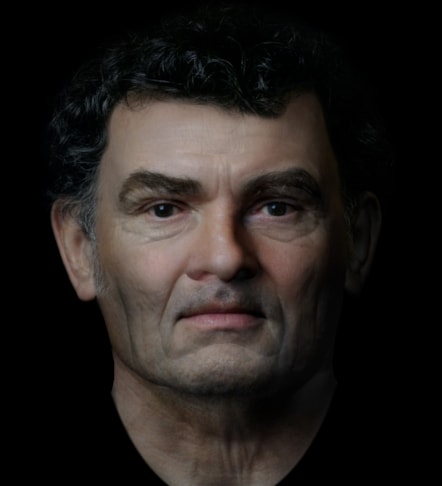
A man buried near the Roman fort at Inveresk, just east of Edinburgh, has been given a face for the first time in almost 2,000 years. The reconstruction, announced by National Museums Scotland in October 2026, is based on his skull, scientific analysis of his remains and informed decisions about details that bones alone cannot reveal.
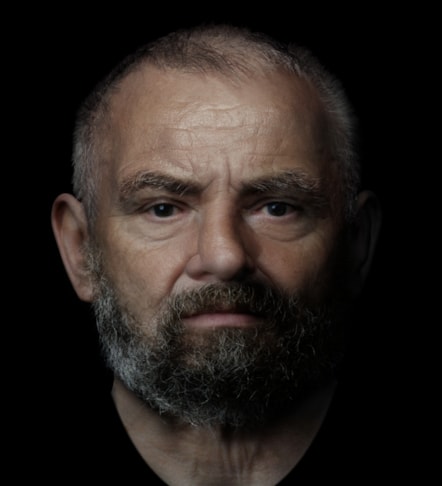
The museum has published press photographs of the reconstruction and the skull examination. The facial reconstruction images are credited to © Chris Rynn; the photographs of curator Dr Jess Thompson examining the skull are credited to © Duncan McGlynn.
A man who travelled north
The man died sometime between AD 140 and 165, during the period when the Roman army occupied the Antonine frontier. Analysis suggests that he was born in southern Britain and later moved hundreds of miles north to the Firth of Forth. He was probably in his early fifties when he died.
We do not know his name, why he travelled to Inveresk or what work he did. His presence nevertheless reminds us that a Roman fort was not an isolated garrison. Soldiers were accompanied or supplied by a wider population, including craftspeople, traders and families.
What his bones reveal
His skeleton records a difficult physical life. His nose had been broken and healed. Extensive bone growth around his right elbow, probably the result of septic arthritis, would have severely restricted the movement of his right arm.
There was also marked wear on his front teeth. Researchers suggest that he may have used his teeth to hold objects, perhaps compensating for the difficulty of using his arm. This is a plausible explanation, rather than something that can be established with certainty.
The museum considers it unlikely that he was serving as an active soldier at the time of his death, given the limitations imposed by his arm. That does not tell us whether he had previously served in the army, or what his occupation may have been.
An unusual group of burials
He was one of a group of adult men buried around the Roman fort at Inveresk. Four of the six had been decapitated after death. The Inveresk burials are the first known Scottish examples of this practice and are among the earliest identified in Britain.
Post-mortem decapitation is known elsewhere in Roman Britain, but its meaning is uncertain. It has been interpreted in different contexts as a possible punishment, a burial custom or a practice associated with beliefs about death. We cannot assume that the same explanation applies to every burial, or identify the reason at Inveresk from the evidence currently available.
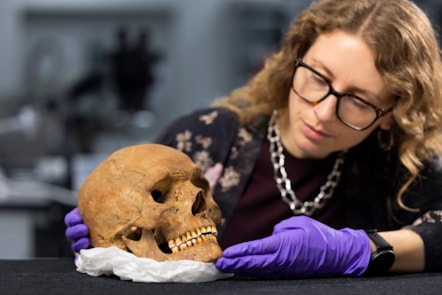
How do you reconstruct a face?
Dr Chris Rynn produced the digital reconstruction using an assessment of the skeleton by National Museums Scotland, earlier isotope research led by Durham University and ancient DNA work involving researchers at York and Harvard.
The skull provides important information about the shape of the face. Scientific evidence can also help estimate aspects of ancestry and appearance. Other details, including hairstyle and some soft-tissue features, necessarily involve interpretation. The result is a carefully informed portrait, not an exact likeness.
The museum’s image library includes several alternative reconstructions, as well as photographs of Dr Jess Thompson examining the skull. Comparing the alternatives is a useful reminder of the uncertainties involved.
Life on the Roman frontier
The Antonine Wall and the forts along it are often described through their military history: construction, garrisons, campaigns and eventual withdrawal. The man from Inveresk offers another perspective. He travelled a considerable distance, lived with a serious disability and died in a community associated with a Roman fort.
His remains cannot answer every question about that community, but they provide unusually direct evidence for one of the people who lived on Rome’s northern frontier.
See the reconstruction
The skull and digital facial reconstruction are due to be displayed in Roman Scotland: Life on the Edge of Empire at the National Museum of Scotland in Edinburgh, from 14 November 2026 to 18 April 2027.
Sources and images: National Museums Scotland press release, 20 October 2026; press photographs and reconstruction animation. Image credits: facial reconstruction © Chris Rynn; skull examination photographs © Duncan McGlynn. The images are available as press assets; check the museum’s stated conditions for reuse on an independent history website before uploading them.
References and further reading
Excavation report: Magnus Kirby (2020), Excavations at Musselburgh Primary Health Care Centre: Iron Age and Roman discoveries to the north of Inveresk Roman Fort, East Lothian, Scottish Archaeological Internet Reports 89, pp. 1–153. Read the open-access report. See especially the section on Roman-period burials (pp. 23–41).
Facial reconstruction: National Museums Scotland announcement (20 October 2026) and press image library.

