Roman altars and carved inscriptions often reach us as bare stone, but traces of paint tell a different story. At Inveresk in East Lothian and on monuments from Rome’s northern frontiers, analysis has recovered evidence of coloured surfaces. Polychromy simply means the use of several colours.
This visual guide introduces the materials behind those colours. It separates findings from Inveresk itself from comparisons elsewhere, and explains why a convincing coloured reconstruction can still contain substantial guesswork.
Reading the colours: these swatches are modern illustrations, not measured matches to ancient paint. Grinding, mixing, the binding medium, lighting and ageing all affect appearance. A pigment identified on one monument does not establish its use on another.
The colours recorded at Inveresk
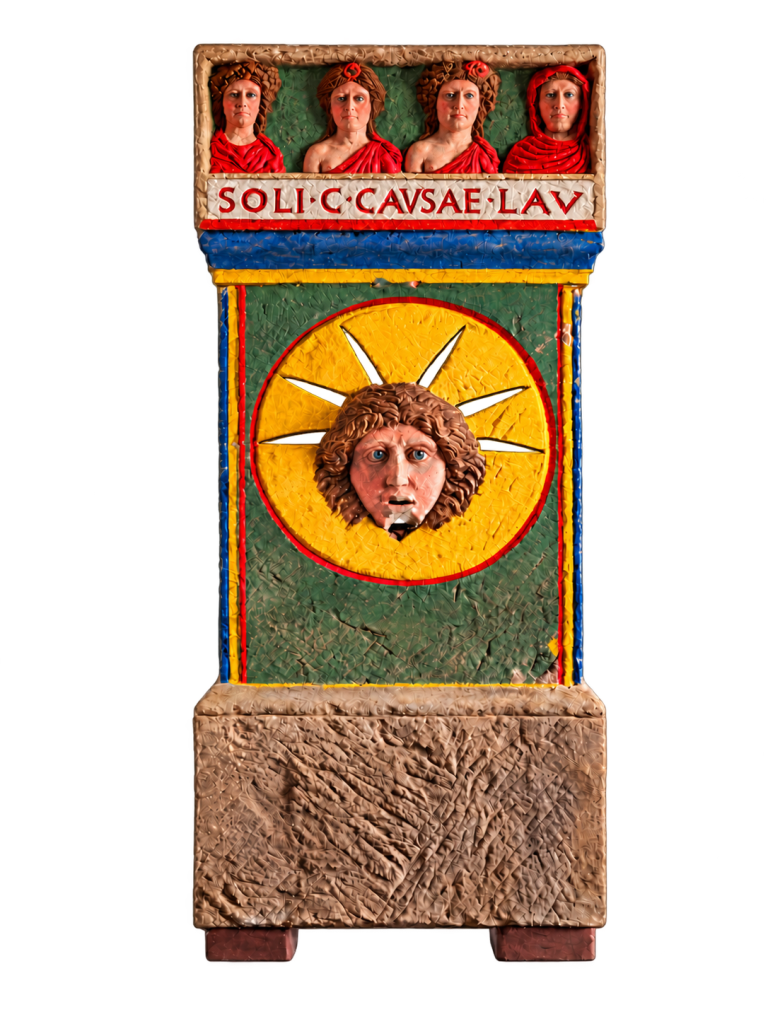
Ruth Siddall examined surviving paint from two different altars: one dedicated to Sol, the Sun god, and one to Mithras. The cards below summarise her pigment analysis, Appendix 4, pp. D70–D77.
Red ochre
Hex: #8A2E1F
Iron-rich earth, coloured chiefly by haematite (iron oxide).
Evidence: Recorded on the red band beneath the Sol altar’s inscription.
Yellow ochre
Hex: #C68B35
Earth containing yellow iron minerals such as goethite.
Evidence: Found with red ochre in orange-red paint on a floral ornament of the separate Mithras altar.
Bone white and gypsum
Hex: #F8F6F0
Bone white is made from thoroughly burnt bone; gypsum is calcium sulphate.
Evidence: Identified in white samples from parts of letters on the Sol altar.
Madder pink
Hex: #9B1B30
A plant-derived colourant from madder roots, attached to mineral particles to make a pigment.
Evidence: A small amount was identified with the ochres on the Mithras altar. This swatch illustrates the colour family, not its mixed appearance.
The inscription needs care. White was sampled from an A’s crossbar and a C’s lower serif. This does not prove a complete white background with red letters. The red samples came from the band below. Siddall describes thin paint applied directly to stone in the sampled areas, without a ground.
A broader palette: Carrawburgh
Carrawburgh lies beside Hadrian’s Wall in northern England. Its altar, dedicated by Marcus Simplicius Simplex, provides a comparison, not an additional list of pigments proven at Inveresk. Louisa Campbell, Margaret Smith and Sarah Dugmore’s 2026 study combines several analytical methods to examine its surviving decoration.
Cinnabar / vermilion
Hex: #CF241A
Mercury sulphide, producing a strong red.
Evidence: Reported in the Carrawburgh inscription and in mixtures. This is not evidence for red letters at Inveresk.
Orpiment
Hex: #F2B818
A yellow arsenic-sulphide mineral.
Evidence: Reported in the painted framing at Carrawburgh. Its yellow is distinct from the iron-based yellow of ochre.
Egyptian blue
Hex: #1B4F8C
A manufactured calcium-copper silicate, made by heating silica, a calcium source, copper-bearing material and an alkali.
Evidence: Reported at Carrawburgh, including in the complex purple mixture. The name does not establish where this particular pigment was manufactured.
Ultramarine
Hex: #182F7C
A blue pigment associated with lazurite in lapis lazuli.
Evidence: Reported in the Carrawburgh analysis. It should not be transferred to Inveresk’s eyes, borders or backgrounds without evidence.
Green earth
Hex: #5B7055
Naturally green, iron-bearing silicate minerals.
Evidence: The Carrawburgh study interprets some traces as green earth. That does not confirm the broad green fields used in modern Inveresk reconstructions.
A mixed purple
Hex: #6B3D70
A compound colour, rather than necessarily a single purple pigment.
Evidence: The researchers report Egyptian blue, ultramarine, cinnabar/vermilion, red ochre, red lead and realgar in the Carrawburgh inscription panel. It should not automatically be called Tyrian purple.
Red lead and realgar
Hex: #D6381E
Two different materials: red lead is a lead oxide; realgar is an arsenic sulphide.
Evidence: Both are reported among the components of the Carrawburgh purple. A red-looking surface cannot be assigned a pigment by eye alone.
A golden surface: pyrite
Hex: #D4AF37
Iron sulphide, often called fool’s gold, rather than metallic gold.
Evidence: The Carrawburgh team interprets a golden coating over the inscription panel as pyrite mixed with beeswax. This flat swatch cannot reproduce its reflective effect.
For the object and its religious setting, see Red, purple and gold: the lost colours of a Roman altar to Mithras.
Colour on the Antonine Wall
Louisa Campbell’s 2020 study used portable X-ray fluorescence and Raman spectroscopy to investigate the Antonine Wall distance slabs. These methods provide evidence that their carved scenes and lettering were coloured.
At Summerston, Campbell interprets lead-rich traces on several figures as possible red lead and suggests that some red colouring represented blood. Raman results suggest orpiment on Victory’s dress and a white border. Other signals are interpreted as madder and possibly realgar. These are analytical interpretations with differing levels of confidence, rather than a complete surviving paint scheme.
Read Campbell’s research paper alongside the site’s introduction to the messages carried by the distance slabs.
How researchers recover the colours
A visible trace is a starting point. Microscopy examines individual particles, while X-ray fluorescence measures elements. Raman spectroscopy and other laboratory methods can help distinguish compounds. Combining methods matters: detecting an element is not always enough to identify a particular paint.
Researchers must also consider the stone itself, burial deposits, deterioration and conservation treatments. The locations of samples matter as much as the colour names. Paint on a frame does not establish the colour of the inscription field inside it.
What a reconstruction can show
A reconstruction can help us understand how colour separated clothing from skin, made lettering stand out or drew attention to a divine figure. It should identify which details follow surviving traces, which draw on comparison and which are illustrative choices.
There is no single painting sequence that can safely be imposed on every altar. Nor does a pigment’s possible geological source prove that a particular batch came from that location.
Sources and further reading
Siddall, R. (2016), “Analysis of red and white pigments from the Inveresk Park altars”, Appendix 4, pp. D70–D77, supplementary material to Hunter, Henig, Sauer and Gooder, Mithras in Scotland: a Mithraeum at Inveresk (East Lothian).
Campbell, L. (2020), “Polychromy on the Antonine Wall Distance sculptures: non-destructive identification of pigments on Roman reliefs”, Britannia 51, 175–201. DOI: 10.1017/S0068113X20000124.
Campbell, L., Smith, M. and Dugmore, S. (2026), “Multi-Technique Analysis and Digital Reconstruction of Polychromy on a Mithraic Altar from Carrawburgh Roman Fort near Hadrian’s Wall”, Colourants 5(1), 6.
Continue exploring: Roman altars · Roman inscriptions.

