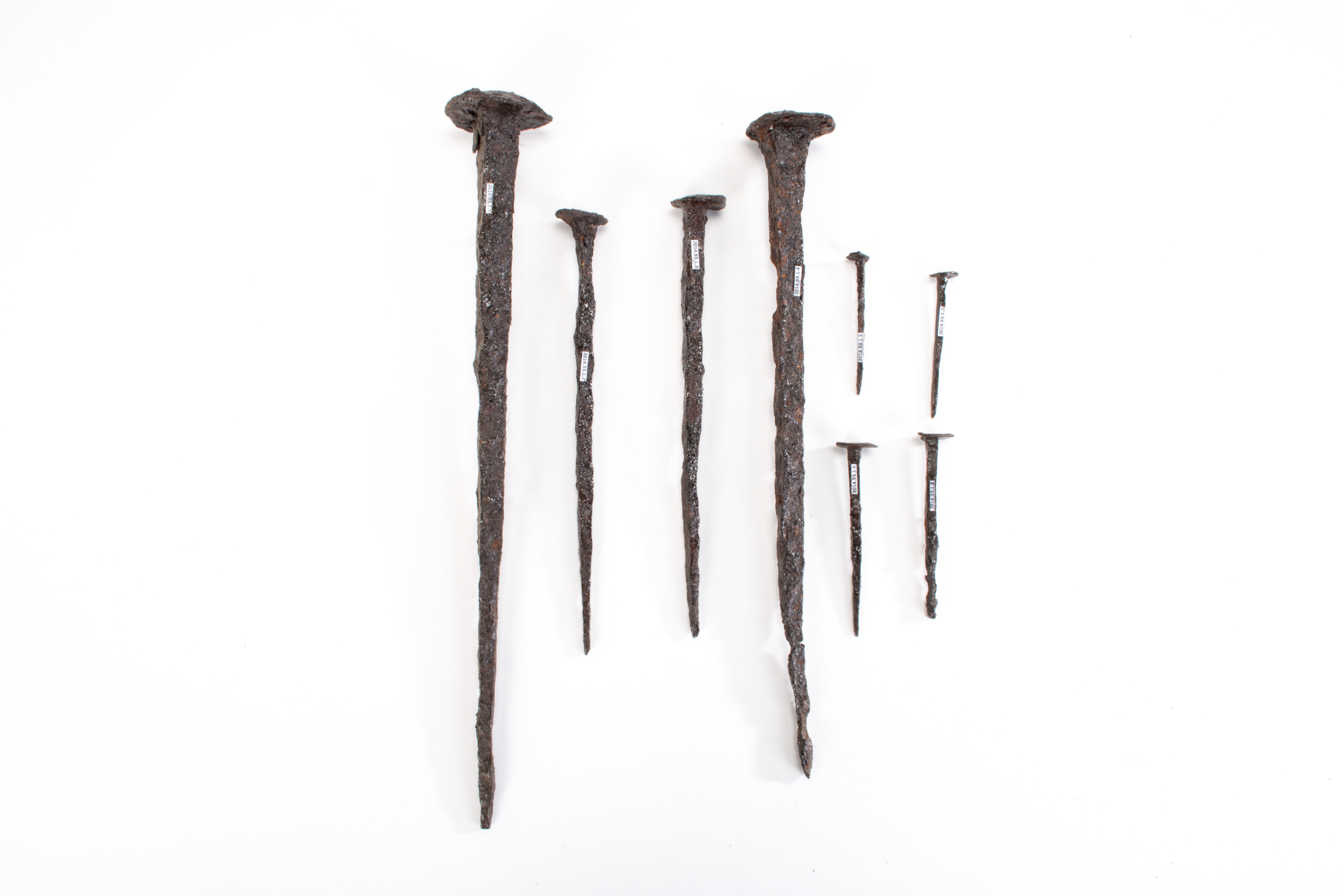
An iron nail from the legionary fortress at Inchtuthil in Perthshire has a square shank and a conical head. Look closely and those two features tell you where the smith wanted the iron to go. Much of it was drawn out into a taper. A small amount had to stay at the top.
From iron rod to square-shanked nail
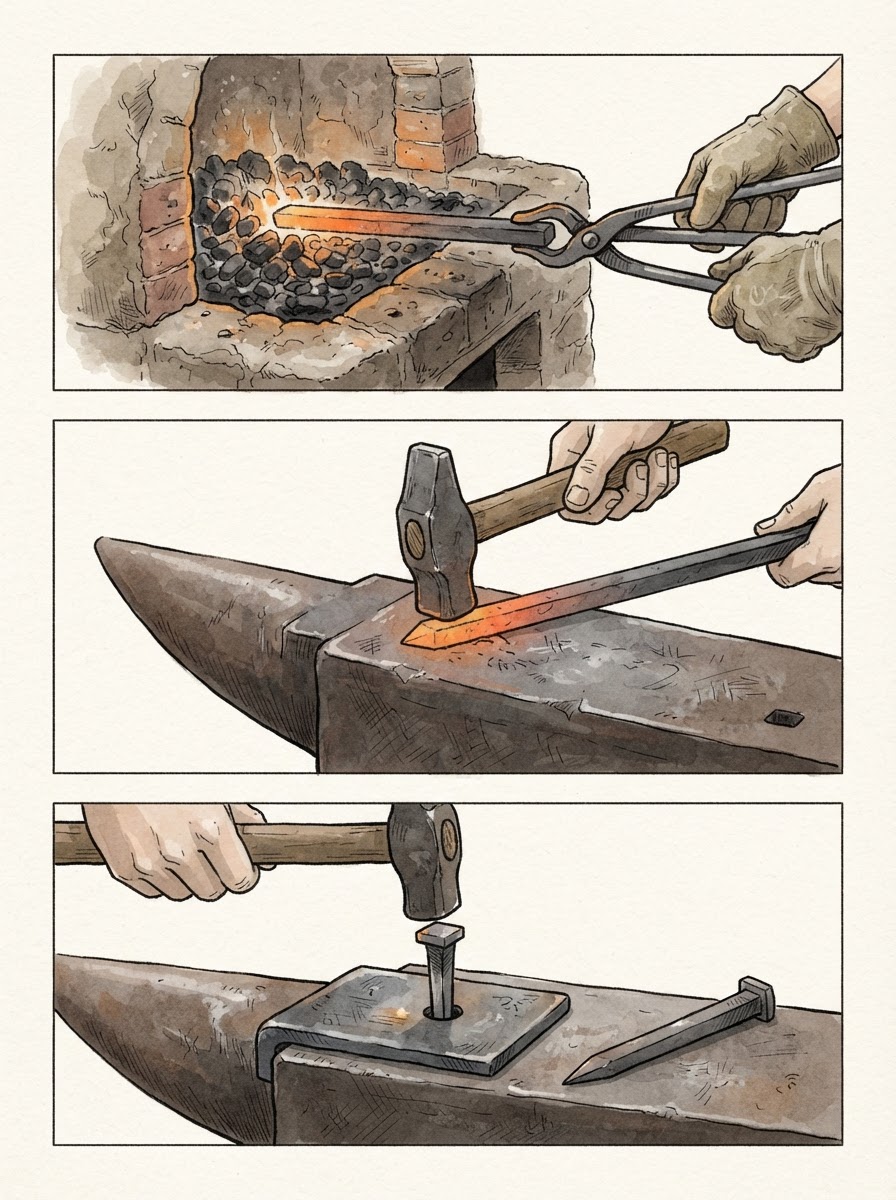
The smith heated iron rod in the forge until the end softened enough to shape on an anvil. Hammering a face, turning the iron and hammering again gradually lengthened the shank and narrowed it towards the point. Working each face in turn gave the nail its four sides. A round wire nail leaves a very different outline.
The smith left enough metal for the head and separated the nail from the stock. A heading tool, essentially a hole that admitted the shank, supported the nail while the protruding metal was hammered down and spread. The head could then bear against the surface of a timber. Compare the profiles of several Inchtuthil nails and you can see small differences in the way their heads were finished.
Thomas Timbrell and the Roman smithy
Thomas Timbrell of Heritage Blades studied history at Leicester and trained in blacksmithing and metalworking at Warwickshire College. His work ranges from spoons to surgical instruments. For the Edinburgh event his subject is the Roman smith’s toolkit and the objects smiths supplied in Scotland. A nail makes a good introduction to that work because the changes made by the hammer are still legible in the finished object.
Meet Thomas Timbrell · Browse Timbrell’s photographs of his work · Compare five Inchtuthil nails · Read Reading Museum’s account of forging a Roman nail
Part of the Romans in Scotland series inspired by Meet the Makers at the National Museum of Scotland, 21–22 November 2026.


.jpg)