To throw a pot is to shape clay with your hands while it turns on a potter’s wheel. At Graham Taylor’s National Museum of Scotland workshop, Taylor makes the rounded body on the wheel and a second pair of hands adds the face. For a Roman pottery workshop, the work began earlier, with clay still in the ground.
Where did the clay come from?
A potter could dig a shallow pit where a layer of suitable clay lay close to the surface. The useful material was the fine clay beneath the topsoil. At the Roman pottery workshop at Loupian in southern France, archaeologists found evidence of clay extraction and wide, tile-lined basins where workers mixed the clay. This gives us a Roman example of the work that came before the wheel. Explore the excavated workshop at Loupian.
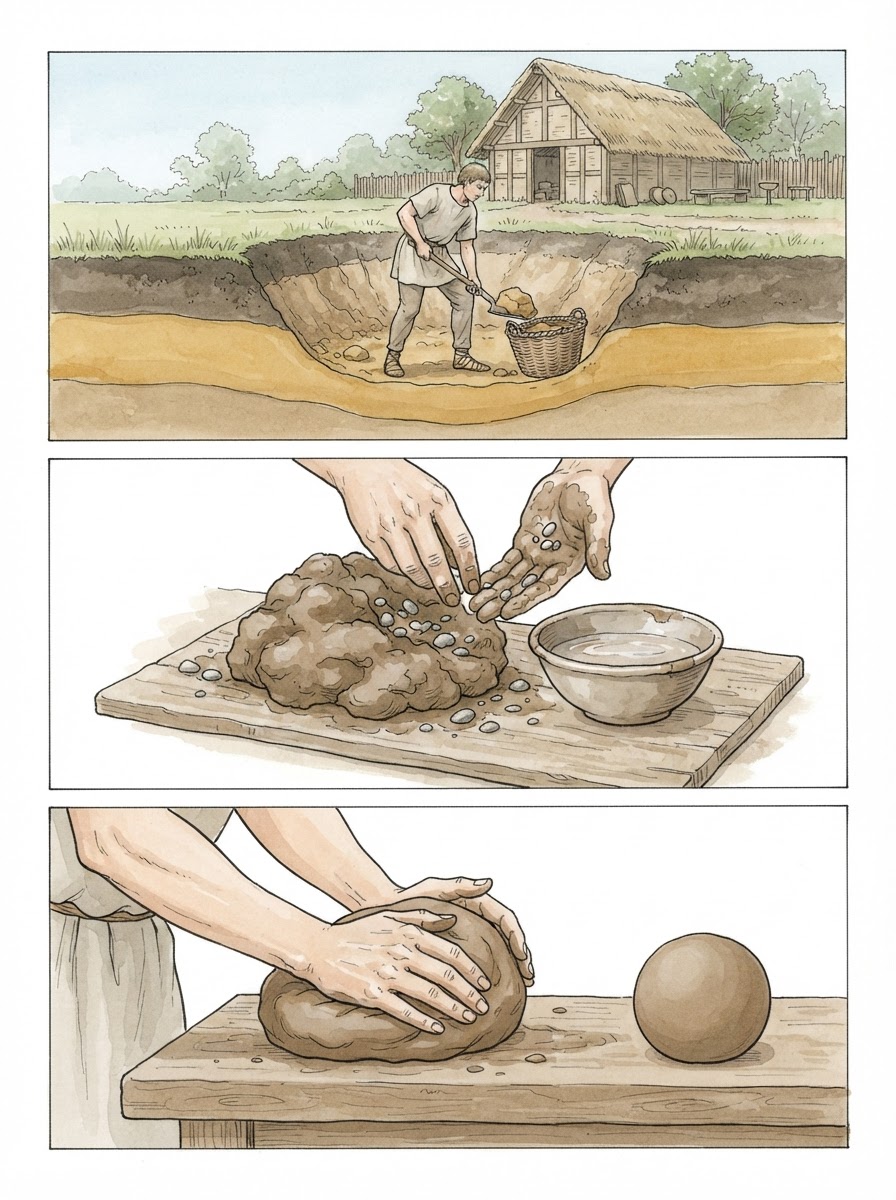
Freshly dug clay can contain pebbles and hard lumps. One way to prepare it is to moisten it, pick out the larger stones and knead it on a board. Kneading spreads the moisture evenly. The potter needs a lump soft enough to stretch between the fingers and firm enough to stand up as the walls grow taller. Read Historic England’s guide to pottery production.
How the potter shapes the body and adds the face
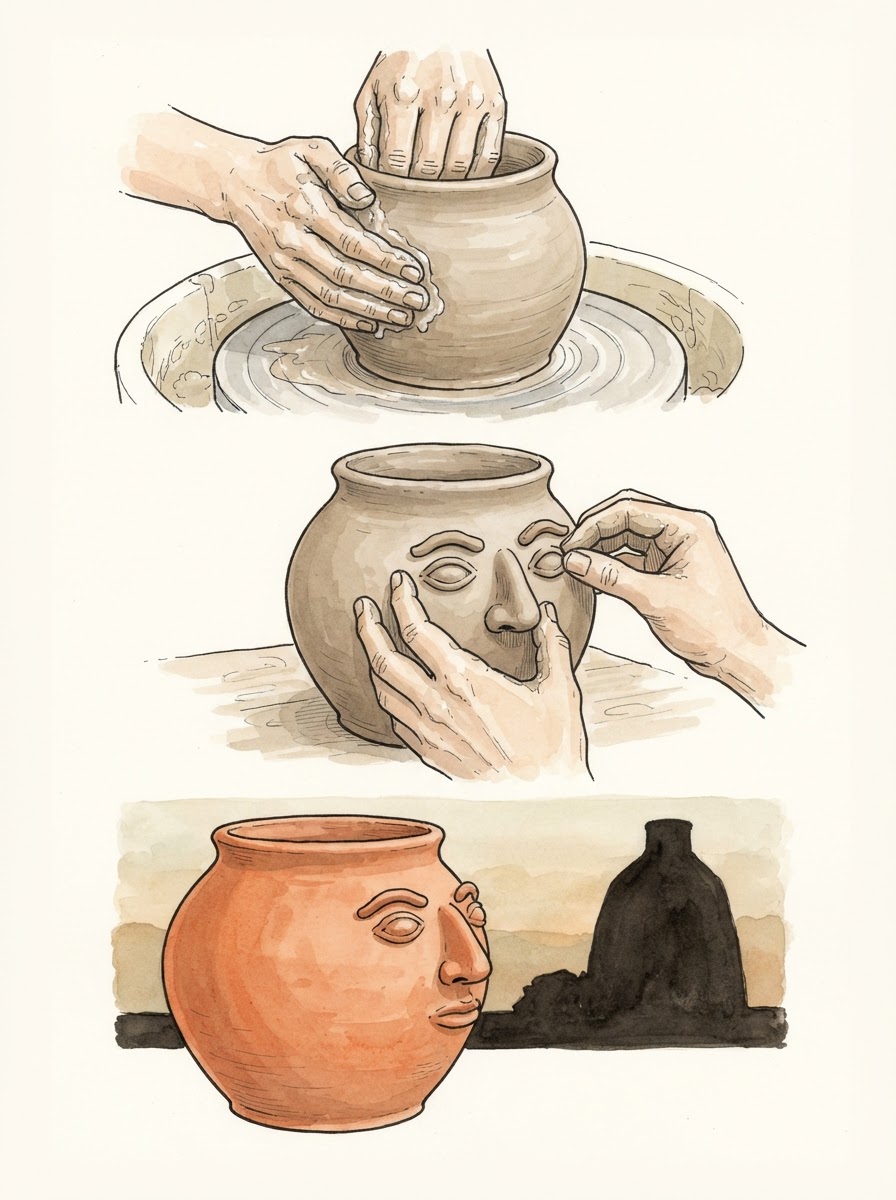
The potter presses the lump onto the centre of the wheel and steadies it with wet hands until it turns without wobbling. With the wheel spinning, the potter presses thumbs into the middle to open a hollow, leaving clay at the bottom for the base. Fingers inside and outside then guide the clay upwards. With each turn, the wall grows taller and thinner. This is the action potters call throwing. The opening, shoulder and foot can all be shaped as the vessel turns. The resulting body needs enough firmness to carry additional clay without sagging under the decorator’s fingers.
The decorator chooses a front and builds up the features. A small projection can become a nose, while applied strips or incised lines can define eyes and mouth. From the side, the face has to follow the curve of the wall. Looking at a finished pot in profile reveals how far the features project. Once the additions and body have dried together, firing turns them into a single ceramic object.
Graham Taylor and Potted History
Taylor runs Potted History with his daughter Sarah Lord. The Edinburgh programme distinguishes two workshops. The morning pots draw on finds from the second-century Roman fort at Inveresk, Musselburgh. The afternoon head pots draw on examples from across Roman Britain. Taylor supplies vessels from his wheel and takes the decorated pieces back to his workshop for firing. His replica gallery also shows hunt cups with dogs and hares in relief, another way to turn a curved pot wall into a picture.
Visit Graham Taylor and Sarah Lord’s Potted History · See Taylor at the wheel and a pot being decorated · Browse Taylor’s photographs of replica Roman vessels
Part of the Romans in Scotland series inspired by Meet the Makers at the National Museum of Scotland, 21–22 November 2026.


