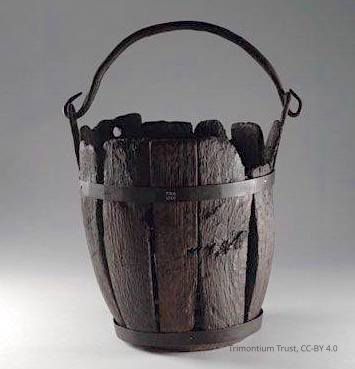
At Newstead, near Melrose, a late first-century well bucket survives with its oak sides, iron handle and supports. Its shape poses a practical question. How do you turn several straight pieces of wood into a round vessel that will come back up the well full of water?
Fitting the staves
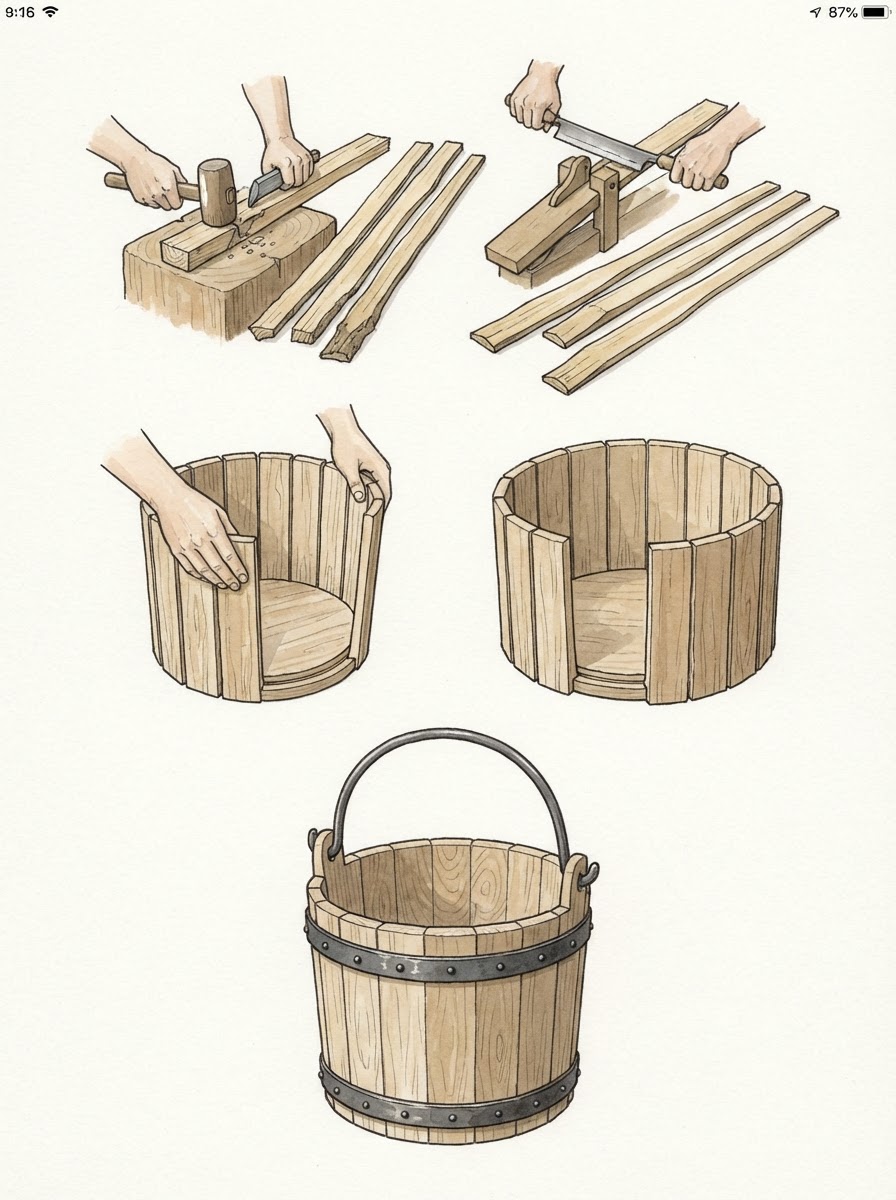
Each upright piece of the bucket wall is a stave. A woodworker could split oak along the grain to produce blanks, trim them to length and dress their long edges at a slight angle. Set two finished staves together, and the angle is barely visible. Bring a whole set together, and those small angles turn the wall into a circle.
The bottom has to fit that circle closely. A trial assembly gives the maker a chance to find a high spot or an open seam before fitting the base and securing the sides. The iron handle introduces a different problem. A bucketful of water hangs from just two points, so the handle needs sound attachments. Look at where metal meets wood in the photograph. The surviving pieces establish the bucket’s broad construction. The precise order in which its maker trimmed and fitted them is a reconstruction.
Hamish Darrah and the marks left by tools
Hamish Darrah of Archaeowood demonstrates Roman woodworking. His research with National Museums Scotland and the University of Leicester also takes him further back, to the bronze tools of northern Britain. He uses replicas for particular tasks and compares the wear they acquire with traces on ancient tools. His photograph of cross-cutting timber illustrates a useful distinction for a bucket maker. Cutting across the grain shortens a piece. Splitting along it produces a length of workable wood.
Visit Archaeowood · See Darrah cross-cutting timber · Examine the Newstead well bucket
Part of the Romans in Scotland series inspired by Meet the Makers at the National Museum of Scotland, 21–22 November 2026.

