https://artsandculture.google.com/asset/saffo/NQHJ4PX9zPcpzg
Sappho: the woman whose poetry survived the ancient world
More than 2,600 years ago, on the Greek island of Lesbos, a woman began writing poems about love, longing, beauty and loss. Only fragments of her work survive, yet Sappho remains one of the most famous poets of the ancient world.
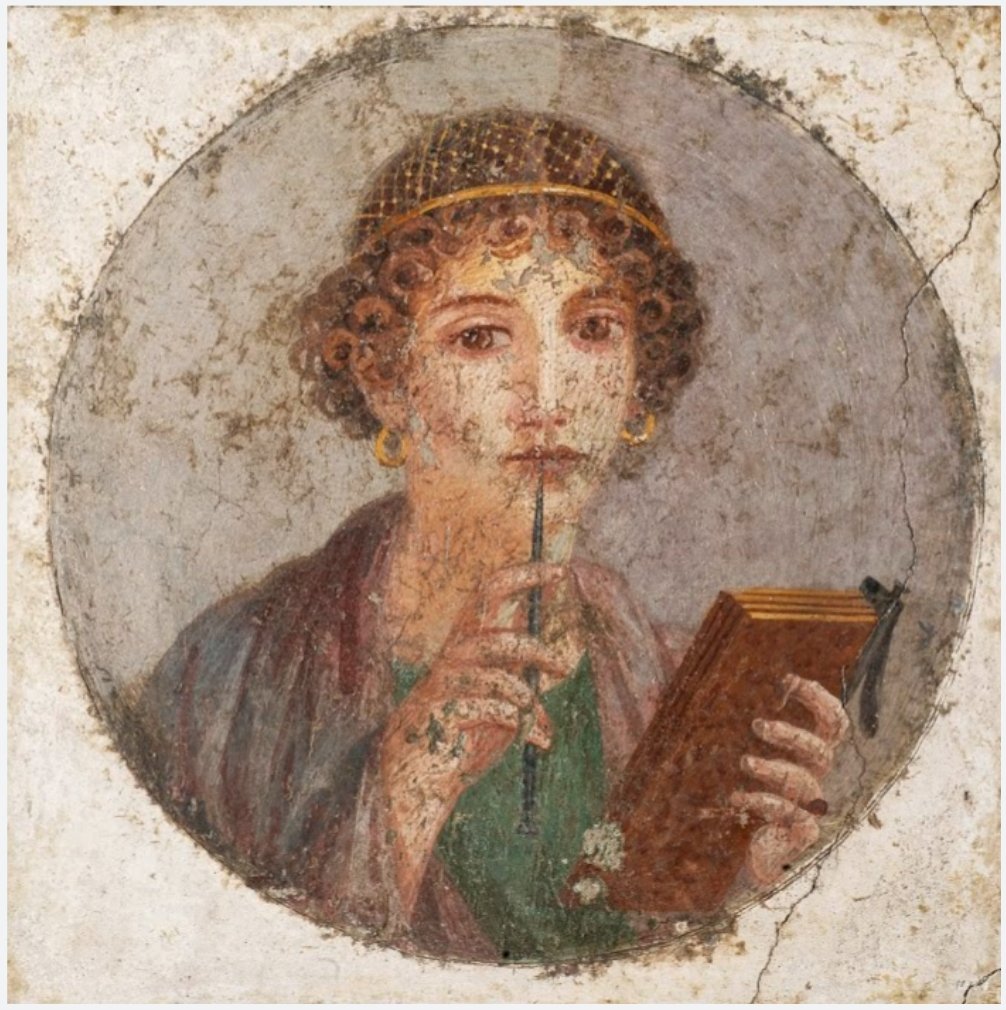
The woman in the well-known Roman fresco above is often called Sappho — or Saffo in Italian. She holds a stylus thoughtfully to her lips and a set of writing tablets in her hand, an image that seems almost perfectly suited to the celebrated Greek poet.
There is, however, a complication. The painting was made at Pompeii in the first century AD, roughly 600 years after Sappho lived. It is almost certainly not intended as a realistic portrait of her. Archaeologists generally regard it as the portrait of an educated Roman woman, although the traditional name “Sappho” has stuck.
The real Sappho lived an even more remarkable life.
A poet from Lesbos
Sappho was born around 630 BC, probably at Mytilene on the island of Lesbos, just off the coast of what is now Turkey.
She appears to have come from a wealthy or aristocratic family. Ancient writers give us the names of several members of her family, although the surviving accounts were written long after her lifetime and cannot always be trusted.
One person we know rather more about is her brother Charaxos. Sappho herself refers to him in her poetry. A remarkable papyrus published in the twenty-first century contains part of a poem in which she worries about Charaxos returning safely from a voyage.
It provides a tantalising glimpse of Sappho not simply as a legendary poet, but as a woman concerned about her family.
Her world was very different from the later classical Athens of Socrates and Plato. Greece was divided into numerous independent communities, and the island of Lesbos had its own aristocratic rivalries and political struggles.
At some point Sappho may even have been forced into exile in Sicily, although very little is known about the episode.
Poetry that was meant to be heard
Today we normally encounter poetry printed silently on a page.
Sappho’s audience experienced it differently.
Her poems were lyric poetry, composed to be sung or recited, sometimes with musical accompaniment. The word “lyric” itself comes from the lyre, the stringed instrument associated with this kind of performance.
Sappho wrote in the local Aeolic dialect of Greek.
Rather than telling enormous stories of heroes and wars like Homer’s Iliad and Odyssey, she often concentrated on intensely personal moments.
Desire.
Jealousy.
Friendship.
Marriage.
Separation.
Beauty.
The gods.
And, above all, love.
One surviving poem describes the overwhelming physical sensation of seeing a beloved person talking to somebody else. The speaker’s heart races; speech fails; heat spreads through the body.
It feels startlingly modern.
Sappho and the women in her poems
Many of Sappho’s poems express affection and desire for women.
Exactly what this tells us about Sappho’s own life has been debated for centuries. We simply do not possess enough evidence to reconstruct her relationships or to place them into modern categories of sexuality.
What is certain is that women occupy the centre of much of her surviving poetry.
Sappho appears to have lived and worked within a female social world in which music, poetry, religious ritual, marriage and education were important. Scholars have suggested that she may have taught young aristocratic women, although the precise nature of this group remains uncertain.
Her association with women became so famous that the name of her home island, Lesbos, eventually gave us the word lesbian, while the adjective Sapphic derives directly from her name.
Both developments occurred long after Sappho herself lived.
“Deathless Aphrodite”
Only one of Sappho’s poems survives complete: the Hymn to Aphrodite.
In it, the poet calls upon Aphrodite, goddess of love, asking for her help in matters of the heart.
Sappho reminds the goddess that she has helped her before. Aphrodite descends from heaven in a chariot and asks who has caused Sappho pain and whom she wants to love her.
The poem combines religion with something intensely human: the desperate wish that another person might return your affection.
That combination is characteristic of Sappho. The gods inhabit her world, but so do the everyday emotions of real people.
One of antiquity’s greatest poets
Sappho became enormously famous.
Ancient scholars collected her poetry into nine books, probably containing thousands of lines. The people of Lesbos honoured her on their coins. Later Greek and Roman writers quoted and imitated her.
Plato was even said to have called her the “Tenth Muse”, adding her symbolically to the nine divine Muses of Greek mythology.
Roman poets knew her work well.
Catullus adapted one of her most famous poems into Latin, while writers such as Horace experimented with the poetic form now known as the Sapphic stanza.
By the Roman period, Sappho had already become a cultural icon.
That may help explain why a Roman woman shown with writing implements could later so easily be imagined as Sappho.
How did almost all her poetry disappear?
For centuries Sappho’s poems continued to be copied.
Then the manuscripts disappeared.
There are many romantic stories explaining their loss, including claims that Christian authorities deliberately burned her works. There is little convincing evidence for a single organised destruction.
The explanation was probably more mundane.
Sappho wrote in an increasingly unfamiliar Greek dialect. Books had to be copied by hand, generation after generation. If people stopped copying a particular author, that author’s work could simply vanish.
By the medieval period, almost all of Sappho was lost.
But not quite.
Other ancient writers had quoted passages from her, preserving a handful of lines.
Then archaeologists began discovering ancient papyri in the dry sands of Egypt.
Some contained fragments of Sappho.
Sometimes the circumstances of their survival were extraordinary. Pieces of discarded books had been reused as waste material or incorporated into objects made from papier-mâché-like layers of papyrus.
Gradually, lines written more than two millennia earlier began to reappear.
Today we possess only a small fraction of Sappho’s original work — sometimes whole sections of poems, sometimes merely a few words.
There are poems in which entire lines have disappeared.
Yet even those fragments can be extraordinarily powerful.
Did Sappho throw herself from a cliff?
Later antiquity created another story about Sappho.
According to the legend, she fell hopelessly in love with a beautiful ferryman called Phaon. When he rejected her, Sappho travelled to the island of Leucas and threw herself from a cliff.
It is a wonderful tragic story.
It is probably fiction.
The tale developed centuries after Sappho’s lifetime and may partly result from later writers turning the passionate speaker of her poems into a fictionalised version of the poet herself.
We do not know how Sappho died.
A voice across 2,600 years
Perhaps the most extraordinary thing about Sappho is how little of her writing was needed to secure her immortality.
Nine books became hundreds of fragments.
Hundreds of fragments sometimes became isolated sentences.
And still her voice survived.
The great epic poets wrote about armies, kings and the destruction of cities. Sappho often wrote about something much smaller: what happens inside one human being when another person enters the room.
More than 2,600 years later, that may be precisely why she still speaks to us.
The image traditionally known as “Sappho”
The famous image associated with Sappho was discovered at Pompeii and dates from the Roman period. It shows a fashionable young woman holding wax writing tablets and a stylus, with the stylus resting against her lips as though she is considering what to write next.
She probably isn’t Sappho.
But as an image of an educated woman caught in the act of thinking and writing, it has become one of the most memorable visual representations of the ancient poet.
And perhaps that makes the traditional identification strangely appropriate.

