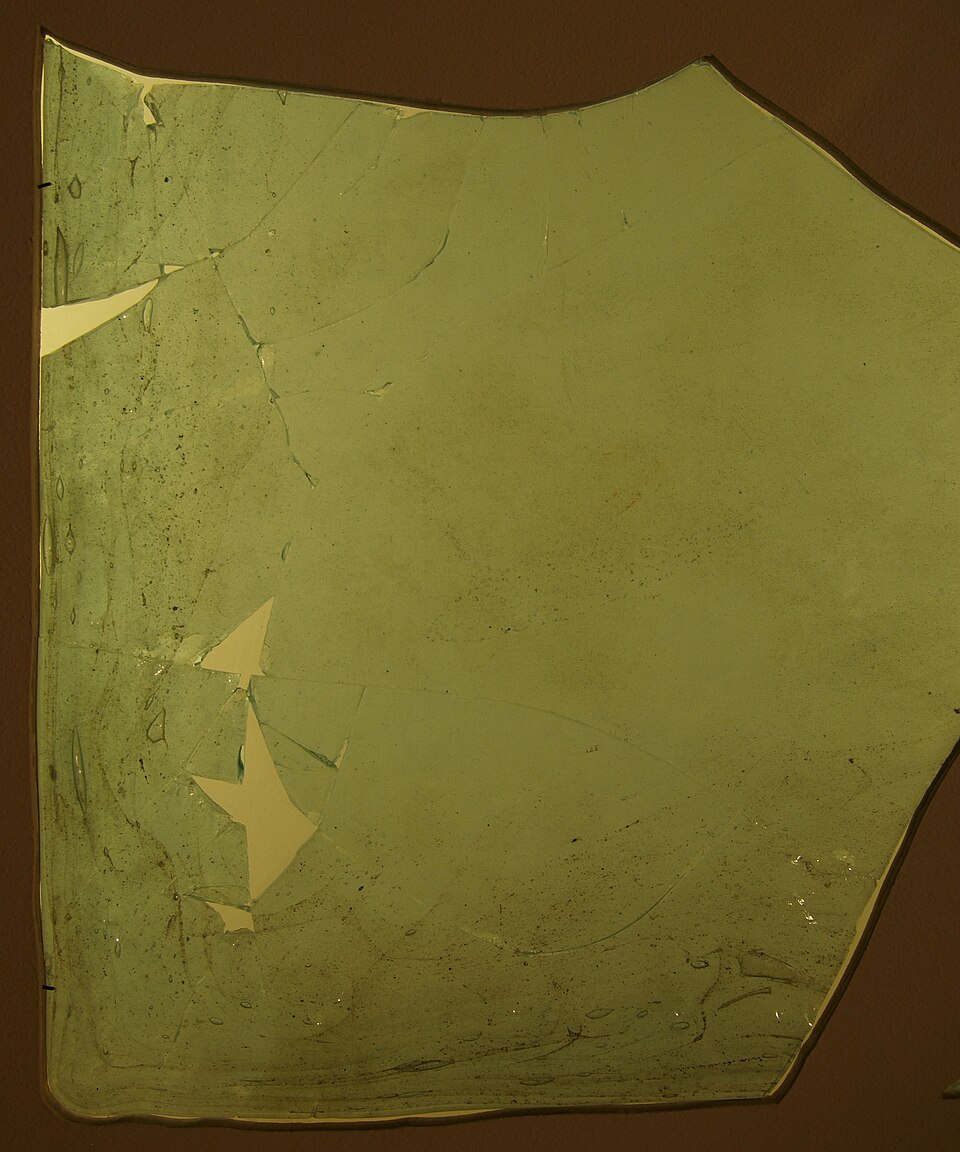
Yes — Roman buildings in Scotland had glass windows. Fragments have turned up at military forts from Perthshire to the Borders, on the Antonine Wall, and in Roman Edinburgh. At Cramond, archaeologists even recovered pieces of the wooden framing made to hold the panes. The evidence is much more tangible than we might expect from a material that breaks so easily.
These were not the clear, double-glazed windows we know today. The pieces are usually pale blue-green, often a few millimetres thick, with one smooth face and another rougher, matt face. They let daylight into buildings and could help retain warmth, particularly in bathhouses.
What did Roman window glass look like?
Many early Roman panes were made by working hot glass into a relatively flat sheet. Archaeologists often recognise them by the contrast between a glossy face and a matt face, with rounded or worked edges. The exact manufacturing technique is still discussed; modern experiments suggest that glass could be drawn and shaped while hot, rather than simply poured into a mould.
Such panes were usually less transparent than modern glazing. They could admit light while giving only a hazy view outside. Some surviving pieces have bubbles and uneven thickness, and the natural colour of the glass is often greenish or bluish.
Six discoveries that tell the story
1. Inchtuthil, Perthshire — glass at a legionary fortress
At Inchtuthil, the great legionary fortress built during Rome’s late first-century campaigns, Birgitta Hoffmann identified two window-glass fragments among finds from early excavations; another had been recovered in later work. The three pieces show that glazing reached the Roman army far north of the later Antonine Wall. A bathhouse is a plausible place for it, but the exact original position of the fragments is unknown. Read the Roman Gask Project’s specialist study.
2. Cramond, Edinburgh — traces of the wooden window frame
Cramond has produced Roman window glass, but its most revealing finds are two pieces of wooden window-frame with grooves for panes. Those rare survivals help us understand how glass was fitted into a building, rather than merely proving that the material was present. The framing is described in the archaeological literature cited by Jennifer Price. Explore the Roman fort at Cramond.
3. Bearsden — the shape of a pane
Excavators at Bearsden recovered three pieces of window glass. One had been carefully trimmed into a small square or rectangular pane with a surviving side about 95 mm long. Jennifer Price argued that this may indicate a glazed opening divided by bars, probably in the bathhouse, although its exact original position cannot be demonstrated. The report also records where the three fragments were deposited: near the bathhouse, on an internal road and in a barrack building. Read the excavation report, chapter 9, pp. 188–93.
4. Bar Hill — a sizeable collection
At Bar Hill on the Antonine Wall, 32 pieces of window glass were listed in the excavation evidence discussed in the Bearsden report. A photograph of Bar Hill glass arranged to show how a window worked appears in the Scottish Archaeological Research Framework, associated with the Hunterian Museum’s Antonine Wall collection. See the photograph of the Bar Hill glass and research context.
5. Croy Hill — seventeen fragments
Excavations around Croy Hill recovered 17 fragments, distinguishable by their colour and thickness into at least three possible panes — perhaps more, because fragments were scattered over several areas. The specialist report by Sally Cottam and Jennifer Price records the characteristic matt and glossy surfaces and some rounded edges. Read the 2022 Croy Hill glass report, section 15.3.
6. Crawford, South Lanarkshire — glass in the fort headquarters
At Crawford, two small pieces of window glass were recorded in the southern portico of the headquarters building (principia). More strikingly, a deposit over the floor of its shrine room (sacellum) contained more than 40 fragments, including pieces from pane edges and a corner. That is evidence from an administrative and ceremonial building, not just a bathhouse. Read the excavation report.
Other Scottish locations
Window glass is also reported from the following sites. The numbers come from different excavations and publications, so should not be compared as if every fort had been excavated to the same extent.
- Ardoch, Perthshire: one matt/glossy fragment was identified in material re-examined by the Roman Gask Project.
- Strageath, Perthshire: two window-glass fragments are reported in the archaeological literature.
- Newstead (Trimontium), Scottish Borders: James Curle recorded both vessel glass and window glass throughout the periods of Roman occupation.
- Balmuildy, Antonine Wall: pieces were found in the headquarters, commander’s house and fort bathhouse.
- Westerwood, Antonine Wall: small quantities recorded.
- Old Kilpatrick and Duntocher, Antonine Wall: small quantities reported in earlier excavation accounts.
- Camelon, Falkirk: eighteen pieces reported, many associated with a craft-working area.
- Falkirk: numerous pieces came from above the pebbling in a building heated by a hypocaust (underfloor heating).
- Carriden, Bo’ness: a piece of window glass about 111 mm long was recovered from the fort annexe.
- Inveresk, Musselburgh: window-glass fragments are noted in excavation reports.
- Birrens, Dumfries and Galloway: pale green window glass is recorded in a museum collection, including object DUMFM:1967.545.
For Birrens there is even an illustrated museum entry: Window Glass, Birrens — Future Museum. For Newstead, the original excavation account is available in James Curle’s A Roman Frontier Post and its People. The Carriden annexe report and the Falkirk hypocausted-building report give especially clear examples of glass recovered from identifiable contexts.
Which buildings had glazed windows?
Bathhouses are strong candidates. It makes sense to admit daylight without losing as much heat from warm rooms, and some pieces have been found in or near bathing complexes. Officers’ accommodation, headquarters buildings and other substantial structures may also have used glazing.
But we should be careful: finding a shard in a ditch, road or later rubbish deposit does not tell us exactly which window it once occupied. At Bearsden, even the interesting pane found near the bathhouse cannot be assigned securely to a particular window. The Crawford finds make a useful contrast because they were recovered from the headquarters complex.
Why are the finds so small and scattered?
Glass was worth salvaging. Roman builders could remove panes for reuse, and broken glass could be collected to be melted down. Jennifer Price suggested that deliberate removal before the abandonment of some forts helps explain how little survives. In other words, a fort with only one or two fragments may once have had more glazed windows than the archaeological record suggests. Conversely, the presence of fragments alone does not prove that every building was glazed.
Where can you see the evidence?
The Scottish Archaeological Research Framework includes a photograph of genuine window-glass pieces from Bar Hill associated with the Hunterian’s Antonine Wall gallery. The Future Museum record for Birrens illustrates actual Scottish material. Both are excellent places to start if you want to see Scottish examples rather than a general Roman reconstruction. The photographs on those pages have their own usage rights, so they are linked here rather than copied.
Sources and further reading
- Jennifer Price, ‘Glass’, in David J Breeze (ed.), Bearsden: A Roman Fort on the Antonine Wall (2016), pp. 184–93 — especially pp. 188–89 on window panes and other Scottish finds.
- Sally Cottam and Jennifer Price, ‘The Roman Glass’, in William S Hanson, Excavations outside the Roman fort on the Antonine Wall at Croy Hill, 1975–8 (2022), section 15.3.
- Birgitta Hoffmann, ‘Roman Glass from the North of Scotland’, Roman Gask Project — Inchtuthil and Ardoch.
- G S Maxwell, Excavations at the Roman fort of Crawford, Lanarkshire — catalogue of glass from the headquarters complex.
- G Bailey, ‘Excavation at Carriden Roman fort annexe’ (1997).
- L J F Keppie and J F Murray, ‘A Roman hypocausted building at Falkirk’ (1982).
- James Curle, A Roman Frontier Post and its People — chapter on glass at Newstead.
- Future Museum, ‘Window Glass, Birrens’ — museum object DUMFM:1967.545.
Further on this website: Roman Glass looks at the wider range of Roman glassmaking and objects, from everyday vessels to luxury pieces. The window-glass evidence adds another dimension: Roman soldiers and civilians in Scotland could bring daylight into substantial buildings while keeping out some of the weather.


