There are some Roman women mentioned in Scotland. Centurions brought their families to Scotland or married into the local population. Women and children lived in and around Roman fortifications in Scotland.
The tombstone of Verecunda (RIB 2183) is a fascinating and poignant archaeological artefact from Roman Scotland. Discovered along the Antonine Wall, it offers a rare, direct glimpse into the lives of the civilian women who lived on the edge of the Roman frontier.
1. Discovery and Location
The tombstone was discovered around 1723–1728 at Shirva (near Twechar and the Roman fort of Auchendavy), roughly halfway across the Antonine Wall in East Dunbartonshire.
It was found alongside several other Roman stones (including the tombstone of a 15-year-old boy named Salmanes and a stone dedicated to a soldier of the Second Legion). These stones had been ripped from nearby military sites during antiquity and repurposed to build a later underground stone passage or cellar (souterrain) built into the defensive ditch of the Wall. Today, the tombstone is safely preserved and on display at The Hunterian Museum at the University of Glasgow.
2. The Inscription
The sandstone slab features a remarkably brief, minimalist inscription carved in three lines:
Plaintext
D MVERECVNDAE
The Translation:
D(is) M(anibus) / Verecundae
“To the Divine Shades (or Spirits of the Departed) of Verecunda.”
3. What the Tombstone Tells Us About Her
Despite its brevity, the inscription tells historians a great deal through what it omits:
- A Single Name: Unlike elite Roman citizens who carried a full three-part name (tria nomina), this woman is identified solely by her single name, Verecunda. In the Roman world, a single name on a funerary marker strongly implies she was either an enslaved person, a freedwoman (a former slave), or a local Caledonian woman who had adopted a fashionable Roman virtue-name.
- An Act of Love or Status: Carving stone was expensive. The fact that a single-named woman received a formal Roman tombstone with a carved epitaph indicates that someone of means—perhaps a Roman soldier, an auxiliary officer, or a wealthy trader living in the civilian settlement (vicus) outside the fort—cared deeply for her and paid to commemorate her memory.
Because her exact story remains a mystery, Verecunda has captured the imagination of modern historians. The Hunterian Museum and Historic Environment Scotland even featured her as a main playable character in their digital educational games and interactive exhibits, using her tombstone to explore the complex themes of cultural identity, migration, and daily civilian life on Rome’s final frontier.
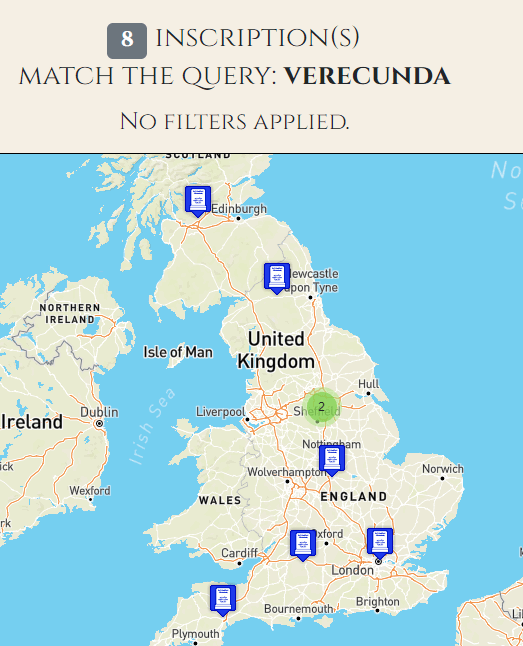
The name Vercunda is found throughout Britain.
Interpretations: Slave girl vs. free woman?
Interpretations fall mainly into two camps: those treating her as a slave (or slave-born) woman, and those noting the ambiguity. The evidence and claims are below.
- Slave (serva) interpretation: Many modern treatments assume Verecunda was a slave or the daughter of a slave. The basis is the single name and the expense of a stone. For example, a local heritage guide notes: “There was very little information inscribed on her gravestone apart from her name. Due to this, it is thought she might have been a slave at one of the forts”. Similarly, an interpretive exhibit at the Hunterian frames her as a Caledonian slave girl working at a fort commander’s house. An archaeological figure caption (Jones 2021) notes that “Verecunda… is conventionally interpreted as belonging to a slave or a local girl given a Roman name, due to the use of a cognomen alone without a nomen”. In sum, proponents of the slave theory argue: (a) her single name suggests non-citizen status, (b) slaves often had tombstones if their masters cared enough, and (c) the unusual nature of her burial implies special circumstances (e.g. a beloved servant).
- Free or local interpretation: Other writers emphasise that we cannot be sure. As one popular account states, Verecunda’s tombstone “adds no other information whatsoever”, leaving her identity mysterious. Scholars like Allason-Jones et al. (2020) point out only the naming convention: “The single-name cognomen would more likely suggest a slave or local girl…” – implying local non-Roman origin rather than a Roman citizen. Some propose she could have been a freeborn local woman who happened to use a Roman cognomen (perhaps given by a patron or through cultural assimilation). The lack of explicit servile markers means she might have been a non-slave whose family or circumstances simply went unrecorded. There is no inscriptional formula here that definitely indicates slavery.
- Evidence strength: It must be stressed that all claims beyond the name are speculative. No primary evidence (text or archaeology) states her legal status or parentage. The “slave” label rests on what is absent in the inscription. In Roman onomastics, a single name often correlates with non-citizen status, but not invariably. The evidence for Verecunda being a slave is therefore weak. Equally, the evidence against it is only the lack of a “serva” label – but such labels are not always used even when applicable. There is no counter-evidence (e.g. an explicit title of wife/daughter). In sum, we cannot assert her social status with confidence: the slave interpretation is one plausible reconstruction, but it is not proven.
The other Verecunda
RIB 621 (from the Roman fort at Templebrough near modern Rotherham) provides compelling comparative context. It does add significant weight to the argument that a woman named Verecunda on the northern frontier was a free provincial woman, rather than an enslaved person.
1. What RIB 621 Explicitly Tells Us
The Templebrough inscription is remarkably informative:
Dis M(anibus) / Verecu(n)d(a) Rufi (fi)lia cives / Dobunna annor(um) XXXV Excingus / coniux coniugi karissima[e] / pos(u)it de suo
“To the spirits of the departed: Verecunda, daughter of Rufus, a tribeswoman of the Dobunni, aged 35; Excingus, her husband, set this up from his own resources to his dearest wife.”
This inscription establishes three key facts about that Verecunda:
- She was freeborn (ingenua): She is named as Rufi filia (“daughter of Rufus”). In Roman epigraphy, recording filiation proves legal freeborn status.
- She was a native Briton: She is explicitly identified as a civis Dobunna—a tribeswoman of the Dobunni (a Celtic tribe centred around the Cotswolds and Cirencester).
- She married a native Briton: Her husband carries the unmistakably Celtic name Excingus (“the marcher” or “the warrior”).
2. How This Impacts the Scottish Tombstone (RIB 2183)
The Shirva tombstone on the Antonine Wall simply reads:
D(is) M(anibus) / Verecundae
Traditional epigraphic rules suggest that an individual appearing with only a single name (nomen nudum) is typically an enslaved person or of low social standing, as Roman citizens carried multi-part names. However, provincial and frontier epigraphy often breaks these rules:
A. A Fashionable Latin Name Amongst Free Britons
RIB 621 demonstrates that native British families were readily adopting Latin virtue-names like Verecunda and Rufus alongside their Celtic heritage, while remaining legally free non-citizens (peregrinae). Non-citizen provincials in Britain routinely used only a single personal name (or a personal name followed simply by their father’s name).
B. The “Shorthand” of Frontier Inscriptions
The Antonine Wall was occupied for only a couple of decades (c. 142–165 AD). The extreme brevity of the Shirva stone—lacking age, filiation, or commemorator—may simply reflect local workshop economics, available space, or the cost of letter-cutting on a remote frontier post, rather than servile status.
C. A Companion Following the Army
Templebrough, like Auchendavy and Shirva, was an auxiliary military station. RIB 621 shows how native women travelled across tribal boundaries with soldiers or traders (a Dobunnic woman moving north into Brigantian territory). The Scottish Verecunda may similarly have been a free provincial woman living in the vicus (civilian settlement) outside the fort at Auchendavy.
Conclusion
While the Shirva inscription cannot prove legal status conclusively because it lacks filiation, RIB 621 dismantles the assumption that “Verecunda” must imply an enslaved woman. It proves that native Celtic women in Roman Britain proudly bore the Latin name Verecunda as free citizens of their respective tribes.
References
- Funeral inscription for Verecunda (Roman Inscriptions of Britain)
- Verecunda website ( Hunterian Museum)

