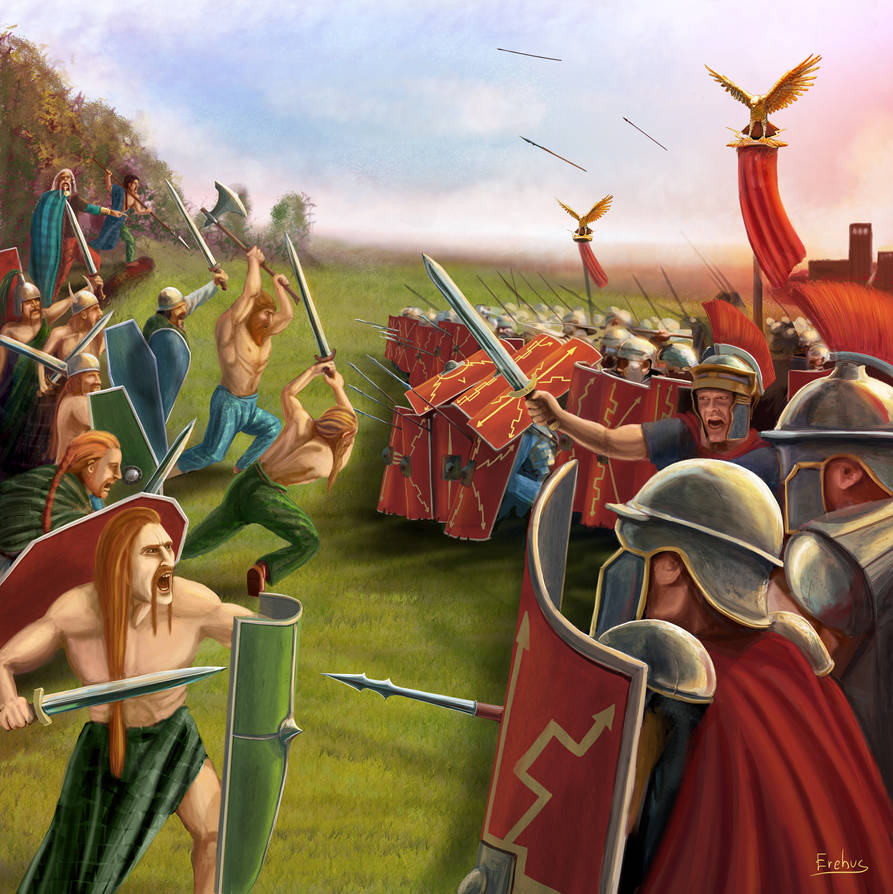
A metal-working site uncovered in Moray may have helped arm Caledonian tribes against the Romans before being burned down by the invaders.
Archaeologists working near Elgin in Moray have uncovered what may be one of the most important Iron Age industrial sites yet found in Scotland — a substantial settlement where iron appears to have been produced on an unusually large scale.
Even more intriguing is the way the settlement seems to have ended.
The site at Lochinver Quarry, south-west of Elgin, appears to have been abandoned suddenly after buildings and industrial structures were burned. The destruction may date to the later first century AD, raising a fascinating possibility: was the settlement destroyed during the Roman campaigns of Agricola in northern Scotland?
The evidence does not yet prove that the Romans were responsible, but the timing makes the possibility worth examining.
A major Iron Age settlement
Archaeological investigations at Lochinver Quarry have been carried out over a number of years ahead of sand and gravel extraction.
The excavations have revealed activity extending across several prehistoric periods, but the later Iron Age remains are particularly significant.
Archaeologists uncovered:
- roundhouses and substantial timber buildings;
- palisaded enclosures;
- furnaces associated with iron smelting;
- hearths and working areas;
- charcoal-production pits;
- iron ore that had apparently been prepared for smelting;
- fragments of tuyères, the ceramic nozzles used to direct air from bellows into furnaces;
- slag and other waste produced during iron working;
- pottery, beads and other artefacts.
Two bronze cauldrons were also discovered, one placed inside the other and buried in a pit.
Together, these finds suggest that Lochinver was much more than a small farming settlement.
It appears to have been an important centre for the production and working of iron.
Iron production on an unusual scale
Iron was essential to Iron Age society.
It was used for agricultural implements, woodworking tools, fittings and weapons. Producing it required considerable skill and organisation.
Ore had first to be collected and prepared. Large amounts of charcoal were required to reach the temperatures needed inside the furnaces. Bellows supplied oxygen to the fire, while specialist metalworkers controlled the smelting process.
The amount of evidence found at Lochinver suggests that iron production there may have been taking place on a scale considerably greater than simply supplying one household.
The site has therefore been described as potentially one of the largest prehistoric iron-smelting complexes yet identified in Scotland.
That raises an obvious question.
Who was all this iron being produced for?
A settlement suddenly abandoned
Perhaps the most striking feature of Lochinver is the apparent sudden end of the settlement.
Buildings and industrial structures were burned.
Charcoal-production pits appear to have been abandoned while still containing their final loads.
Prepared iron ore seems to have been left waiting to be smelted.
In other words, normal activity appears to have stopped abruptly.
Dr Clive Waddington of Archaeological Research Services, which has been investigating the site, described the evidence as indicating that something happened which prevented activity from continuing.
Rather than slowly declining or being dismantled, the settlement appears to have suffered a catastrophic ending.
Enter Agricola
The possible date of this destruction makes the discovery particularly interesting for the history of Roman Scotland.
During the governorship of Gnaeus Julius Agricola, beginning around AD 77 or 78, Roman armies pushed steadily north through Britain.
Our main written source is Agricola’s son-in-law, the Roman historian Tacitus.
According to Tacitus, Agricola campaigned deep into northern Scotland before confronting a large Caledonian army at the Battle of Mons Graupius, probably in AD 83 or 84.
The exact location of the battle remains unknown.
Possible sites have been suggested across north-east Scotland, including locations in Aberdeenshire and further north.
Moray therefore lay within the wider region potentially affected by Roman campaigning.
Was Lochinver producing weapons?
One possibility suggested by the excavation is that iron production at Lochinver increased because communities in northern Scotland were preparing for conflict with Rome.
Iron could, of course, have been used for many peaceful purposes.
But during a military crisis, the ability to manufacture iron weapons and equipment would have been extremely important.
If Lochinver was supplying iron to local communities resisting the Roman advance, it would have represented a valuable strategic resource.
Destroying such a centre would have made military sense.
A Roman force attempting to prevent further resistance might deliberately destroy furnaces, workshops, supplies and settlements capable of supporting enemy forces.
Did the Romans burn Lochinver?
This is where caution is necessary.
There is currently no direct archaeological evidence proving that Roman soldiers destroyed Lochinver.
No Roman weapon has been discovered embedded in the destruction deposits.
There is no inscription identifying a Roman unit.
Nor is there an ancient written account describing an attack on this particular settlement.
Instead, the argument is circumstantial.
The evidence can be summarised as:
large-scale iron production + sudden burning and abandonment + a possible late first-century date + Roman military operations in northern Scotland at roughly the same time.
That makes Roman involvement possible — perhaps even plausible — but it remains a hypothesis.
Other explanations for the destruction cannot be ruled out.
What does Tacitus tell us?
Tacitus describes the campaign culminating at Mons Graupius as a major confrontation between Agricola’s army and a confederation of northern peoples.
After the Roman victory, Agricola’s forces moved through hostile territory before eventually withdrawing towards their winter quarters.
If Tacitus’ account broadly reflects what happened, Roman operations are unlikely to have consisted simply of one battle.
Armies required food and supplies and sought to prevent defeated opponents from regrouping.
Settlements, agricultural resources and manufacturing centres could therefore have been affected by the campaign.
Lochinver may offer archaeological evidence for this wider disruption.
Does Lochinver tell us where Mons Graupius was?
Not directly.
The discovery does not identify the battlefield of Mons Graupius.
Even if Roman involvement in the destruction of Lochinver could eventually be demonstrated, Agricola’s army could have operated over a large area before and after the battle.
Nevertheless, Lochinver may become an important piece in the much larger puzzle of Agricola’s campaigns.
One of the problems with studying the Roman advance into northern Scotland is that we possess an unusually detailed literary account in Tacitus but relatively little archaeological evidence that can be linked securely to individual events.
A settlement apparently destroyed at approximately the right time would therefore be highly significant.
Archaeology versus the written record
Lochinver also illustrates one of the most interesting problems in studying Roman Scotland.
Tacitus gives us a dramatic narrative of armies, speeches, battles and generals.
Archaeology shows something different: farms, settlements, workshops and ordinary communities living in the landscape through which those armies moved.
If the destruction at Lochinver was connected with Agricola’s campaigns, it would provide a rare glimpse of what Roman conquest may have meant for the people already living in northern Scotland.
Rather than simply lines moving across a campaign map, conquest could involve the destruction of homes, workshops, food supplies and economic resources.
A remarkable discovery
Whatever caused its destruction, Lochinver Quarry is already an important archaeological site.
Its extensive evidence for iron production offers new information about the economy, technology and organisation of communities in northern Scotland during the Iron Age.
The possibility that its final destruction coincided with Agricola’s invasion makes the discovery even more compelling.
Future radiocarbon dating and analysis of the finds may allow archaeologists to narrow the chronology further.
If the destruction can eventually be placed securely around AD 80–90, the connection with Agricola’s northern campaigns will become increasingly difficult to ignore.
For the moment, however, the most accurate conclusion is also the most intriguing:
Lochinver may preserve evidence for the violent impact of Rome’s invasion of northern Scotland — but the case remains unproven.
Further reading
BBC News:
Could Roman invasion explain destruction of Iron Age settlement?
https://www.bbc.com/news/articles/cw41ll3dw12o
Archaeological Research Services:
Lochinver Quarry archaeological investigations
https://archaeologicalresearchservices.com/projects/lochinver-quarry/
The Roman campaigns in northern Scotland are principally described by Tacitus in his Agricola, particularly the chapters describing the campaigns culminating in the Battle of Mons Graupius.

