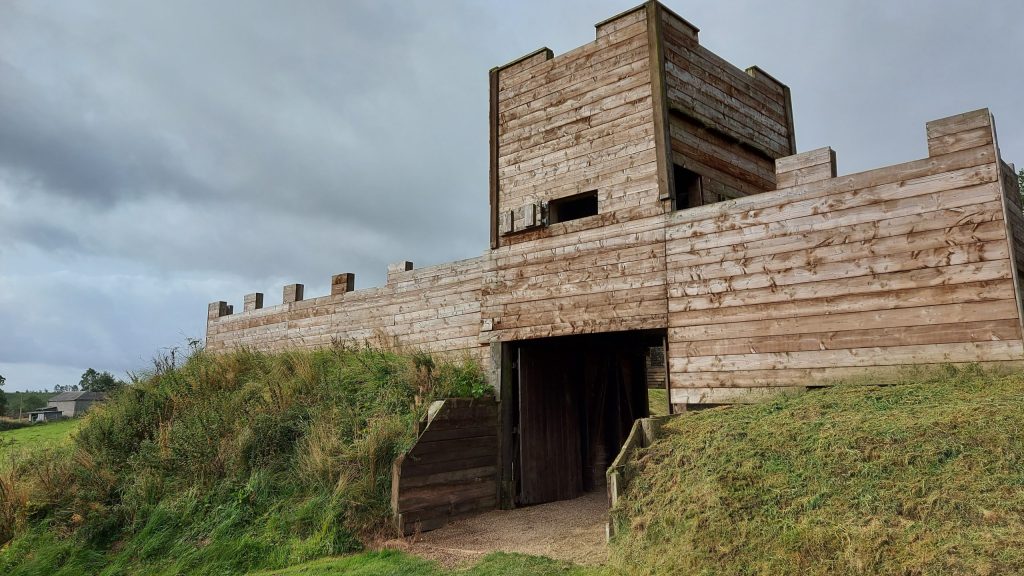
Visit Strageath Roman Fort
📍 Location: Strageath, Perthshire
👁 What survives: The fort platform and subtle earthworks survive in the landscape, while excavation has revealed several phases of occupation.
⭐ Best for: Seeing the setting of a repeatedly occupied Roman fort north of the Antonine Wall.
🥾 Visit: A rural site with uneven ground and subtle remains rather than standing masonry.
🏛 Nearby Roman places: Ardoch, the Gask Ridge and Dalginross
Strageath at a glance
| Occupation | A Flavian occupation and two major Antonine phases, separated by abandonment and rebuilding. |
| Garrison | The resident unit has not been securely identified in the evidence summarised here. |
| Size | Internal area not securely established in the sources summarised here; measurements of the fort, annexes and different phases should be kept separate. |
| Troop estimate | Barrack numbers and layouts changed between phases; they should not be combined into one headcount. |
- 80 AD Fort Built
- 87 AD fort evacuated
- 142 AD fort reoccupied
- 155 AD abandoned again
- 158 AD fort reoccupied
- 164 AD abandoned again
The Roman fort at Strageath was an important outpost fort located north of the Antonine Wall system. It is notable both for its complex structural history and the rich artefact assemblage recovered from it.

Occupational History and Layout
The fort experienced multiple phases of occupation, spanning both the Flavian and Antonine periods:
Flavian Occupation
During the initial Flavian occupation, the timber buildings were constructed using a continuous-trench technique. The fort’s layout was meticulously planned using standard Roman measurements (*pedes Monetales*), and the shape of its *principia* (headquarters building) was designed to mirror the overall shape of the fort. Excavators also found evidence of an early granary, suggesting it was used to supply troops who lived in tents inside the fort while they constructed its ramparts and gates.
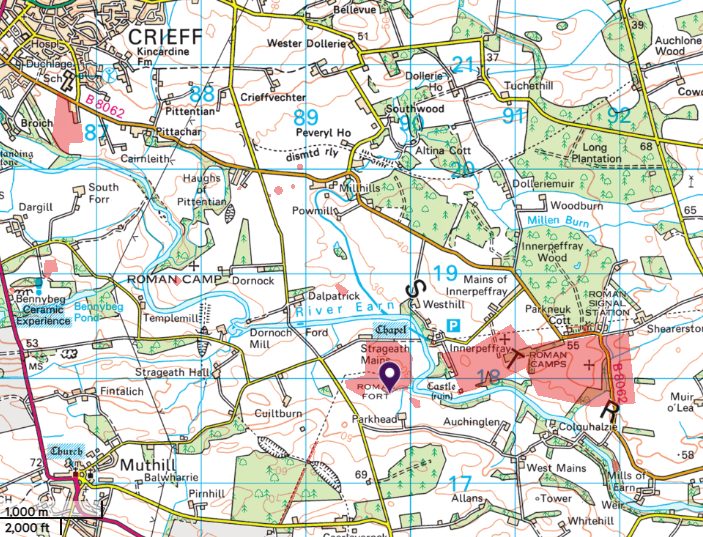
Two Antonine Occupations
Strageath is above average in size, featured a large annexe and strong defences, and is one of the few sites in Scotland to provide unequivocal evidence of two distinct phases of Antonine occupation (Antonine I and II) . During the Antonine periods, the fort’s timber buildings were erected using post-hole construction rather than trenches. At the end of the first Antonine period, the fort was completely replanned. As part of this reconstruction, the rampart was considerably enlarged, and the number of barrack buildings increased from eight to twelve. This enlargement of the garrison might have served as a counterpoint to the reduction of garrison sizes in the primary forts along the Antonine Wall itself.
Unlike some other forts, there is a complete lack of evidence for stone construction in Strageath’s central range, indicating that the fort remained a timber-built installation throughout its history.
Significant Finds and Artefacts
While many Scottish forts suffer from a dearth of small finds, Strageath produced a remarkably large assemblage of artefacts.
Military and Exotic Artefacts: The collection shows a distinct bias toward exotic items, most notably decorative griffin mounts. It also features a heavy preponderance of weaponry, producing a significant number of spears.
Julia lived here
An Antonine I demolition layer in Building XI yielded a Dressel 20 amphora rim inscribed with the female name “IVLIA”, an incredibly rare find, as women’s names rarely appear on such transport vessels. A hexagonal glass bottle fragment was recovered from an Antonine context at the site.
See an artist’s impression of the Julia script here https://romaninscriptionsofbritain.org/inscriptions/2494.135
Inscriptions
The graffito IVLIA on an amphora rim (RIB 2494.135) records a woman’s name. It is personal evidence, not the title of a military unit.
References
- Strageath Roman Fort (Trove NRHE)
- Strageath inscription finds ( mostly pottery) Roman Inscriptions of Britain
- Recent finds from Strageath Roman fort (The Tayside and Fife Archaeological Committee) 2021

