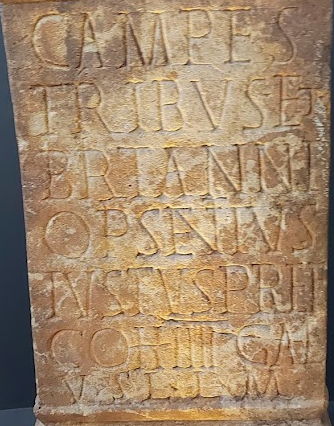
This person served at Castlehill Roman Fort, north of Glasgow. The family name Pisentius is rare but clusters strongly in central Italy (Etruria/Umbria), with attestations at Rome (Praetorians). It is likely that this person came from the Pisa area of Italy
Here are attested epigraphic occurrences of the nomen Pisentius (masc.)—grouped by province/region and keyed to standard refs:
- Britannia (Scotland, Antonine Wall – Castlehill)
- Q(uintus) Pisentius Iustus, eques, praef. coh. IV Gallorum; votive altar “Campestr(ibus) et Britanniae.” Mid–2nd c. (c. 139–161). RIB 2195; EDH HD071321. romaninscriptionsofbritain.org+1
- Urbs (Rome, Italia)
- C(aius) Pisentius Sabinus, C. f., Arretinus, miles cohors VI praetoria, century of Marcus; funerary slab set up by his brothers C. Pisentius Iustus and C. Pisentius Probus (both named in the text). Imperial period (likely 2nd c.). Kelsey Museum/USEP MI.AA.UM.KM.L.1519. usepigraphy.brown.edu+2usepigraphy.brown.edu+2
- Umbria (Montefalco/Mevania, Italia)
- C. Pisentius L. f., sexvir (municipal magistrate); now-lost stone. Augustan date (27 BC–AD 14). CIL XI 5052. keytoumbria.com
- Etruria – Clusium/Chiusi (Italia)
- Multiple inscriptions of the gens Pisentius: CIL XI 2236, 2237, 2392, 2393, 2406, and a later Christian piece CIL XI 2557 (Catacombs of S. Mustiola), showing the name’s persistence into Late Antiquity. (Synthesis by the École française de Rome.) OpenEdition Books
- Umbria – Iguvium/Gubbio (Italia)
- Pisentius attested in CIL XI 5886 (and related Umbrian pieces noted in scholarship). Dokumen
References

