Two thousand years ago, could you take home a souvenir of Hadrian’s Wall? A handful of small bronze cups and pans suggest that some Romans did something remarkably similar. Decorated with bright enamel, miniature towers and the names of frontier forts, they are also unexpectedly useful historical documents.
These vessels were found not just near the Wall, but as far away as France and Spain. A new study published in Britannia in April 2026 introduced the Berlanga Cup, adding important new evidence from the eastern part of the frontier. The objects are often called “souvenirs”, but their exact purpose remains uncertain.
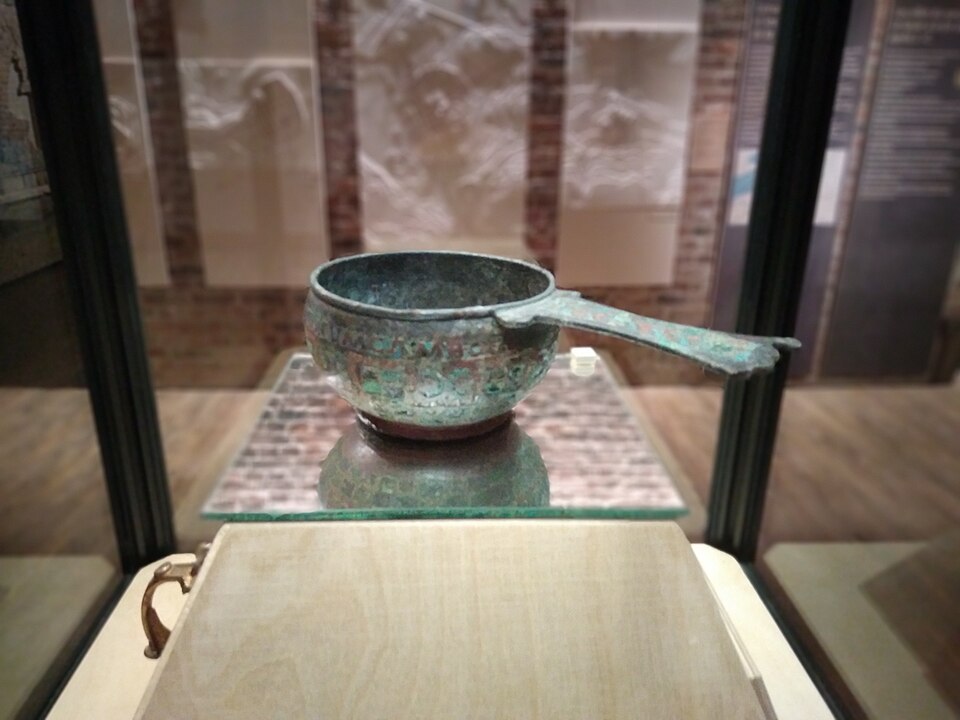
A tiny picture of Hadrian’s Wall
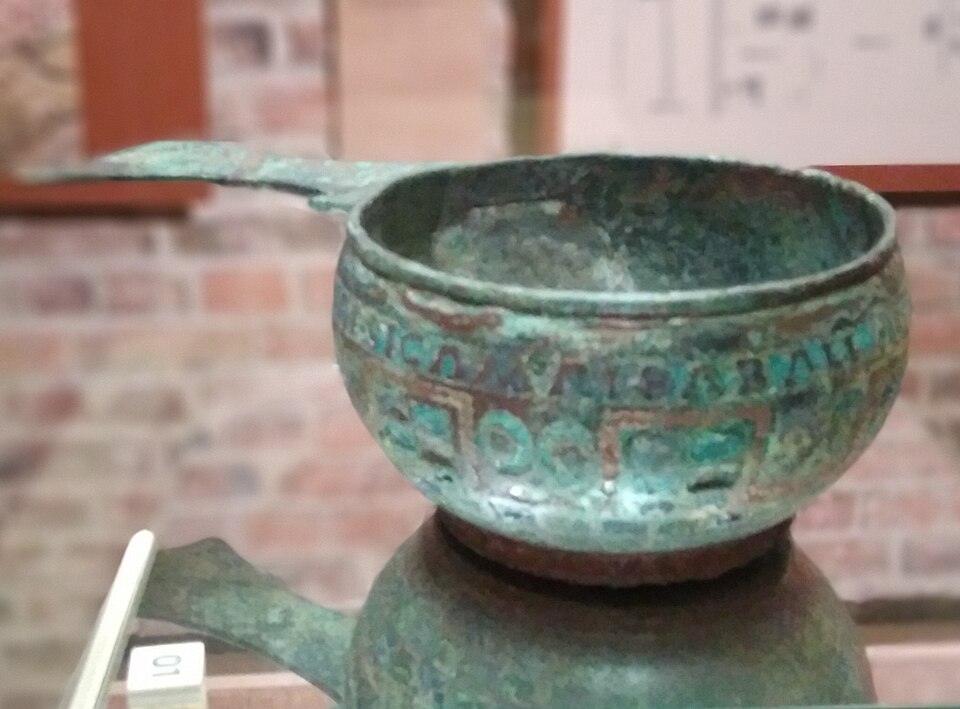
Most of the vessels are made of copper alloy with coloured enamel set into recesses in the metal. A band of crenellations and squares resembles a defended wall, with towers rising above courses of masonry. The design is stylised, not a literal architectural plan. On several examples, the names of forts run around the rim.
This matters because much of our knowledge of Roman place-names on the Wall comes from texts copied centuries after the soldiers lived there. These second-century objects provide independent, more nearly contemporary evidence for some of the names.
The Amiens Skillet: six forts on one vessel
The Amiens Skillet, or Amiens patera, was unearthed in 1949 in a Gallo-Roman building at Amiens in northern France, ancient Samarobriva. It is now held by the Musée de Picardie (inventory MPD 3984). The museum dates it to the second half of the second century AD. Its bowl is roughly 10 cm across, with a surviving handle about 9 cm long.
Around its rim it names Mais (Bowness-on-Solway), Aballava (Burgh by Sands), Uxelodunum (Stanwix), Camboglanna (Castlesteads), Banna (Birdoswald) and Aesica (Great Chesters). Some letters and spellings differ from modern conventional forms. These are all forts in the western and central-western stretches of Hadrian’s Wall.
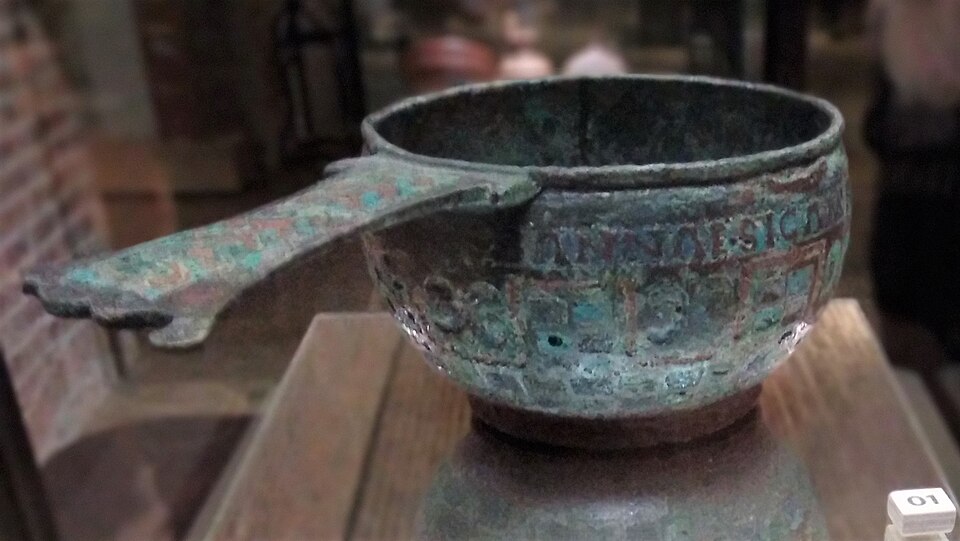
The discovery was remarkable: the skillet looks closely related to the Rudge Cup found in Wiltshire in 1725, yet it had travelled to the other side of the English Channel. Was it carried home by a soldier, given as a gift, or acquired by someone proud of a connection with the northern frontier? We do not know.
The other Hadrian’s Wall vessels
- Rudge Cup (Wiltshire, discovered 1725). A small enamelled bronze cup bearing five fort names: Mais, Aballava, Uxelodunum, Camboglanna and Banna. It is associated with Alnwick Castle. See its inscription and drawings in Roman Inscriptions of Britain.
- Ilam Pan / Staffordshire Moorlands Pan (Staffordshire, discovered 2003). A particularly colourful vessel now in the British Museum, with Mais, Coggabata, Uxelodunum and Camboglanna. It also bears the intriguing words RIGORE VALLI AELI DRACONIS, whose precise interpretation remains debated. View the British Museum record and photographs.
- Bath Pan (Bath, discovered 1980). It has wall-like decoration but no list of fort names. A later inscription on the handle appears to relate to Sulis Minerva at Bath.
- Basildon fragment (Essex). A small surviving portion associated with the same class of decorated vessels; too little survives to reconstruct a full pan or route.
- Hildburgh fragment (Spain). Named for the collector who acquired it, rather than a secure excavation findspot. It is reportedly from the León–Zamora region and shares features with other vessels in the group.
- Berlanga Cup (Berlanga de Duero, Spain; published 2026). A newly studied, incomplete enamelled cup now at the Museo Numantino in Soria. For the first time in the series, it names forts on the eastern stretch of Hadrian’s Wall.
What the Berlanga Cup changes
In April 2026, Roberto De Pablo Martínez and colleagues published a detailed study of the Berlanga Cup in the journal Britannia. Its surviving inscription is read as references to Cilurnum (Chesters), Onno (Halton Chesters), Vindobala (Rudchester) and Condercom (Benwell). The first and third names are partly reconstructed from damaged text, while Onno and Condercom are preserved more fully.
Earlier scholars sometimes imagined a matching set of cups covering different sections of the Wall. The Berlanga researchers argue against that: the surviving vessels vary in their shape, decoration and selection of forts. They suggest that specialist metalworkers may have finished individual vessels to order, perhaps for soldiers or others associated with the frontier. That is a plausible interpretation, not proof of a Roman souvenir trade.
The finds in France and Spain also raise questions about the movement of people, possessions and memories across the empire. The researchers discuss a possible connection between Berlanga and cohors I Celtiberorum, a military unit with links to both Iberia and Britain. The identification of any individual owner remains speculative.
What does this tell us about Roman Scotland?
Hadrian’s Wall lies south of modern Scotland, while the later Antonine Wall ran between the Forth and Clyde. Both were part of Rome’s changing northern frontier. The painted and enamelled imagery of forts on these tiny vessels makes an interesting comparison with Scotland’s carved Antonine Wall distance slabs, which commemorated construction work and military achievement on a much grander scale.
The contrast is revealing: a stone distance slab was intended to be seen in place, while a cup could travel far from the frontier. Both could communicate something about the Wall, the army and those associated with it.
See the objects and read the evidence
- Musée de Picardie: Amiens Patera — the museum catalogue, dimensions and fort inscription.
- Wikimedia Commons: Amiens Patera photographs — seven photographs with image-specific reuse licences.
- De Pablo Martínez and colleagues (2026), “The Berlanga Cup”, Britannia — open-access research, artefact photographs and reconstructions.
- Roman Inscriptions of Britain: Rudge Cup — original text, commentary and illustrations.
- British Museum: Staffordshire Moorlands Pan — photographs and catalogue entry.
- Current Archaeology (June 2026): an illustrated introduction to the group.
Image credits: The three Amiens photographs in this article were taken by Bycro at the Musée de Picardie and are reproduced from Wikimedia Commons under Creative Commons Attribution–ShareAlike 4.0. They have been resized for web display. Follow the individual image links in each caption to view the source photographs and licence details.


