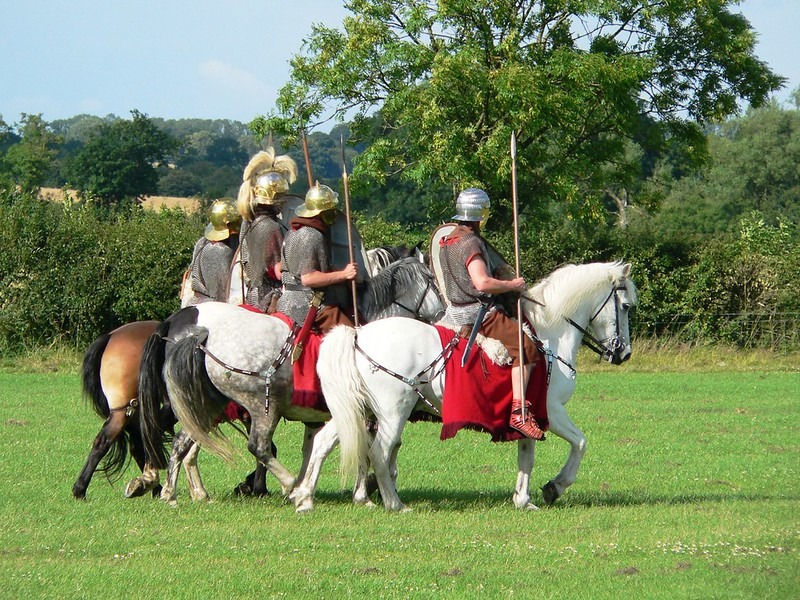
For around twenty years the northern frontier of the Roman Empire ran across central Scotland along the Antonine Wall. Then, during the late 150s and early 160s, the Roman army began moving south.
This was not the end of Rome’s involvement in Scotland. Over the next fifty years, the frontier remained volatile. Hadrian’s Wall was rebuilt, Roman troops continued to operate north of it, northern peoples attacked the Roman province, Roman governors fought campaigns and negotiated treaties, and money probably crossed the frontier as payments to maintain peace.
By AD 208 the situation had deteriorated sufficiently for the emperor Septimius Severus himself to arrive in Britain with a huge army and the imperial family.
AD 158–165: abandoning the Antonine Wall
The decision to give up the Antonine Wall appears to have been taken by AD 158.
One of the most important pieces of evidence is an inscription, RIB 1389, recording building work on Hadrian’s Wall in AD 158. Modern research by Nick Hodgson has argued that this rebuilding is best understood as preparation for the Roman army’s permanent return to the southern frontier.
The evacuation was probably not a single dramatic march south. Instead it seems to have been a controlled and phased withdrawal. Buildings at some Antonine forts were dismantled, equipment was removed, and accommodation further south had to be made ready. At Bearsden, for example, buildings were demolished and burnt, and the defences slighted.
Current scholarship therefore places the beginning of the withdrawal around AD 158, with the process largely completed during the early-to-mid 160s. The traditional date of about AD 165 remains a useful date for the end of permanent Roman occupation of the Antonine frontier.
Hadrian’s Wall once again became Rome’s principal northern frontier.
But Rome did not completely leave Scotland
The withdrawal from the Antonine Wall should not be imagined as Romans disappearing behind Hadrian’s Wall and closing the gate.
Roman military activity continued north of the frontier. Forts such as Birrens and Newstead could function as forward positions, although the extent and duration of occupation varied. Hadrian’s Wall itself was refurbished and a new road, the Military Way, helped connect its forts and installations.
Even more importantly, Roman goods continued to reach communities in southern Scotland.
Archaeological evidence suggests a periodic rather than continuous relationship with Rome. Roman objects occur on indigenous settlements, especially at major centres such as Traprain Law. Southern Scotland may increasingly have operated as a buffer between the Roman province and peoples further north.
That relationship could involve trade, diplomacy, gifts — and sometimes violence.
The early 160s: trouble on the frontier
The withdrawal itself may have taken place against a background of unrest.
During the reign of Marcus Aurelius, the governor Sextus Calpurnius Agricola was sent to Britain. The Historia Augusta says that Britain was suffering from what it calls dangerous insurrections.
Unfortunately, the ancient sources provide almost no details. We do not know precisely who was fighting the Romans or where the campaigning took place.
It does, however, reinforce the impression that the return to Hadrian’s Wall was taking place at a time when Rome was reassessing how best to control northern Britain.
AD 165–180: plague across the Empire
At roughly the same time, the Roman Empire was struck by the Antonine Plague, beginning around AD 165 and recurring for many years.
It probably placed significant pressure on the Empire’s population, economy and army. However, the evidence for its direct effects in Britain — and particularly Scotland — is limited, so it would be unsafe to say that the plague itself caused the abandonment of the Antonine Wall.
Read more about the Antonine Plague
AD 181–184: the northern frontier is broken
The clearest evidence of serious warfare comes early in the reign of Commodus.
Cassius Dio describes what he regarded as Commodus’s most dangerous war. Northern peoples crossed the wall separating them from the Roman army, caused widespread destruction and killed a Roman general together with his troops.
Because the Antonine Wall had already been abandoned, the wall mentioned by Dio is now generally understood to have been Hadrian’s Wall.
The emperor sent Ulpius Marcellus to restore the situation. Fighting probably continued for several years before Roman control was re-established. Commodus celebrated victory and assumed the title Britannicus in AD 184.
Read the story – 181 to 184 AD Disturbances from Scotland
AD 185–187: Rome’s own soldiers rebel
The northern tribes were not Rome’s only problem.
The army in Britain itself became increasingly politically troublesome. In AD 185, the future emperor Pertinax was sent to Britain to restore discipline.
According to his ancient biography, soldiers rebelled against him. Pertinax was attacked so severely that he was left for dead among the casualties. He survived and suppressed the mutiny, but eventually asked to leave Britain because of the hostility of the legions.
This matters because the enormous Roman garrison required to defend Britain could itself become a threat to an emperor.
That problem would explode a few years later.
AD 193–197: Britain becomes involved in Roman civil war
Commodus was murdered at the end of AD 192. The following year became one of the great struggles for the Roman throne.
One of the contenders was Clodius Albinus, governor of Britain and commander of its three legions.
Initially, Septimius Severus recognised Albinus as Caesar while Severus dealt with his rival Pescennius Niger in the east. Once Niger had been defeated, Severus and Albinus became enemies.
Albinus took substantial numbers of troops from Britain to the Continent to support his claim to the throne.
In AD 197, the armies of Albinus and Severus fought an enormous battle outside Lugdunum — modern Lyon. Albinus was defeated and killed.
Britain’s northern frontier had once again been weakened by events hundreds of miles away.
AD 197: Rome pays the Maeatae for peace
What happened next provides one of our clearest glimpses of relations between Rome and the peoples of Scotland.
The new governor of Britain, Virius Lupus, faced trouble from two groups whom Cassius Dio calls the Maeatae and the Caledonians.
Dio says that the Caledonians had failed to keep earlier agreements and were preparing to assist the Maeatae. Lupus apparently did not have sufficient military strength to resolve the situation by force.
Instead, he paid the Maeatae a large sum of money for peace and received some captives in return.
This is particularly important because Roman silver found in Scotland has long raised the possibility that Rome used payments, gifts and subsidies to influence northern elites.
The archaeological evidence does not allow every hoard to be labelled a Roman bribe. Some may have been military money, savings or deposits for other reasons. Nevertheless, payments such as the one recorded in AD 197 provide a historical mechanism by which large quantities of Roman silver could reach communities beyond the frontier.
See the distribution of finds here:
The Caledonians and Maeatae emerge
By the beginning of the third century our Roman sources describe northern Britain differently from those writing in Agricola’s time.
Names such as the Caledonians and Maeatae become increasingly important. Cassius Dio says that the names of many other peoples had effectively become associated with these two major groupings.
The Maeatae seem to have occupied territory closer to the Roman frontier, while the Caledonians were farther north. Exactly what these names represented — individual tribes, political alliances or broader confederations — remains debated.
Read about the Caledonian Maeatae Versus Septimius Severus
The development of these larger groupings may itself have been one consequence of more than a century of Roman military and diplomatic intervention in Scotland.
AD 205–207: the frontier deteriorates again
By the governorship of Lucius Alfenus Senecio, there was renewed concern about northern Britain.
A substantial programme of reconstruction took place along Hadrian’s Wall. Defences and buildings were repaired at several forts, including Birdoswald, Chesters and Housesteads.
The literary evidence also points towards continuing conflict. Herodian later claimed that the governor reported that northern peoples were rebelling, raiding Roman territory and carrying off booty.
Whatever the precise circumstances, by AD 207–208 Rome clearly regarded the northern frontier as a serious military problem.
This time the emperor would not leave the fighting entirely to a provincial governor.
AD 208: Septimius Severus comes to Britain
In AD 208, Septimius Severus travelled to Britain accompanied by his sons Caracalla and Geta, his wife Julia Domna, the imperial court and a huge military force.
For the next three years the effective centre of the Roman Empire moved to York.
The emperor intended not merely to defend Hadrian’s Wall but to carry Roman armies deep into Scotland once again.
After almost fifty years during which Rome had tried retreat, frontier defence, diplomacy, payments and limited military intervention, another emperor was preparing to attempt what Agricola and Antoninus Pius had failed to achieve:
the conquest of northern Britain.
Continue the story:
Septimius Severus – the AD 208 invasion of Scotland

