A Roman soldier in Scotland could not rely on a permanent kitchen at the end of a day’s march. Grain was an essential part of the army’s food supply, and soldiers needed ways to turn it into something edible. Excavations at temporary camps reveal one practical answer: small field ovens, often recognisable today as a pair of joined pits.
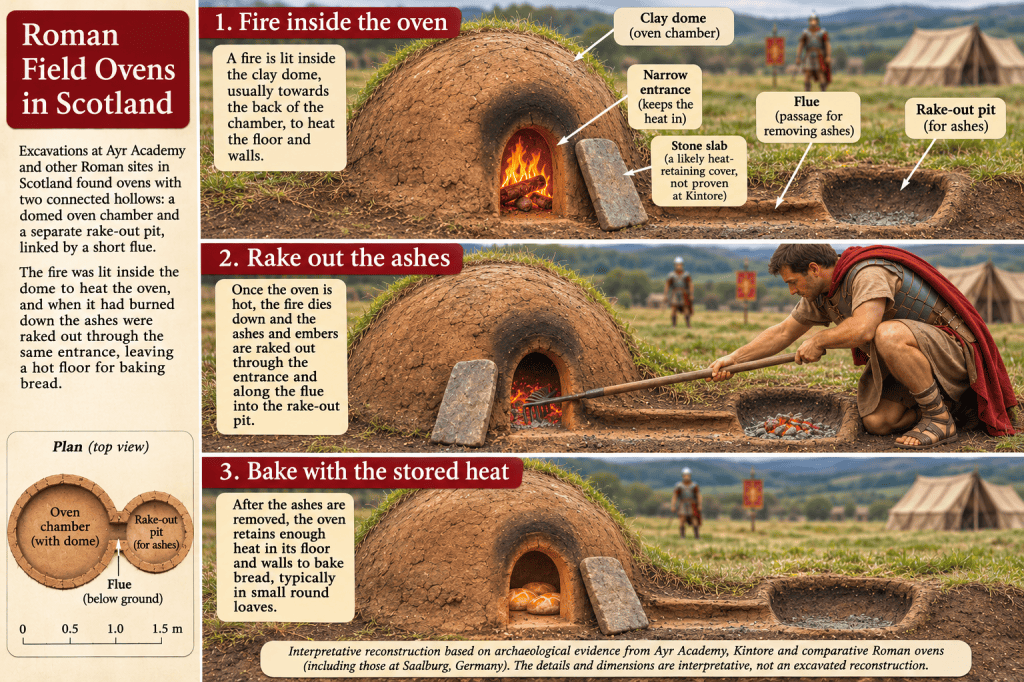
Comparison with Saalburg: The reconstructed ovens at the Roman fort of Saalburg in Germany have rounded heat-retaining domes, narrow arched doorways, soot around the mouths and substantial stone foundations. A visitor photograph of the two ovens provides a useful visual comparison for the possible above-ground shape of military baking ovens. These are permanent reconstructed fort installations, however, not excavated examples of the temporary camp ovens at Ayr; the stone bases, doors and exact proportions must not be assumed for Scotland. The illustration above combines the Saalburg dome concept with Ayr’s archaeological evidence for a separate ash-rake-out pit.
What did a Roman field oven look like?
The most characteristic remains are bipartite features: two connected hollows, sometimes described as dumbbell- or figure-of-eight-shaped in plan. The surviving archaeological evidence may include reddened or scorched soil, charcoal, ash, stone slabs and fragments of baked clay. These tell us where fires burned, even when little remains of anything above ground.
The two parts were not necessarily two places where food was cooked. At Ayr, the scorched oven floor marked the chamber in which the fire had burned; the adjoining rake-out pit contained burnt soil, charcoal and ash cleared from the oven, apparently through the connecting neck or passage. Some ovens had stone slabs, while fragments of fired clay with wood impressions and dome moulding indicate a clay superstructure over at least some examples. Not every oven was identical: their dimensions, construction and preservation varied.
How was bread prepared?
A plausible sequence begins well before the fire is lit. The soldiers would first have to obtain grain, grind it into meal or flour using a quern, mix it with water to make dough and shape it into loaves or flat rounds. The clay-covered oven chamber was then heated by a fire on its floor. Once it was hot, the fire debris could be raked out through the connecting opening into the adjoining ash pit, leaving a heated surface on which the dough could be baked using retained heat. The ash pit was therefore a disposal and working area, not a separate hearth for a second fire.
This sequence follows the interpretation of the Ayr ovens, where the excavation distinguishes fire-reddened oven bases from the rake-out deposits. The principle is familiar from some traditional Italian wood-fired bread and pizza ovens: light the fire inside the oven, allow the masonry or clay to absorb heat, and move the fire debris away before baking on the hot floor. This is a practical comparison, not evidence that Roman field ovens had the exact same construction or baking method as a modern pizza oven. A fire towards the back of the domed chamber and a comparatively narrow opening are plausible ways to heat the oven while reducing heat loss, as in some traditional wood-fired ovens. However, the Ayr excavations do not establish the fire’s exact position or the original width of the entrance. The connecting opening is an interpretation of the surviving double features; the height of the dome and how loaves were placed inside are not directly preserved.
Kintore: evidence on an extraordinary scale
The strongest Scottish evidence comes from the temporary camp at Kintore, near Inverurie in Aberdeenshire. Extensive excavations between 2000 and 2006 identified around 180 two-part features interpreted as field ovens, as well as at least 60 rubbish pits. Their variety in construction, size, alignment and fuel use is striking.
Some had been fired repeatedly. That is useful evidence that activity in the camp lasted longer than a single overnight halt, although it does not establish the precise length of one stay or rule out multiple episodes of occupation. Kintore shows that a so-called temporary camp could have a substantial and organised food-preparation operation. See the Scottish Archaeological Research Framework’s Kintore case study.
Ayr: oven chamber, ash pit and clay dome
At the site of Ayr Academy, excavations identified 26 fire-pit features arranged in two parallel rows approximately 30 metres apart. Many had two connected parts. The oven area could be identified through scorched natural soil, stone slabs and burnt clay, while the ash pit at the opposite end contained charcoal-rich material raked out from the baking chamber. In the published supplementary catalogue, for instance, context 128 had a burnt base while adjoining context 126 contained rake-out deposits; a stone lining was recorded in fire-pit 582. Some fired-clay fragments bear impressions of timber and curved moulding, consistent with a clay-domed covering. This is stronger evidence for a specific construction and working method than a simple figure-of-eight plan alone.
GUARD Archaeology interprets the ovens as facilities for baking bread rather than drying grain. Archaeobotanical analysis also contributed evidence about fuel and plants. The radiocarbon results have a broad range with overlap in the Flavian period, consistent with a later first-century interpretation but not proof of a particular campaign or Agricola’s presence. The excavators’ illustrated explanation includes a photograph captioned ‘Stone-lined oven and rake-out material at Ayr Academy’; readers can compare it with the reconstruction above. See Arabaolaza, ‘A Roman Marching Camp in Ayr’ and its supplementary catalogue of the features.
Haughend, near Alyth: nearly twenty more ovens
A 2021 excavation at Alyth Substation, Haughend, Perth and Kinross, found an early Roman ditch possibly belonging to a temporary camp, associated with nearly twenty field ovens. The excavators consider an association with the late-first-century Roman campaigns likely, though the precise historical attribution remains an interpretation.
Particularly helpful are the photographs of partially excavated ovens published by CFA Archaeology. They show the archaeological features themselves rather than a modern reconstruction. The accompanying open-access excavation report by Magnus Kirby and colleagues (2023) gives the detailed evidence.
What did the soldiers cook?
Bread or other baked cereal foods are the clearest likely products of the field ovens. Wheat and barley were important to Roman military provisioning, and the combination of ovens, querns and grain supplies makes baking a reasonable interpretation. We should not assume, however, that every field oven produced a standard wheat loaf, or that a particular excavated pit can be matched to a known recipe.
Soldiers also consumed grain-based dishes such as porridge or puls, and they could boil vegetables, pulses and meat in cooking vessels over fires. These foods belong to the wider story of camp cooking, rather than being securely demonstrated as products of the two-part baking ovens. For more about the diet, see Food & Drink in Roman Scotland and Cooking.
Why do the ovens matter?
On aerial photographs, a marching camp may be little more than the shadow of its perimeter ditch. An excavated oven tells another story. Soldiers had to carry or obtain fuel, process grain, prepare meals, dispose of ash and repeat the process whenever the army remained in place. At some sites the ovens are among the few surviving traces of what actually happened inside the camp.
The field ovens also warn against assuming that every temporary camp was occupied for only one night. Kintore’s repeated firings provide clear evidence of sustained or repeated activity. Read more about life inside a Roman marching camp and the Roman camps of Scotland.
What remains uncertain?
Excavation records the parts that survive: cuts in the ground, burning, ashes, stones and sometimes fragments of clay structure. The complete oven, its roof height, the detailed form of the passage to the ash rake-out pit, how bread was inserted and the number of soldiers using each installation are often reconstructions rather than directly observed facts. Some features initially thought to be Roman have subsequently been dated to other periods, so their identification must rest on context and scientific dating as well as shape.
Sources and further reading
- Cook, M. and Dunbar, L. (2008), Rituals, Roundhouses and Romans: Excavations at Kintore, Aberdeenshire 2000–2006. Society of Antiquaries of Scotland.
- Scottish Archaeological Research Framework, “Case Study: Kintore Roman Camp”.
- Arabaolaza, I. (2019), “A Roman Marching Camp in Ayr”, Britannia 50, 330–349.
- Kirby, M., with contributions by D. Alldritt, A. Boyle and A. Clarke (2023), “A rectilinear post-built structure, Roman field ovens and prehistoric settlement at Alyth Substation, Haughend, Perth and Kinross”, Tayside and Fife Archaeological Journal 29, 31–58.
- GUARD Archaeology, “New Evidence for Roman Conquest of Scotland” (photograph and excavator’s explanation of the Ayr oven and rake-out material).
- Arabaolaza (2019), online supplementary catalogue (individual oven bases, ash deposits, burnt clay and dating evidence).

