Just west of the Aberdeenshire town of Kintore, beneath fields, roads and modern development, lie the remains of one of the most revealing Roman temporary camps excavated in Britain. The site is known as Deer’s Den. From the surface there is little to suggest the presence of an army, but archaeology has uncovered the places where Roman soldiers baked food, disposed of rubbish and lived during a campaign.
Kintore matters because so much of the inside of the camp has been investigated. We know the outlines of many Roman camps from aerial photographs, but their interiors are usually much harder to examine. At Deer’s Den the evidence provides an unusually close view of army life.
A large camp beside the Don
The camp lay near the River Don, on the western side of Kintore. Early surveys recorded an enclosure of about 110 acres (44 hectares); some later accounts describe it as roughly 120 acres (49 hectares). These are differing estimates for a large camp, not proof of two separate enclosures. Its defensive ditch and rampart once surrounded an area big enough for a substantial campaigning force, although the area alone cannot tell us precisely how many soldiers were present.
The earthworks had already suffered extensive damage by the nineteenth century. Much of the layout was subsequently traced from aerial cropmarks, which reveal buried ditches even where nothing can be seen on the ground. Excavations associated with the A96 bypass, housing and school construction then provided a rare chance to examine its defences and interior.
View the approximate camp location on OpenStreetMap. This is a location marker, not a surveyed outline of the Roman defences.
The ovens: evidence of an army at work
The most striking discoveries were about 180 two-part features interpreted as Roman field ovens, together with at least 60 rubbish pits. Many of the ovens had a firing area and a chamber associated with baking. They varied in size, orientation, construction and the fuel used. Those differences may reflect the ground conditions and varying states of preservation, but perhaps also the habits of different groups of soldiers.
An army needed to do much more than march and fight. Grain had to be processed, meals prepared, equipment maintained and refuse cleared away. At Kintore those everyday tasks left a remarkable archaeological record. The ovens bring us closer to the soldiers’ daily routines than the outline of a ditch ever could.
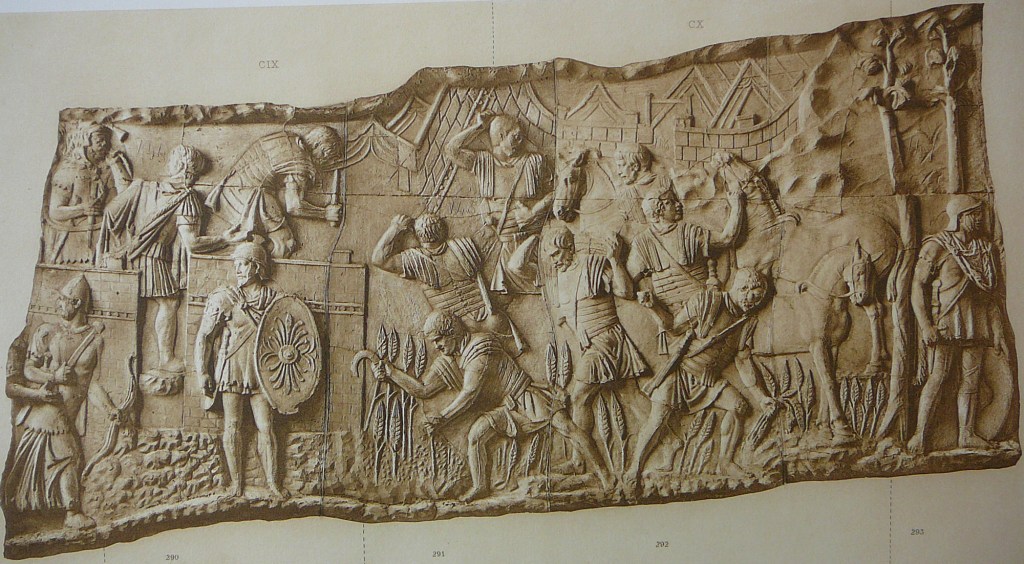
Repeated use of some ovens shows why a temporary camp need not be a one-night halt. In the lecture’s discussion of Kintore and Milltimber, Jones considers four to six firing episodes and an illustrative stay of roughly one to six weeks, depending on how often baking took place. This is an estimate based on activity, not a measured duration for the whole camp, and rebuilding or separate visits complicate the picture. See Rebecca Jones, Roman Camps in Scotland, Callander’s Landscape (57:06 onwards).
Gateways and defences
The camp had a substantial perimeter ditch. The northern and western sides have both been investigated, and evidence has been recorded for entrances protected by a titulus — a short detached stretch of ditch and bank placed in front of a gateway. Anyone approaching the opening would have to turn around the obstruction instead of heading directly through it.
Such arrangements help archaeologists recognise Roman temporary camps even when much of the rampart is gone. Kintore belongs in a catalogue of camps with titulus gateways. The published evidence should not, however, be stretched into a confident claim about the total number of entrances. Nor is there secure evidence here for a clavicula gateway.
Read more about tituli and claviculae in Roman camp gateways.
When was the camp occupied?
Excavation and the substantial radiocarbon programme support late-first-century, broadly Flavian activity at Kintore. This is stronger evidence than the older attribution of the camp to Severus based on its size. It does not fix the occupation to a particular year or identify Agricola personally as the commander.
Jones uses Kintore as an important comparison for the large northern camps, including Normandykes, Ythan Wells I and Muiryfold. Logie Durno also belongs in the discussion of northern campaigning, but is substantially larger and should not be labelled a 110-acre camp. These comparisons support proposed Flavian dates; they do not transfer Kintore’s radiocarbon results to every enclosure. See Rebecca Jones, Roman Camps in Scotland, Callander’s Landscape (37:39 onwards).
A landscape with a much longer history
The Romans did not arrive in an empty landscape. Archaeologists also recorded prehistoric pits and roundhouses, including remains of Iron Age settlement. Sorting features of different periods has been central to interpreting the site. The discoveries are a reminder that even a seemingly straightforward Roman camp can overlie centuries of earlier occupation.
Why Kintore changes the picture
The layout of a camp tells us how an army defended itself. Kintore offers something different: evidence of what happened after the perimeter was dug. Its ovens and pits show soldiers cooking, using resources and managing waste. Repeated firing makes it difficult to treat every temporary camp as a one-night halt. Most importantly, Kintore shows how much information may remain inside other Scottish camps that have so far been studied mainly from the air.
It is worth comparing Kintore with Dunning, where there is evidence for a second period of use, and with the wider discussion of Roman camps in Scotland. For a reconstruction of camp organisation and everyday routines, see Inside a Roman marching camp.
Ovens across the interior
The excavated ovens were distributed through the camp interior, rather than confined to a neat line behind the rampart. The familiar reconstruction of a uniformly organised Roman camp needs to accommodate this evidence. Jones compares Kintore with other camp interiors in Rebecca Jones, Roman Camps in Scotland, Callander’s Landscape (16:07 onwards).
The lecture provides an accessible companion to Cook and Dunbar’s excavation monograph. The distinction between dated activity, a reconstructed camp plan and an estimate of the length of a stay remains essential.
Sources and further reading
Scottish Archaeological Research Framework, “Case Study: Kintore Roman Camp” — a useful summary of the excavations and their significance.
Trove / National Record of the Historic Environment, Kintore (18584) — the national site record, including earlier surveys and subsequent investigations.
Alexander, D. (2002), “Excavation of Neolithic pits, later prehistoric structures and a Roman temporary camp along the line of A96 Kintore and Blackburn Bypass, Aberdeenshire”, Proceedings of the Society of Antiquaries of Scotland, 130, 11–75.
Cook, M. and Dunbar, L. (2008), Rituals, Roundhouses and Romans: Excavations at Kintore, Aberdeenshire 2000–2006. Major excavation monograph.


