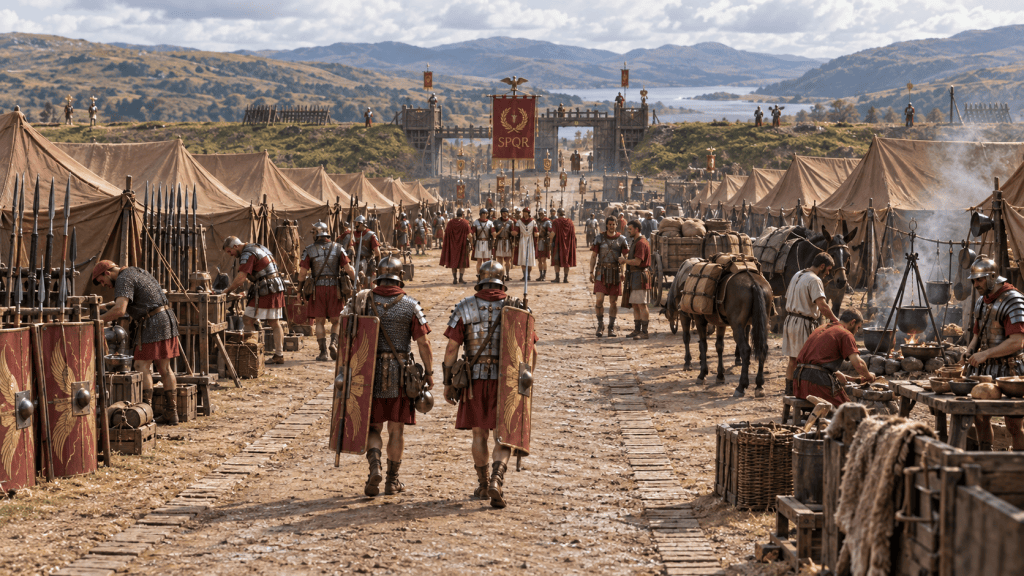
Imagine a Roman army somewhere in Scotland nearly 2,000 years ago. It has spent much of the day marching. Thousands of soldiers are carrying weapons and equipment. Pack animals accompany the column. Wagons carry supplies. Scouts are moving ahead and cavalry patrol the surrounding countryside.
But before the soldiers can eat or sleep, there is another job to do. They have to build a camp.
For the Roman army, making camp was not simply a matter of finding a convenient field and putting up tents. The camp was part of the army’s military system: surveyed, organised and defended. Within a few hours, an apparently empty piece of countryside could be transformed into a temporary military base.
And Scotland contains some of the best archaeological evidence anywhere for these camps.
A fortress built for the night
We often call them marching camps, although archaeologists generally use the broader term temporary camps.
Some probably were occupied for only a night or two as an army moved through the countryside. Others may have been reused or occupied for longer periods, while some camps beside the Antonine Wall appear to have accommodated soldiers involved in constructing the frontier.
Whatever their precise purpose, they were very different from permanent Roman forts. A fort such as Bearsden, Newstead or Bar Hill contained substantial barracks, headquarters buildings, granaries and other structures.
A marching camp could contain almost none of these. The soldiers lived in tents. The impressive archaeological footprint was created largely by the defences dug around them.
First, find the right ground
The job began before the main army arrived. Roman surveyors and officers selected a suitable location.
Ideally it needed:
good drainage,
a reliable water supply nearby,
enough space for the army,
reasonable access,
and ground which could be defended.
High ground was useful, but a Roman camp did not simply have to occupy the highest hill. It also had to work as a practical base for thousands of men, animals and supplies.
Surveyors then marked out the camp.
The Roman surveying instrument known as a groma could be used to establish straight lines and right angles. Stakes and standards helped identify important points so that individual units knew where they were expected to go.
This was one of the great advantages of a standardised military system.
A soldier arriving at a new camp did not need somebody to show him around. His unit normally occupied a recognised place within the layout.
The Greek historian Polybius, describing the Roman army centuries earlier, compared entering a Roman camp with returning to a familiar town: each soldier knew roughly where his own “house” should be.
Digging the defences
The most important task was to secure the perimeter. A ditch — fossa — was dug around the camp.
Roman military writers describe several possible forms, including the familiar V-shaped ditch. The soil removed from it could be thrown inward to help form an earth rampart — the agger. Wooden stakes could then strengthen the top.
The result was not a massive permanent fortress wall. It did not need to be. Even a relatively modest rampart and ditch presented an attacker with several problems. He had to cross the ditch, climb the bank and get past defenders fighting from above, all while under missile attack.
More importantly, the defences prevented an enemy from simply rushing unexpectedly into a sleeping army.
The Romans had learned how dangerous that could be.
Tacitus tells us that during Agricola’s campaigns in Scotland the Caledonians launched a night attack on the camp of the Ninth Legion, Legio IX Hispana. They penetrated the camp before Agricola arrived with reinforcements.
Temporary defences were therefore far more than military decoration.
They could be the difference between a secure night’s sleep and disaster.
The gates were deliberately vulnerable — and deliberately protected
Cutting entrances through the rampart obviously created weak points. Roman engineers therefore developed ways of protecting them without necessarily building elaborate timber gatehouses. One of the most distinctive was the titulum.
This was a short length of defensive ditch constructed outside the gateway, forcing anyone approaching the entrance to divert around it. Examples survive archaeologically at numerous Scottish camps.
Another arrangement was the clavicula, where the defences curved around an entrance so that an attacker could not simply charge directly through the opening.
These distinctive gateways can sometimes help archaeologists recognise a Roman camp even when little else survives. A Roman military writer known today as Pseudo-Hyginus, probably writing in the late second century AD, described a camp with four principal gates.
The porta praetoria faced towards the army’s operational front. Opposite it was the porta decumana. On the two sides were the porta principalis dextra and porta principalis sinistra — the right and left principal gates.
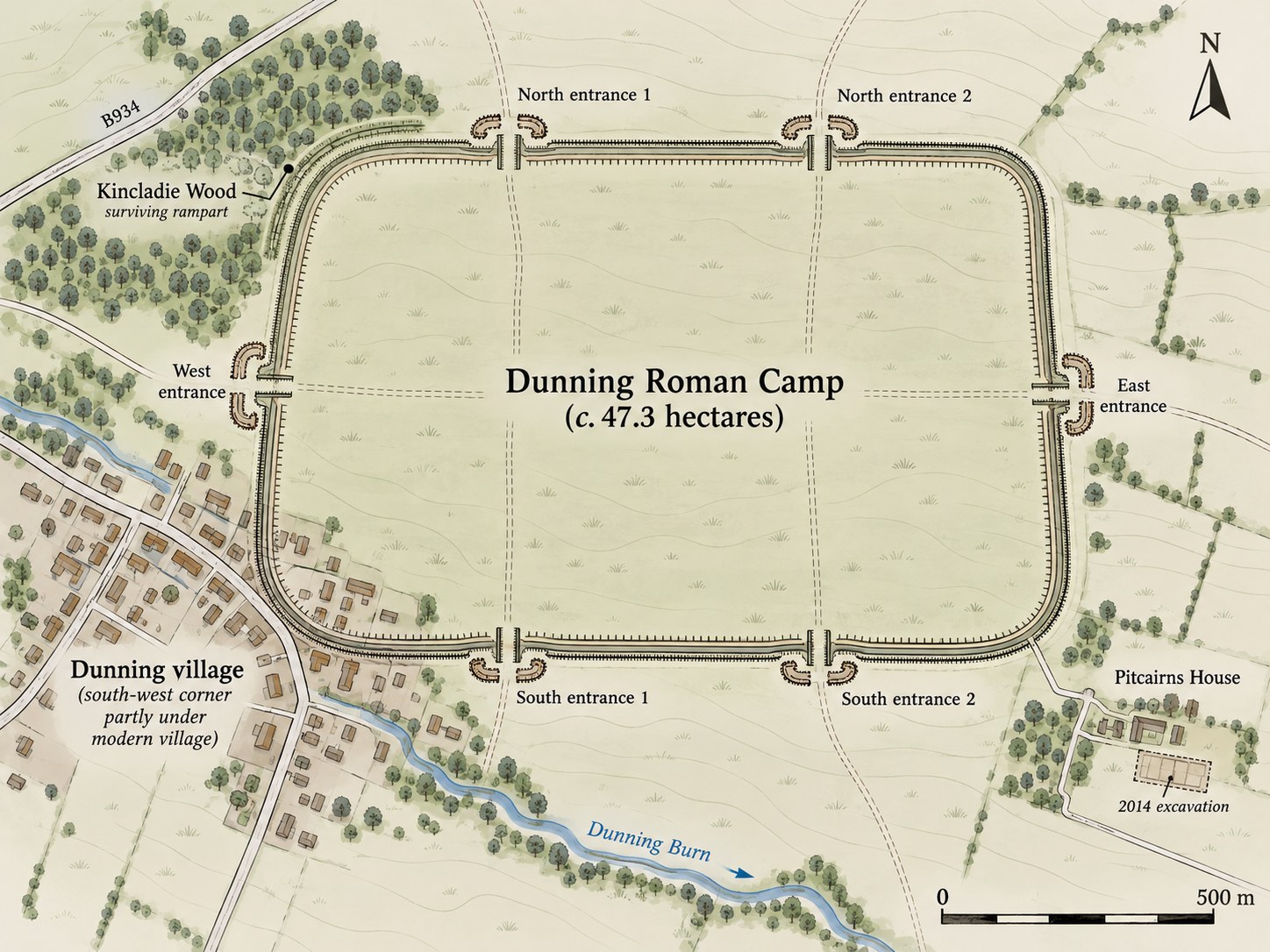
The four named principal gates belong to the familiar literary model; they should not be treated as a rule for every marching camp. Dunning had six entrances, with two on its north side, two on its south, and one each on the east and west. Raedykes, Normandykes and other Scottish camps also had six. Extra entrances offered more routes through a large enclosure, although they do not tell us which units occupied it or securely date its construction. See Roman marching camps with six gates for examples and the distinction between recorded and inferred gateways.
Step through the gate
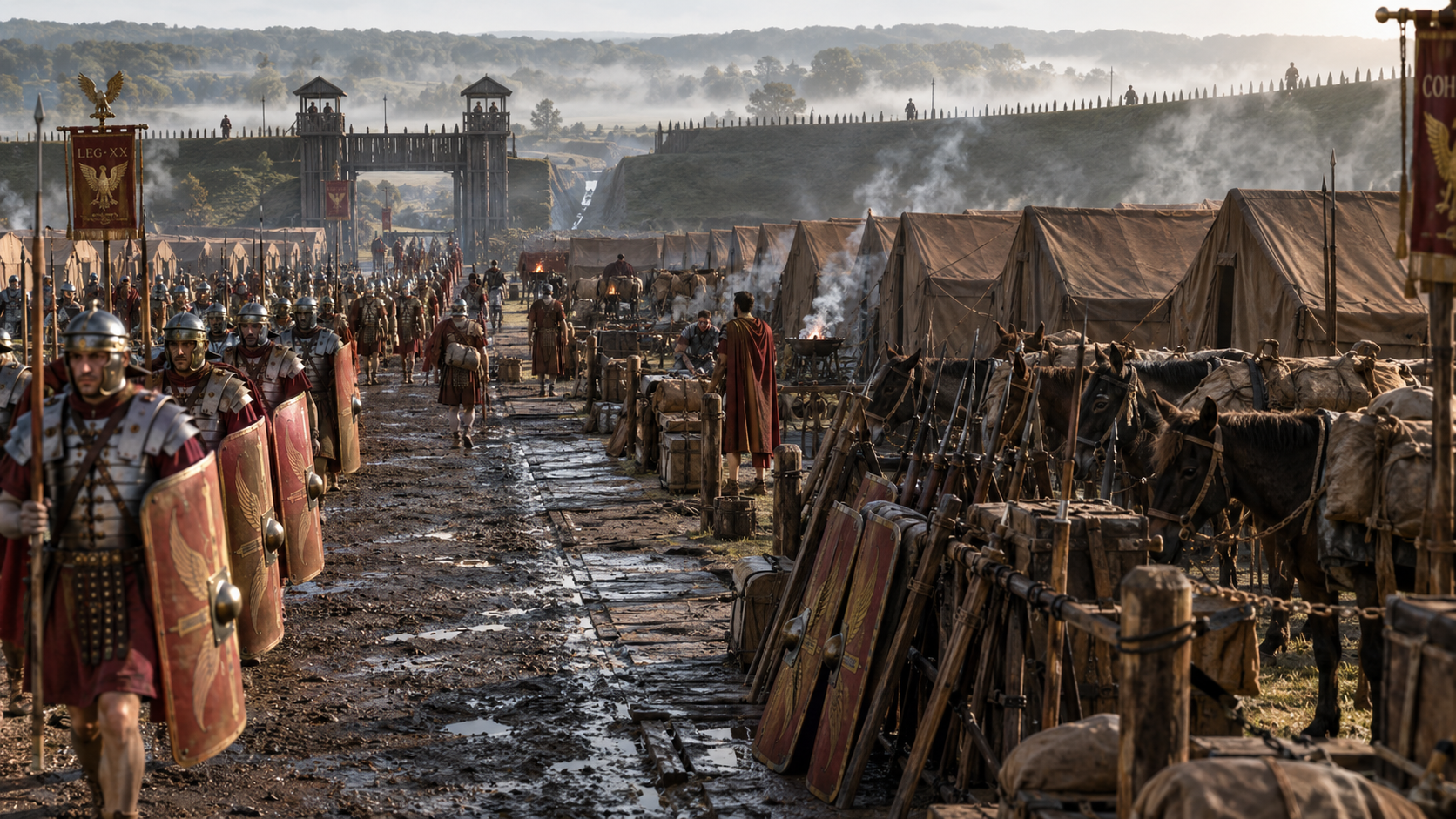
Entering the camp would reveal something very different from the permanent stone forts whose remains are familiar today.
There might be thousands of people inside, yet almost everything was temporary. Rows of leather tents stretched across carefully allocated plots. Roads and open spaces divided the different parts of the army.
Standards identified units.
Horses and pack animals occupied designated areas.
Weapons, shields and equipment had to be stored where soldiers could reach them quickly.
Smoke rose from cooking fires and ovens.
Men carried water, prepared food, repaired equipment and tended animals.
Messengers and officers moved through the streets.
The impression would probably have been less like a campsite and more like a temporary town that had appeared in a matter of hours.
The streets of the camp
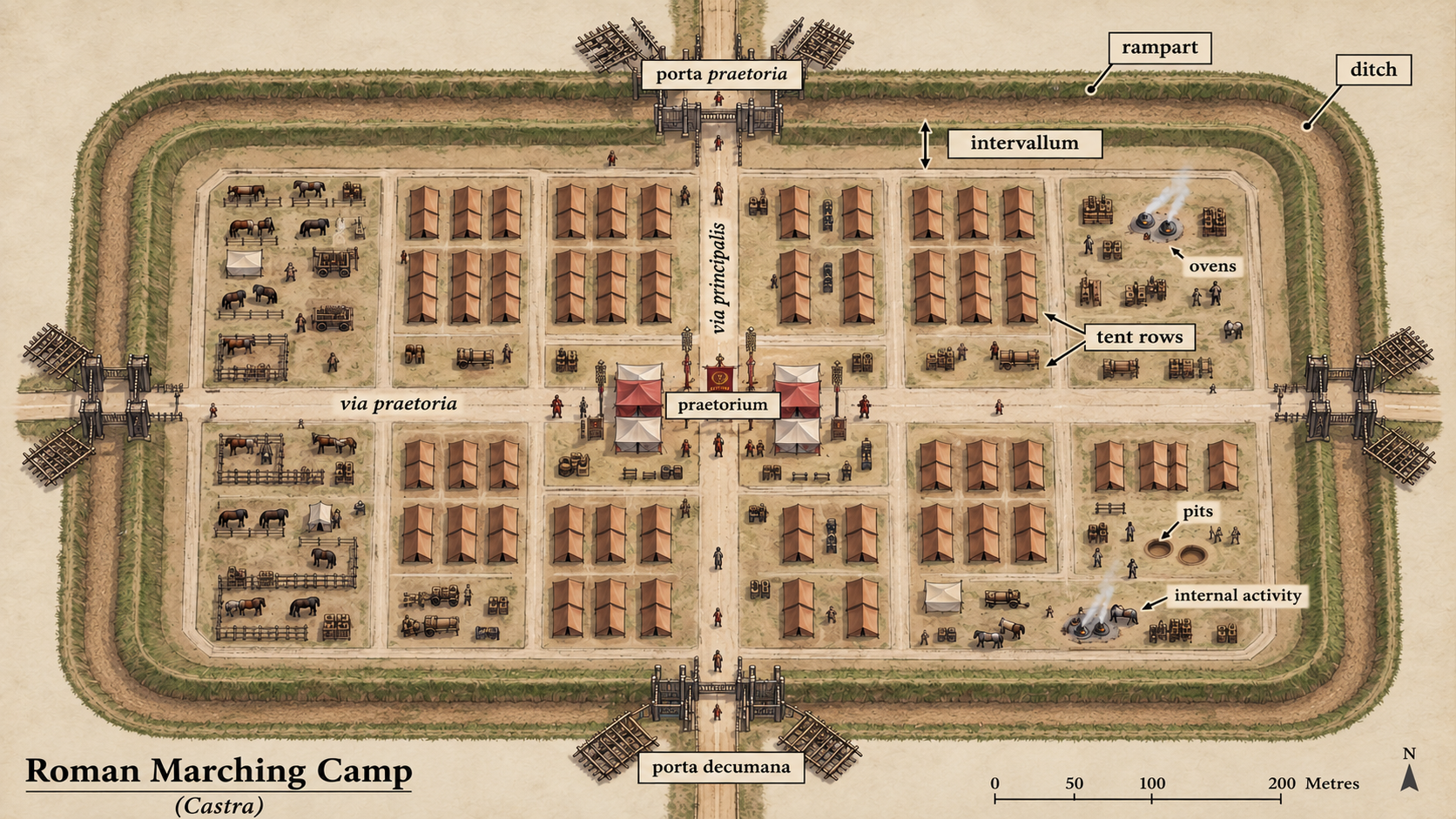
Several important routes helped organise movement. The via praetoria ran towards the main front gate. Crossing it was the via principalis, connecting the two principal side gates. A further road, the via quintana, could run across the rear part of the camp.
These broad routes allowed troops to assemble and move without thousands of men attempting to use the same narrow passage. Pseudo-Hyginus envisaged both the via praetoria and via principalis as about 60 Roman feet wide.
Around the inside of the defences was another vital area: the intervallum. This kept the tents away from the rampart. It created room for soldiers to move around the perimeter, reduced the danger from missiles or fire reaching the tents and provided space for troops gathering to defend the rampart. It also meant that an enemy who succeeded in crossing the outer defences had not immediately reached the sleeping areas.
Eight soldiers to a tent
At the heart of camp life was the small group of soldiers who lived together. A legionary contubernium traditionally consisted of eight soldiers sharing a tent.
Pseudo-Hyginus describes a tent occupying roughly ten Roman feet, with additional room required for pitching it. His idealised camp arranged tents in long, regular rows. Nearby space could be allocated for weapons and pack animals.
The tent itself was probably crowded. Eight men, their clothing and personal belongings had to fit into a space that modern campers would regard as decidedly uncomfortable. Yet these men ate, marched, worked and fought together.
The contubernium was therefore more than an accommodation arrangement. It was one of the basic social units of the Roman army.
At the centre of command
The most important part of the camp belonged to the commander. The praetorium was the commanding officer’s area or tent. Near it were senior officers, military standards and the spaces from which orders could be issued.
Pseudo-Hyginus places the survey point associated with the groma close to this central command area. The layout reflected military hierarchy.
This was not a collection of tents pitched wherever space could be found. The commander, officers, legionaries, auxiliaries, cavalry, specialist troops, animals and baggage could all be allocated particular areas.
Even in the wilderness of northern Britain, the organisation of the Roman army followed it into camp.
What did the soldiers eat?
Building the camp did not end the day’s work. Thousands of men had to be fed. Roman soldiers carried some provisions with them, while the army’s supply system moved large quantities of grain and other food northwards.
Temporary camps sometimes preserve traces of field ovens used for baking bread.
Small pits, hearths and concentrations of burnt material may therefore provide some of the rare evidence for what happened inside camps whose tents themselves have disappeared.
Water was equally important.
A large army accompanied by horses and pack animals required enormous quantities of it, which helps explain why the availability of water mattered when selecting a campsite.
And where were the toilets?
This is the less glamorous side of campaigning, but for archaeologists it can be extremely useful.
Thousands of soldiers occupying even a temporary camp created substantial amounts of human and animal waste.
Latrine pits could be dug within or around temporary camps.
Rubbish pits, ovens, animal remains and other apparently mundane features are particularly important because the leather tents, wooden stakes and many everyday objects normally disappeared.
At some Scottish sites the perimeter ditch is almost all that can be seen from the air.
The camp interior may nevertheless contain the archaeological traces of the people who briefly lived there.
Night falls
Once darkness came, the camp remained a military installation.
Guards watched the gates and perimeter.
Sentries were posted.
Units had assigned duties.
Orders and passwords helped control movement.
The horses needed attention and the army had to be prepared for an alarm.
Thousands of men might be sleeping, but part of the army remained awake.
The events involving the Ninth Legion described by Tacitus demonstrate precisely why.
An enemy who could approach undetected and break through the perimeter might catch an army at its most vulnerable.
And in the morning?
For a genuine marching camp, much of this could disappear almost as quickly as it had appeared.
Tents were taken down.
Equipment was packed.
Animals were loaded.
Units formed up.
The column moved on.
The ramparts and ditches remained behind.
After years of ploughing even these could almost disappear from the surface.
Yet the filled ditches retained more moisture than the surrounding ground. Crops growing above them could behave differently, revealing enormous rectangular shapes when photographed from the air.
That is why so many Roman camps in Scotland were discovered through aerial archaeology rather than excavation.
Scotland’s extraordinary landscape of Roman camps
Roman temporary camps occur across Scotland and belong to several different phases of Roman military activity.
Some may relate to the campaigns of Agricola in the late first century.
Others belong to later advances.
Construction camps appear beside the Antonine Wall, where temporary accommodation was required for the soldiers building Rome’s new frontier in the AD 140s.
At Dunning, archaeological evidence indicates that parts of the camp ditch were re-cut, suggesting that Roman soldiers returned to the site rather than using it on only one occasion.
Farther north, enormous camps reveal the passage of major field armies.
At Black Hill near Ardoch, camps are associated with the campaigns of Septimius Severus and Caracalla in AD 208–211. One encloses around 53 hectares.
Roman troops were still creating temporary military bases in Scotland more than a century after Agricola.
The basic idea had survived: wherever the Roman army went, it took its military organisation with it.
How accurately can we reconstruct a Roman camp?
There is an important warning.
Our detailed literary descriptions are not instruction manuals that can simply be imposed upon every camp found in Scotland.
Polybius was describing the Roman army of the Republican period, long before the invasions of northern Britain.
Pseudo-Hyginus wrote much closer to the period that interests us, but his De Munitionibus Castrorum describes an idealised and extremely elaborate system. The surviving text contains problems and inconsistencies, and the author was proposing how a camp ought to be organised.
Real commanders had to deal with hills, rivers, existing roads, different numbers and types of troops and the demands of particular campaigns.
Archaeology shows considerable variation.
So when we reconstruct a Roman marching camp in Scotland, we are combining two kinds of evidence:
the physical traces left by actual Roman armies, and the principles described by ancient writers.
Together they allow us to step through the gate and imagine one of the most remarkable sights in Roman Scotland:
an entire military town built in an afternoon, occupied by thousands of people — and perhaps abandoned again the following morning.
Explore more
Explore the Roman Army in Scotland
Roman Camps in Scotland · Roman Forts in Scotland: Complete Guide
Agricola’s campaigns in Scotland
Septimius Severus’s invasion of Scotland
More about Roman camps
- Roman Camps in Scotland — an overview of temporary camps and their distribution.
- Dunning Roman Camp — excavation evidence for six entrances and renewed occupation.
- Roman marching camps with six gates — recorded examples and probable reconstructions.
- Burnswark Roman Camps — the camps beside the hillfort and evidence for Roman assault.
- The Lost Fairmilehead Roman Camp — a reminder of the difficulties in identifying camps.
- On the march: Roman camps in Scotland — Rebecca Jones’s illustrated lecture.
- Roman camps in Britain: the known unknowns — a longer lecture on the limits of the surviving evidence.

