
On a broad plateau above the north bank of the River Tay, near Caputh and Murthly in Perthshire, lie the remains of one of the most important Roman military sites anywhere in Britain.
Visit Inchtuthil Roman Fortress
📍 Location: Near Caputh and Murthly, Perthshire
👁 What survives: Subtle earthworks mark the enormous legionary fortress; excavation has revealed an exceptionally complete Flavian plan.
⭐ Best for: The scale and organisation of Rome’s northernmost legionary fortress in Britain.
🥾 Visit: A large rural archaeological landscape with subtle remains rather than standing buildings.
🏛 Nearby Roman places: Bertha, Strageath and the Gask Ridge
Inchtuthil at a glance
| Occupation | Constructed in the AD 80s and abandoned around AD 86–87, before completion. |
| Garrison | Generally associated with the Twentieth Legion Valeria Victrix. |
| Size | About 53 acres (21.4 hectares) for the main fortress; camps and officers’ compound are separate. |
| Troop estimate | Roughly 5,000–5,500 at full legionary establishment; actual occupancy during construction is uncertain. |
Inscriptions
No surviving building inscription securely identifies the legion. The attribution to the Twentieth rests on deployment evidence and archaeological interpretation.
Watch: Inchtuthil with Guy de la Bédoyère
Site visit · Guy de la Bédoyère · Classical and Ancient Civilization
Join Guy de la Bédoyère for a video visit to Inchtuthil’s legionary fortress and its setting above the Tay.
This was Inchtuthil, a legionary fortress of around 53 acres — more than 20 hectares — laid out during Rome’s great Flavian advance into northern Scotland. For a few extraordinary years in the AD 80s, it was intended to be the permanent home of a complete Roman legion at the edge of the Highlands.
Then the strategy changed.
The buildings were dismantled, the army withdrew and an enormous stockpile of iron was hidden beneath a workshop floor. Because Inchtuthil was never rebuilt by later Roman armies, archaeologists were eventually left with something exceptionally rare: the plan of an almost complete first-century legionary fortress frozen at the moment Rome abandoned its northern ambitions.
Agricola’s fortress on the Tay
Inchtuthil occupied a carefully chosen position.
The plateau rises above the Tay close to the point where routes through Strathmore and the Tay valley approach the Highland edge and the Dunkeld gorge. An army based here could move east through the fertile lowlands, west and north towards the Highland glens, or south towards the established Roman communications network.
It belonged to the military landscape created during the campaigns of Gnaeus Julius Agricola, governor of Britain from the late AD 70s. Archaeological syntheses generally place the beginning of construction around AD 82/83 or 83/84, during the final stages of Agricola’s northern campaigns.
That timing matters. The famous Battle of Mons Graupius, described by Tacitus, is normally placed around AD 83 or 84. Inchtuthil should therefore be understood as part of the same phase of Roman expansion rather than confidently described as a fortress built after the battle.
Its purpose was ambitious. Inchtuthil was probably intended not simply to police territory already occupied, but also to provide a base from which Roman forces could advance deeper into the Highlands. Lynn Pitts described it as linked with the so-called glen-blocking forts, while also serving as a potential springboard for further movement through the Dunkeld gorge.
The home of Legio XX Valeria Victrix
The fortress is generally accepted as having been intended for Legio XX Valeria Victrix — the Twentieth Legion.
No building inscription from Inchtuthil actually names the legion, so the identification should not be presented as epigraphically proven. Nevertheless, the wider pattern of Roman deployment makes the association very strong.
A full legion represented perhaps 5,000–5,500 soldiers, before civilian workers, servants, animals and other people attached to the army are considered. Inchtuthil was therefore not merely a fort. It was designed as a substantial military community and operational headquarters.
It was also, so far as we know, the most northerly permanent legionary fortress ever established in the Roman Empire.
A 53-acre Roman military machine
The main fortress measured roughly 1,520 by 1,565 feet — about 463 by 477 metres — enclosing approximately 53 acres.
Its defences included a substantial turf rampart and a ditch about 20 feet — six metres — wide. Work was also under way on a stone fronting or wall, evidence that the Romans did not necessarily regard Inchtuthil as a disposable temporary base.
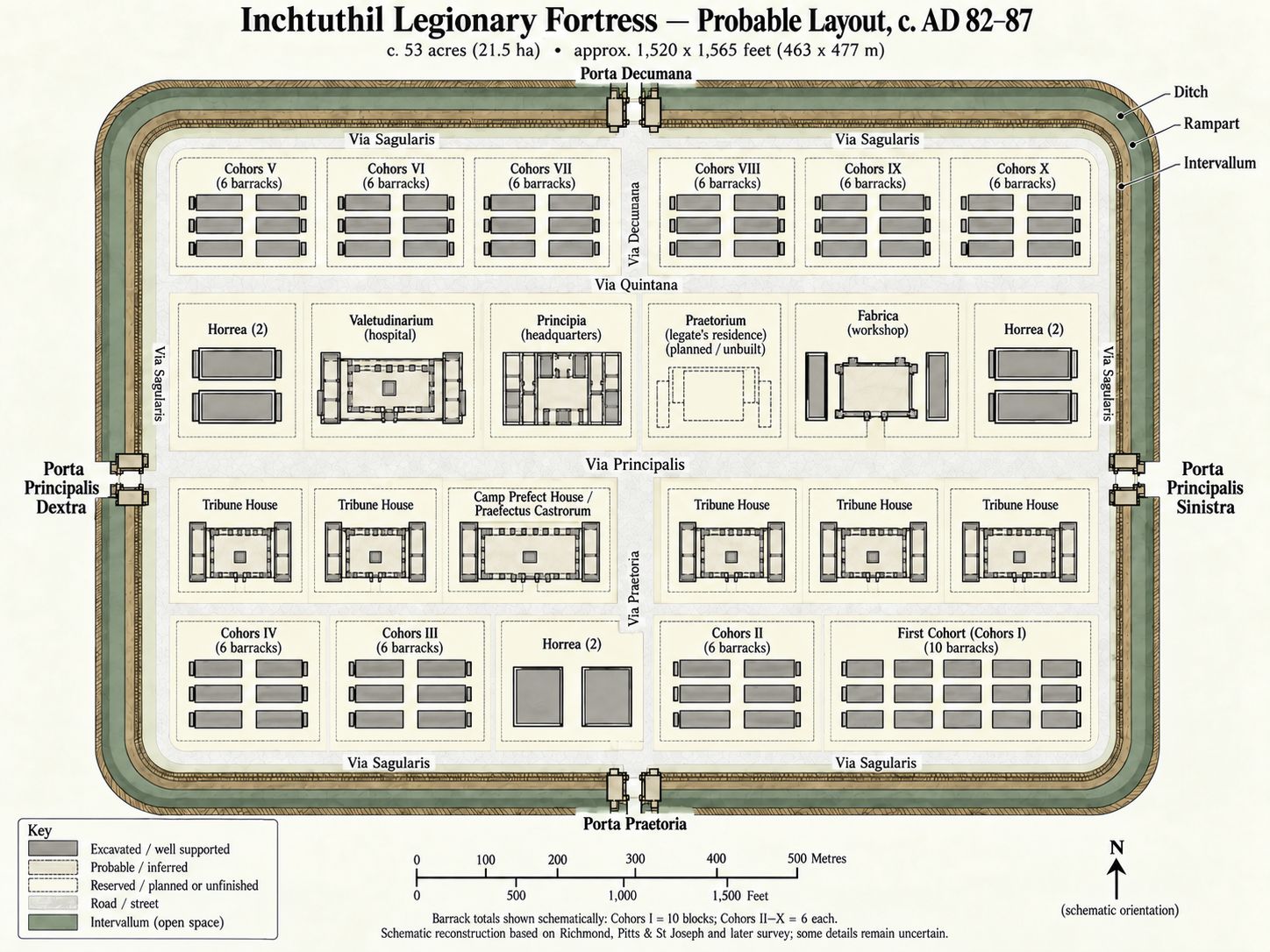
Behind the defences was a carefully surveyed military landscape of roads, barracks, headquarters, stores and specialist buildings.
Among the structures identified were:
- the principia, or legionary headquarters;
- 64 barrack blocks for the soldiers;
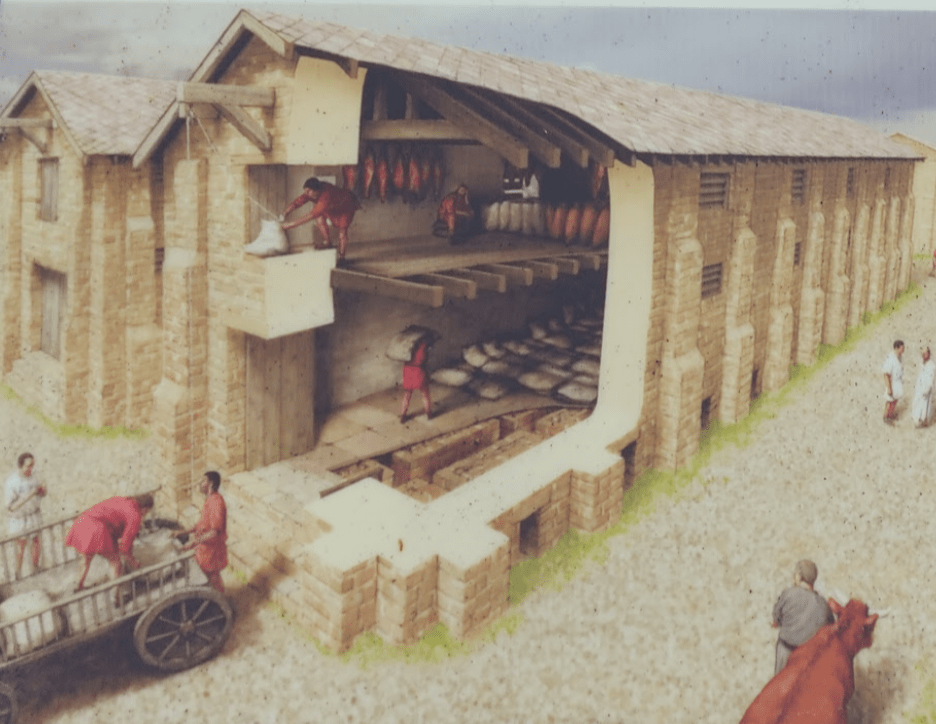
- six completed granaries, with further provision apparently planned;
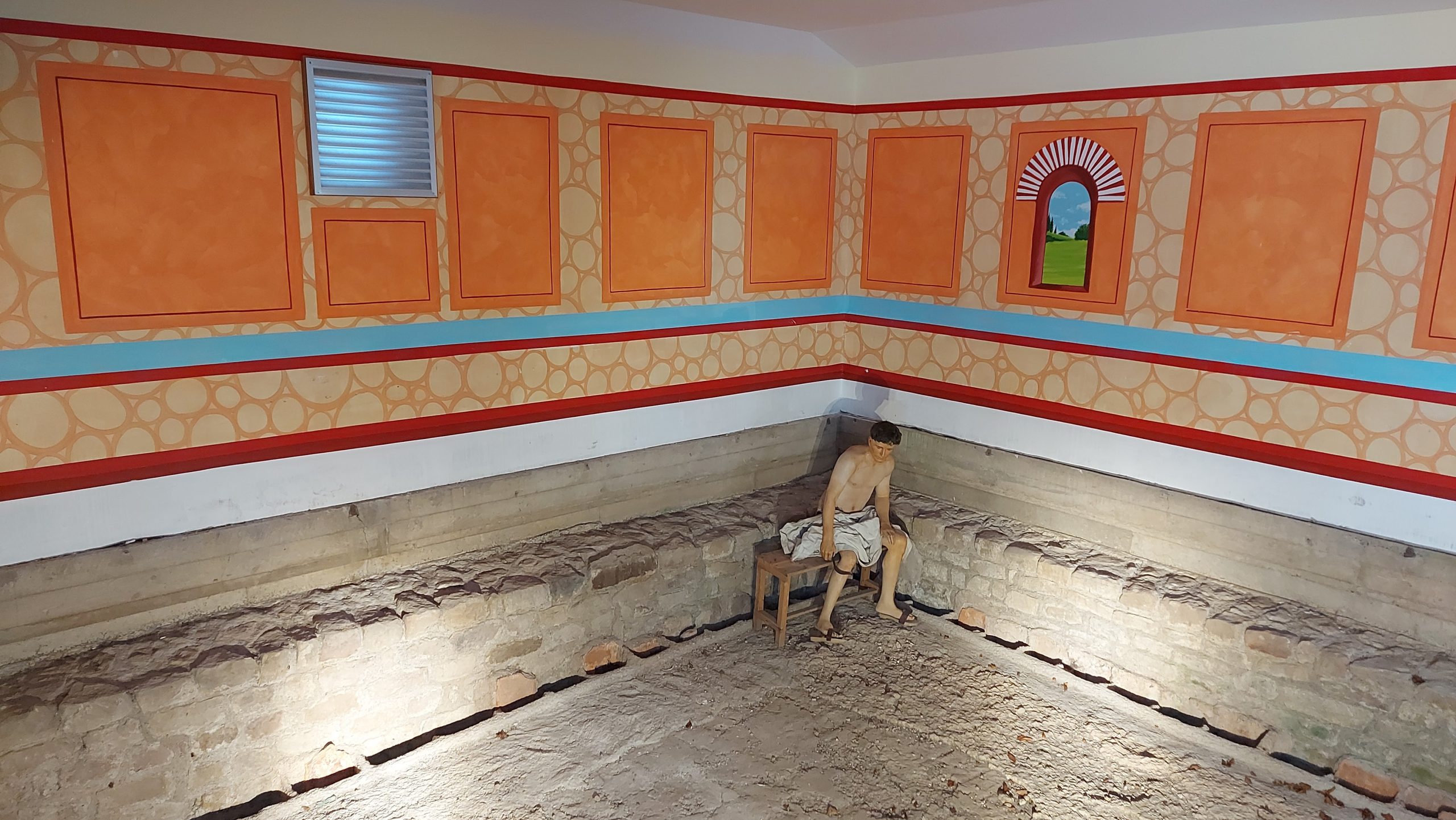
- the valetudinarium, an extensive military hospital;
- the fabrica, the legion’s workshops;
- stores and other service buildings;
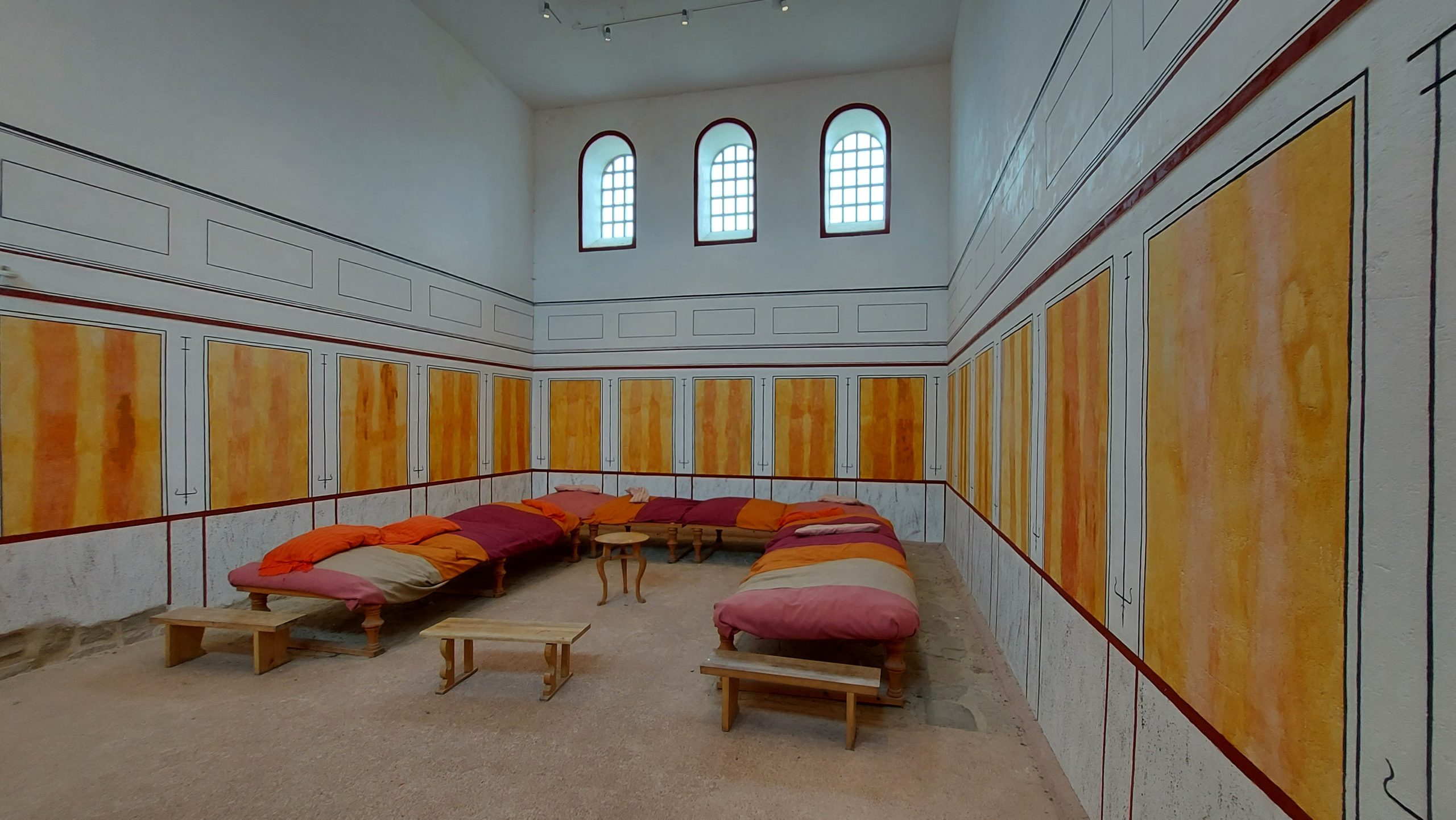
- houses for senior officers;
- and the scamnum tribunorum, the zone occupied by the accommodation of the legion’s senior officers.
Space had also been reserved for important buildings which were never finished, including the commander’s praetorium and major bathing facilities. The unfinished elements are among the clearest archaeological signs that the Roman army departed before its great northern base had been completed.
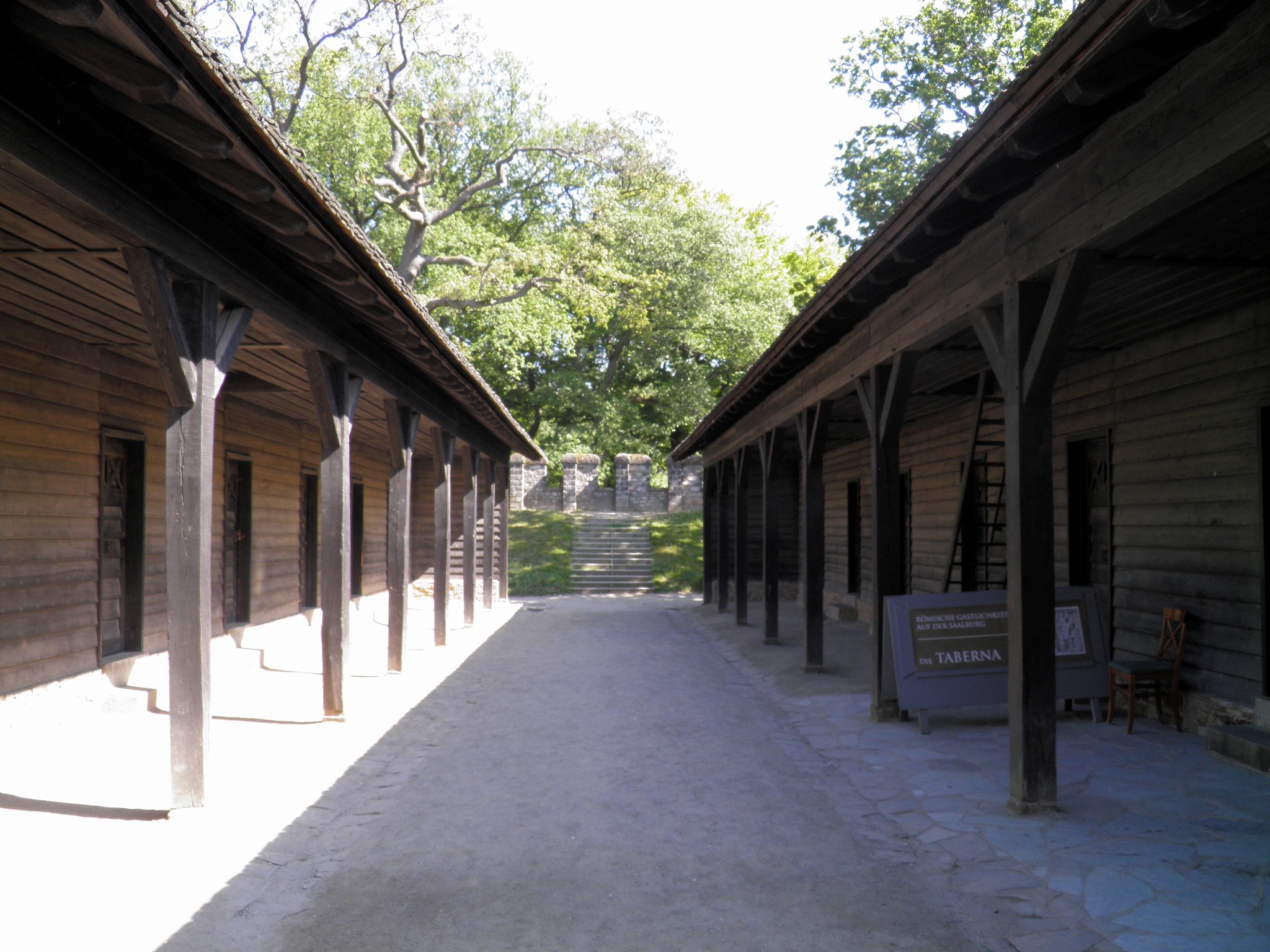
Why build a fortress in timber?
To modern eyes, a timber fortress housing thousands of soldiers can sound surprisingly temporary.
It was nothing of the sort.
Timber construction allowed the Roman army to build quickly using standardised plans, trained military craftsmen and material available close to the site. Barracks, administrative buildings, hospitals, stores and workshops could be erected in a remarkably organised fashion.
Inchtuthil therefore demonstrates one of the Roman army’s greatest strengths: its ability to reproduce complex military infrastructure far from its established bases.
The beginnings of stone defences are especially significant. Inchtuthil belongs to a period when Roman legionary bases were increasingly moving from timber towards more permanent stone construction. The decision to abandon the site interrupted that process.
More than one fort
The legionary fortress was only the centre of a much larger military complex.
To the south-west lay an enormous temporary construction or labour camp. In its first phase it enclosed about 19.9 hectares and may have accommodated the equivalent of around 30 cohorts. It was later reduced to about 14 hectares, perhaps as troops moved into completed accommodation inside the fortress.
A second, much smaller temporary enclosure has also been identified nearby, although its exact purpose remains uncertain. It has been suggested that it could have housed a separate auxiliary force, perhaps cavalry.
On the eastern side of the fortress was another remarkable enclosure, sometimes called the officers’ compound. Excavation revealed an elaborate timber residence, offices, barracks and an impressive bath-house. It may have accommodated a very senior officer — perhaps the legionary commander, the praefectus castrorum, or even a governor while campaigning in the north.
Beyond Inchtuthil itself stood other forts and camps controlling the surrounding countryside. The Roman forts at Cargill, for example, lie only about 4.5 kilometres to the east-south-east.
The result was not an isolated stronghold but a heavily organised military landscape.
Rome changes its mind
Inchtuthil’s extraordinary life was brief.
Around AD 85–86, Rome faced serious military pressures on the Danube. A legion was withdrawn from Britain as imperial resources were redirected towards the developing crisis there. David Breeze summarises the consequence starkly: retreat became the order of the day and Inchtuthil was abandoned while still unfinished.
More specifically, Legio II Adiutrix, previously based at Chester, was transferred away from Britain. The traditional interpretation is that Legio XX Valeria Victrix was consequently pulled back from Scotland to occupy Chester.
Inchtuthil was systematically abandoned around AD 86–87.
This was not necessarily a panicked flight.
The archaeological evidence indicates an organised programme of dismantling. Buildings were stripped, useful timber and fittings were removed, pits were filled and material which could not conveniently be taken away was disposed of.
And beneath the floor of the legion’s workshop, the departing soldiers left one of the most remarkable archaeological discoveries ever made in Roman Britain.
The million nails
Between 1952 and 1965, Sir Ian Richmond and J. K. St Joseph carried out the excavations which transformed understanding of Inchtuthil. Earlier work had taken place in 1901, but it was Richmond and St Joseph who revealed the fortress on a scale that made its international significance clear.
In 1960, excavators investigating the fabrica discovered a deep pit concealed beneath one of its rooms.
The pit measured approximately 3.07 by 2.74 metres and 3.66 metres deep — almost exactly 12 feet. Above its contents had been placed roughly 1.8 metres of gravel.
At the bottom was an astonishing mass of Roman iron.
The Inchtuthil nail hoard at a glance
- Minimum recorded number of nails: 875,428
- Popularly described as: nearly one million
- Depth of pit: about 3.66 m / 12 ft
- Also buried: nine large iron wheel tyres
- Total iron deposit: approaching 10 tonnes
- Discovery: 1960
- Location: beneath the fabrica, or military workshop
The familiar figure of ‘a million nails’ is therefore a useful shorthand rather than a precise count. Modern research gives a minimum figure of 875,428 individual nails.
The distinction between the weight of the nails and the total deposit is also worth making. Some accounts give about seven tonnes for the nails themselves, while the entire deposit of iron, including the wheel tyres, approached ten tonnes.
Even the lower figure is extraordinary. Every nail had been forged by hand.
Why did the Romans bury them?
The traditional explanation is compelling: iron was too valuable to leave behind.
The withdrawing army could not carry every nail south, but neither would Roman commanders have wanted such a valuable store of workable metal to fall into the hands of local communities. Burying the stockpile beneath the workshop floor and sealing it with gravel effectively removed it from circulation.
That remains a strong interpretation, but it is not the only one.
Archaeologists have also suggested that the deposit may partly represent the systematic disposal of surplus material during demolition, while more specialised interpretations have considered whether something beyond simple military pragmatism lay behind such an unusual act of deposition. Modern scholarship therefore treats the idea of ‘hiding the iron from the Caledonians’ as plausible rather than demonstrable fact.
Either way, the hoard gives an extraordinary impression of the industrial scale on which a Roman legion operated.
Nearly a million nails were surplus. Countless others had already disappeared into roofs, floors, gates, workshops, barracks, wagons and fortifications.
What can you see at Inchtuthil today?
Visitors should not expect standing Roman walls like those found at some forts farther south.
Inchtuthil is a landscape archaeological site.
Low traces of the fortress defences survive around parts of the southern, eastern and western sides of the plateau. On the northern side the Roman works merge with the steep natural scarp overlooking the landscape. Other features survive as slight earthworks, while aerial photography reveals further ditches and structures as cropmarks.
Modern geophysical survey has added another layer to the story.
A large magnetic survey in 2009 broadly confirmed the internal arrangement discovered by Richmond and St Joseph, but it also demonstrated that some buildings were less perfectly rectangular than the familiar published reconstruction suggests and revealed an additional large structure in the north-western part of the fortress.
That is an important warning.
The celebrated plan of Inchtuthil is one of the great images of Roman military archaeology, but it remains an archaeological interpretation rather than an architectural blueprint preserved intact from antiquity.
Why Inchtuthil matters
Inchtuthil’s importance extends far beyond Scotland.
Lynn Pitts characterised it as the only complete plan then known of a first-century timber legionary fortress unaffected by later occupation. Unlike Chester, York and Caerleon, Inchtuthil was not repeatedly rebuilt, altered and covered by centuries of later Roman and medieval development.
Its short life is therefore its great archaeological advantage.
We can see the barracks of the soldiers, the houses of their officers, their hospital, stores, granaries and workshops as parts of a single coordinated plan. We can also see which buildings had been completed, which were still under construction and how the army dismantled the base when Rome’s priorities changed.
Historic Environment Scotland describes Inchtuthil as a unique source of evidence for the development of a major Roman military installation on the imperial frontier, preserving evidence for its construction, occupation and dismantling.
Inchtuthil is consequently much more than an abandoned fort.
For perhaps only a handful of campaigning seasons, this Perthshire plateau stood at the centre of Rome’s attempt to turn conquest in northern Scotland into permanent occupation. Its unfinished buildings record the scale of that ambition.
Its dismantled defences record its abrupt end.
And beneath a workshop floor, 875,428 iron nails record the moment when Rome decided that its great northern fortress would never be completed.
Sources and further reading
The fundamental publication remains Lynn F. Pitts and J. K. St Joseph, Inchtuthil: The Roman Legionary Fortress: Excavations 1952–65 (Britannia Monograph Series 6, 1985), now listed as an open-access monograph through the Archaeology Data Service.
Historic Environment Scotland’s scheduled-monument record describes the site’s national importance, while the Canmore archive contains detailed excavation, aerial-survey and geophysical records. Historic Environment Scotland — Inchtuthil scheduled monument record Canmore archive — Inchtuthil legionary fortress
The Perth and Kinross Archaeological Research Framework provides a useful modern synthesis of the fortress’s date, purpose and relationship with the Twentieth Legion.
Recent research into the extraordinary afterlife and archaeological interpretation of the nail hoard was published in Heritage & Society in 2025.
References
- Inchtuthil | Canmore
- BBC Two – Scotland: Rome’s Final Frontier, Inchtuthil – animation
- Inchtuthil From Wikipedia
- Inchtuthil Roman Fortress (Roman Britain)
- Magyaricsová, A. (2026). From a Roman Hoard to Multivocal Assemblages: Inchtuthil Nails, Ontological Itineraries, and the Making of Contemporary Heritage. Heritage & Society, 1–21. https://doi.org/10.1080/2159032X.2025.2604362
- Historic Environment Scotland – Inchtuthil Scheduled Monument record
- Canmore – Inchtuthil Roman legionary fortress
- Canmore – Inchtuthil large temporary/construction camp
- Canmore – Inchtuthil smaller temporary camp/enclosure
- Canmore – Inchtuthil officers’ compound
- Archaeology Data Service – material relating to Inchtuthil: The Roman Legionary Fortress
- Perth & Kinross Archaeological Research Framework – Roman influence and Inchtuthil
- Perth & Kinross Archaeological Research Framework – Chapter 5 PDF
- Taylor & Francis – recent research on the Inchtuthil nail hoard
- Ancient World Online – open-access Britannia monographs including Inchtuthil

