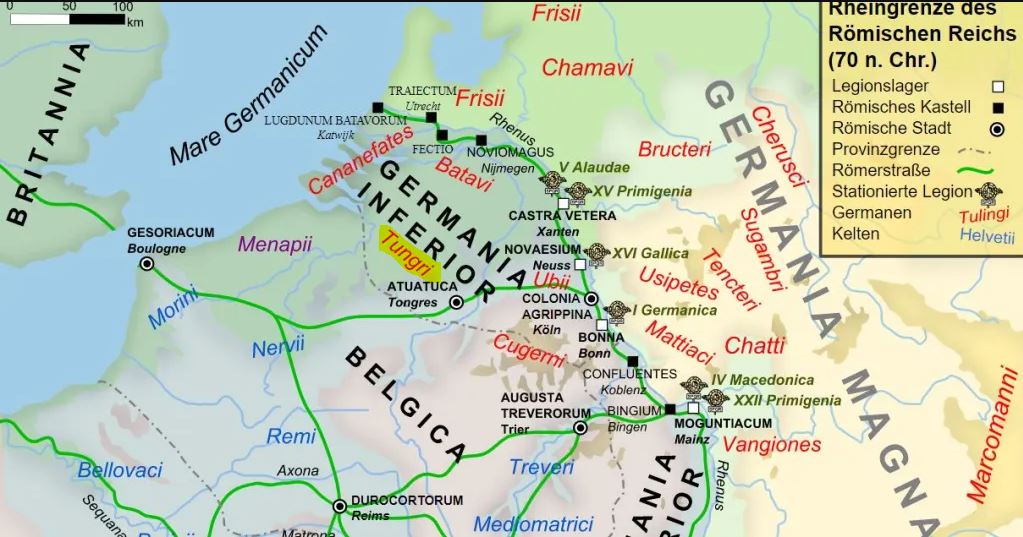
The Tungrians were from modern-day Belgium. There were three units that served as auxiliary units from Agricola’s time.
Ala I Tungrorum
| Location in Scotland | What |
|---|---|
| Castlecary Fort, Antonine Wall | The First Cohort of Tungrians helped build Castlecary Fort around AD 141. |
| Cramond Fort, near Edinburgh | The First Cohort of Tungrians was stationed at Cramond from AD 142; the site also says inscriptions show the Second Cohort of Tungrians was stationed there. |
| Mumrills Fort, Antonine Wall | The site records Tungrians at Mumrills, including Valerius Nigrinus, a cavalryman of ala I Tungrorum, whose altar was found near the fort and dated to the Antonine occupation. |
| Birrens Fort, near Dumfries | The site records a rebuilding in AD 158 for the Second Cohort of Tungrians, and says the Second Cohort was present there. |
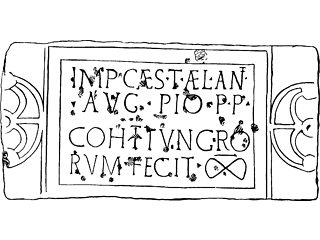
The inscription above is at Castlecary Fort on the Antonine Wall and is dedicated to the First Cohort of Tungrians.
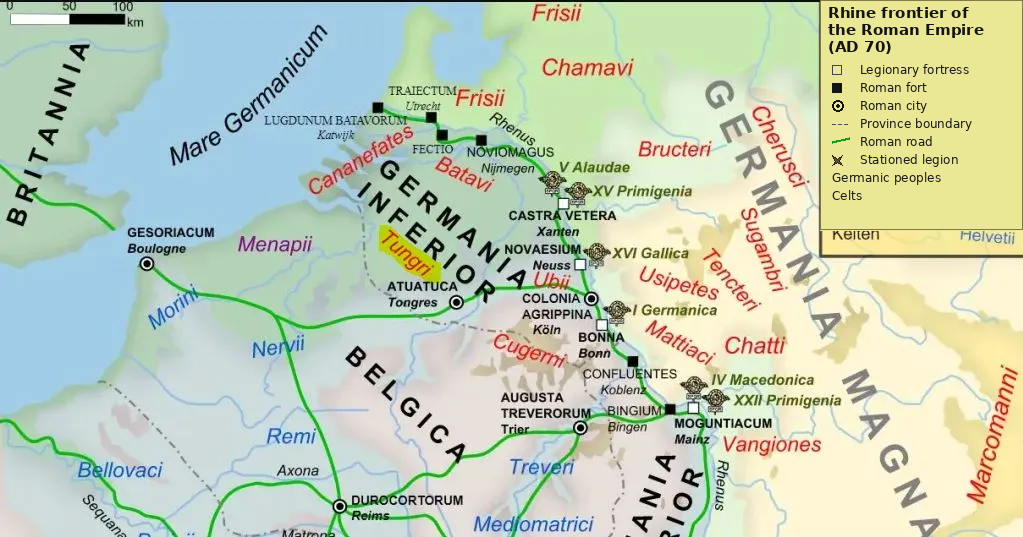
The Second Cohort of Tungrians
The Second Cohort of Tungrians (Cohors II Tungrorum milliaria equitata) left a rich epigraphic and archaeological footprint in Britain. Over a third of all inscriptions recovered from their primary base at Birrens were dedicated by this unit alone. [1, 2, 3]
The most notable altars, gravestones, and building records left by the unit are grouped below by the locations where they were discovered.
🏛️ Birrens Fort (Blatobulgium), Scotland
Birrens has yielded the most significant collection of stones linked to the Second Cohort, dating primarily to their rebuilding and garrisoning of the fort starting in AD 158. [3, 4, 5]
- The Minerva Altar (RIB 2104): A beautifully preserved red sandstone altar dedicated to the goddess Minerva. It features the full nominal description of the unit, noting they were a thousand strong (milliaria), part-mounted (equitata), and “publicly praised” (coram laudata). It was set up under the prefect Gaius Silvius Auspex. [1, 6, 7]
- Altar to Mars and Victory (RIB 2100): Another major altar dedicated by the unit under the same prefect (Silvius Auspex), celebrating Mars and the Emperor’s Victory. [1, 6]
- Altar to Ricagambeda (RIB 2107): Dedicated by the Tungrians to Ricagambeda, a native Germanic or Celtic goddess. This provides clear evidence that while the unit was originally Belgian, it had been heavily reinforced with recruits from the lower Rhine and Germanic territories. [3, 8]
- Grave Marker of Afutianus: A tombstone erected by a woman named Flavia Baetica for her husband, Afutianus, who was a centurion of the Second Cohort of Tungrians. [3]
- Imperial Dedication (AD 158): A large architectural dedicatory tablet erected by the cohort in honour of Emperor Antoninus Pius, securely tying the unit to the extensive rebuilding of Birrens. [4, 5]
🧱 Hadrian’s Wall & Castlesteads Fort, England
When the Romans withdrew south from Scotland, the Second Cohort moved to Hadrian’s Wall. [9]
- The Gordiana Altar (RIB 1983): Found at Castlesteads, this altar is dedicated to Jupiter Optimus Maximus and explicitly dates to AD 241. It grants the unit the honorary title Gordiana (expressing loyalty to Emperor Gordian III), confirming the cohort was still operational in Britain deep into the third century.
- The “Shield” Altar (RIB 2092): An altar featuring a relief carving of a patera (a sacrificial libation dish) on its side. Its unusual concentric ring design has led historians to speculate that it was intentionally carved to mirror the specific, unique concentric shield pattern carried by the Tungrian soldiers. [1, 9, 10]
⚓ Cramond Fort, Edinburgh
- Altar to the Mother Goddesses (Alatervae): Discovered near Cramond, this inscription indicates the presence of the unit during the Antonine period. It was dedicated to the Matres Alatervae (the Mother Goddesses of the Parade-ground), a specific local or native Germanic triad worshipped by the auxiliary cavalrymen of the unit. [9]
Most of the original stone altars recovered from the Scottish sites are preserved and displayed today within the National Museum of Scotland in Edinburgh. [5, 6]
[1] https://www.roman-britain.co.uk
[2] https://romaninscriptionsofbritain.org
[3] https://www.futuremuseum.co.uk
[4] https://romansinscotland.com
[6] https://romaninscriptionsofbritain.org
[7] https://perlineamvalli.wordpress.com

