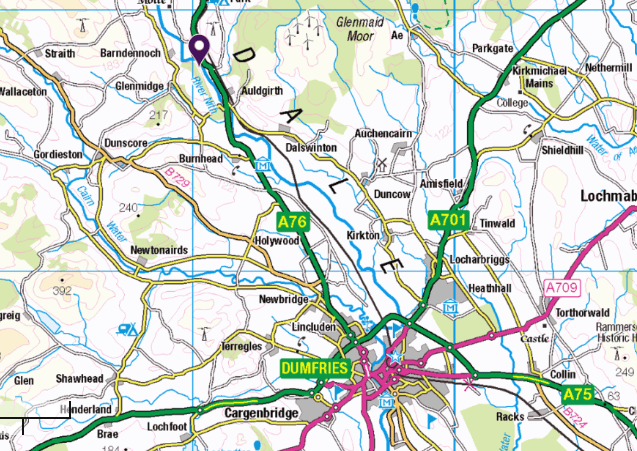
The 1971 excavation of the Roman fortlet at Barburgh Mill, Dumfriesshire, confirmed it was a single-phase military installation dating to the Antonine I period (c. 142–158). Structurally designed to house an infantry century, the site was deliberately dismantled and abandoned, likely after achieving its strategic goal of regional control.
Visit Barburgh Mill
The largely buried fortlet lies in the Nith valley. Use the archaeological record to locate it and establish access to the rural site.
Barburgh Mill at a glance
| Occupation | Antonine I, approximately AD 142–158; one principal occupation. |
| Garrison | Unidentified infantry detachment. |
| Size | Approximately 29.5 × 28.5 m internally, about 0.084 hectares. |
| Troop estimate | About 80 infantry, inferred from the excavated barrack accommodation. |
Inscriptions
Pottery graffiti have been read as names including Sacer or Saciratus and Paullus. They do not identify the parent regiment.
Sources for this summary
Structural Overview and Defences
- Layout and Form: Rather than a perfect square, the fortlet was a parallelogram measuring 29.50 m by 28.50 m internally, situated on a strategically placed hillock in the Nith valley.
- Fortifications: The installation was protected by a turf rampart estimated at 3 m wide and a single V-shaped ditch varying in width from 4.50 m to 6.70 m.
- The Gateway: A six-timber gate passage (3 m wide by 2.30 m long) defended the entrance, with stout posts set deeply into pits, strongly indicating it originally supported an overhead defensive tower.
- Outer Enclosure: An outer ditch and rampart enclosed an irregular area on the north and east sides, subdivided by a medial ditch. Its undefended entrance suggests it served as a temporary shelter or military annex for transit convoys rather than a primary defensive line.
Internal Infrastructure and Daily Life
- Barrack-Blocks: The interior contained two timber barrack-blocks facing an open central area. Together, they comprised a two-room officer’s suite and ten smaller contubernia (men’s rooms), matching the standard blueprint for an 80-man infantry century.
- Construction Quality: The buildings displayed somewhat substandard workmanship, utilising construction trenches for timber uprights, woven wattle-and-daub walls, and shingle roofs. Internal walls were noticeably uneven or crooked.
- Sanitation and Subsistence: A basin-shaped latrine pit with a gravel-filled soakaway channel leading under the rampart into the ditch occupied the south-east corner. No dedicated ovens were found, but localised charcoal patches in the central courtyard indicate the presence of open cooking fires.
Material Culture and Garrison Identity
- Pottery Assemblage: The kitchenware consisted entirely of Black-burnished ware category 1, which highlights a regional supply network likely rooted near the Solway or Carlisle. Mortaria, samian ware from Central Gaul, a flagon, and globular Spanish wine amphorae were also retrieved.
- Personal and Military Artefacts: Discoveries included an iron knife, shoe-studs from military boots, a northern British penannular bronze brooch, a glass melon bead, and bronze harness mounts.
- Inscriptions: Soldiers’ names—specifically Sacer (or Saciratus) and Paullus—were found scratched as graffiti on the bases of personal pottery pieces.
Demolition and Strategic Context
- Deliberate Abandonment: There is no evidence of a hostile assault. Instead, the garrison systematically slighted the ramparts, threw occupation debris and surplus pottery into the ditches, demolished the internal structures, and threw the burnt remains of the superstructures into the latrine pit.
- Historical Timeline: The site was exclusively occupied during the Antonine I period and was entirely bypassed during the subsequent Antonine II reoccupation of south-west Scotland. It represents a highly organised, short-term mechanism of imperial control designed to pacify the local territory.
References
- Barburgh Mill (Canmore)
- The Roman Fortlet at Barburgh Mill, Dumfriesshire David J. Breeze, G. Jobey, B. R. Hartley, J. P. Gillam and Roger Miket Britannia
Vol. 5 (1974), pp. 130-162 (37 pages)


Leave a Reply