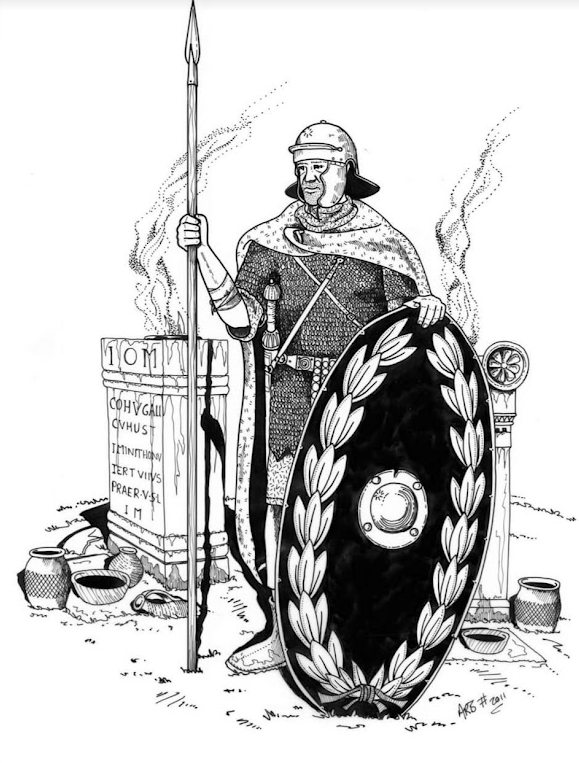
The soldiers who came from across the Empire
The Roman army in Scotland was not made up simply of legionaries. In fact, much of the day-to-day work of occupying forts, patrolling roads and guarding frontiers was carried out by the auxilia — auxiliary regiments recruited originally from peoples across the Roman Empire.
On the Antonine Wall these units formed the main body of the garrison. Their names introduce us to an extraordinarily diverse military world:
Batavians, Tungrians, Nervians, Gauls, Thracians, Vardullians, Baetasians, Cugerni and Hamians.
These names originally referred to the peoples and regions from which a regiment had been recruited. But there is an important qualification.
By the time many of these units reached Scotland, they had existed for generations. A soldier serving in the Second Cohort of Thracians did not necessarily come from Thrace. Units increasingly recruited wherever they were stationed.
The regimental name survived even when the origins of its soldiers changed.
What were auxiliary units?
There were several main types.
Cohorts
A cohort was principally an infantry regiment.
A standard auxiliary cohort is usually described as having a nominal strength of about 500 men, although actual numbers could vary.
Larger military cohorts were nominally around 1,000 strong.
Mixed cohorts
A cohors equitata combined infantry and cavalry.
These units were particularly useful on frontiers because mounted soldiers could patrol and carry messages while infantrymen provided the main garrison.
Cavalry
An ala was a cavalry regiment.
Cavalry gave Roman commanders speed, reconnaissance and the ability to operate over a much wider area than infantry alone.
Auxiliaries during Agricola’s campaigns
Auxiliary troops were crucial during the Roman advance into Scotland in the late first century. Tacitus describes Agricola using thousands of auxiliary infantry and cavalry at the Battle of Mons Graupius. Among the peoples associated with the army of this period were the Batavians and Tungrians, recruited originally around the lower Rhine.
There was also the extraordinary story of a cohort of Usippi who mutinied while serving in Britain and attempted to escape by sea.
Read more:
Agricola’s invasion of Scotland
Auxiliary units on the Antonine Wall
When the Romans returned north under Antoninus Pius, auxiliary regiments occupied many of the forts along the new frontier. The units known from inscriptions include several whose individual stories are explored on this site.
The First Cohort of Baetasians
Originally raised among the Baetasii of the lower Rhine region. The unit is particularly associated with Old Kilpatrick and Bar Hill on the Antonine Wall.
The Second Cohort of Thracians
Associated with Mumrills. One of its soldiers was Nectovelius, a Brigantian from northern Britain who died aged 29 after nine years’ service. His tombstone neatly demonstrates why the name of a regiment should not be treated as the birthplace of every soldier serving in it.
The First Cohort of Tungrians
One of several units carrying the Tungrian name and one of the best-known auxiliary regiments in Roman Britain.
The Second Cohort of Tungrians
Another regiment originally associated with the Tungrian region around modern Belgium.
The Fifth Cohort of Gauls
Known in Scotland particularly through its association with Cramond.
The First Cohort of Vardullians
Originally raised among the Vardulli of northern Spain.
The Nervians
The Sixth Cohort of Nervians is particularly associated with Rough Castle on the Antonine Wall. The fort was too small to accommodate the entire regiment, suggesting that parts of the unit may have been detached to smaller posts nearby.
The First Cohort of Hamians
The Hamians originated in Hama in Syria and were famous as archers. Their presence gives one of the clearest examples of the extraordinary geographical range represented within Rome’s northern army.
Cavalry in Scotland
Mounted auxiliary troops also operated in Scotland.
One known unit was:
Its name indicates an origin among the Gauls.
Cavalry was especially valuable for reconnaissance, communication and controlling the roads and countryside beyond a fort. At Mumrills, an altar erected by Valerius Nigrinus, a duplicarius or double-pay cavalryman, gives us the name of an individual auxiliary soldier serving on the frontier.
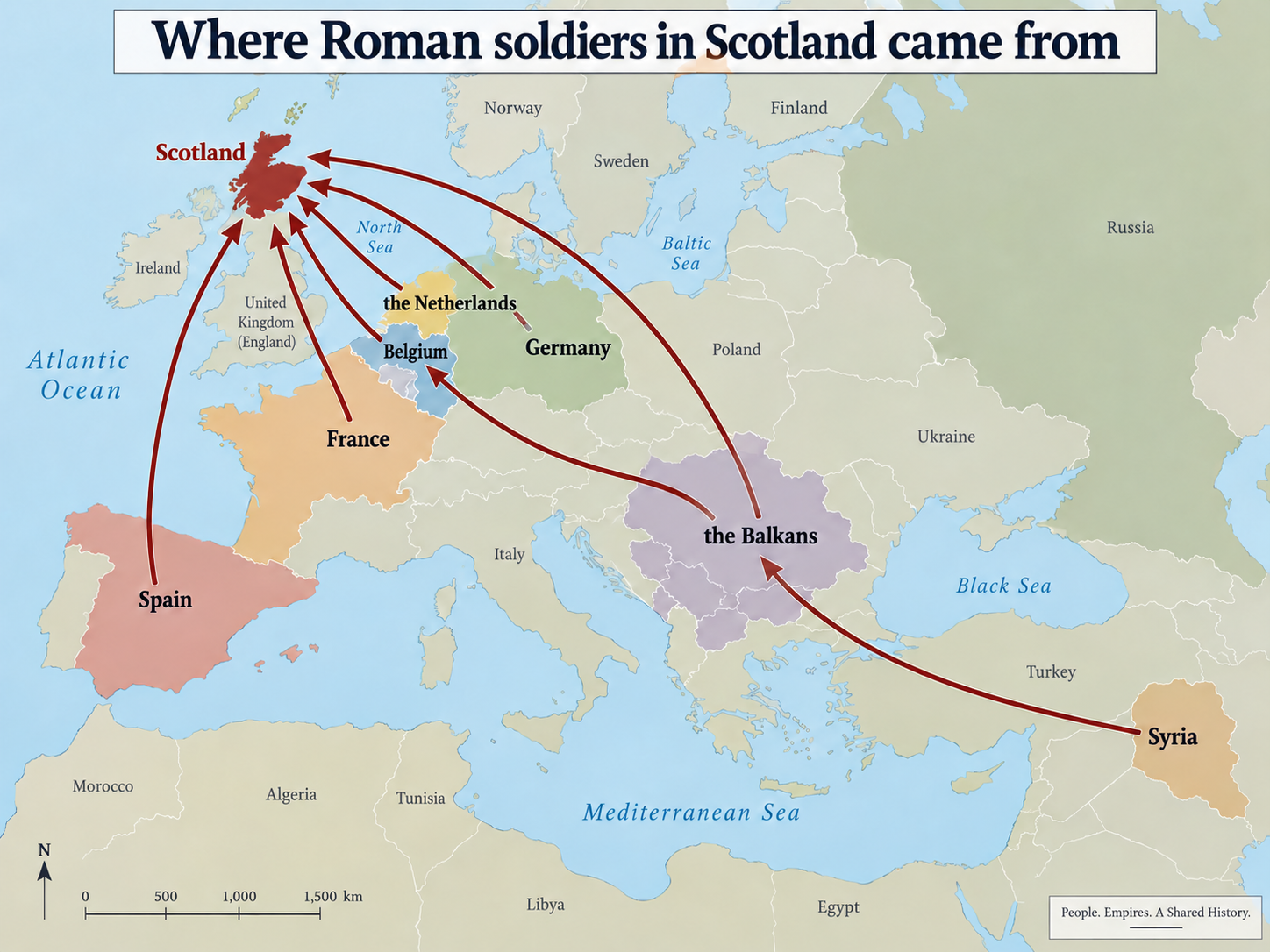
Where did these regiments come from?
The geographic names attached to auxiliary regiments take us across much of the Roman Empire.
Explore:
But these should be thought of as the origins of regimental traditions, rather than a passport record for every man who served in them. By the second century, a unit with a continental European name might contain men born in Britain.
More than support troops
The Latin word auxilia literally means assistance or support.
That can give the misleading impression that auxiliaries were somehow unimportant compared with legionaries. They were not. They garrisoned forts, patrolled frontiers, provided cavalry and specialist troops, took part in major battles and formed a substantial part of Rome’s provincial armies.
In Roman Scotland, they were everywhere.

