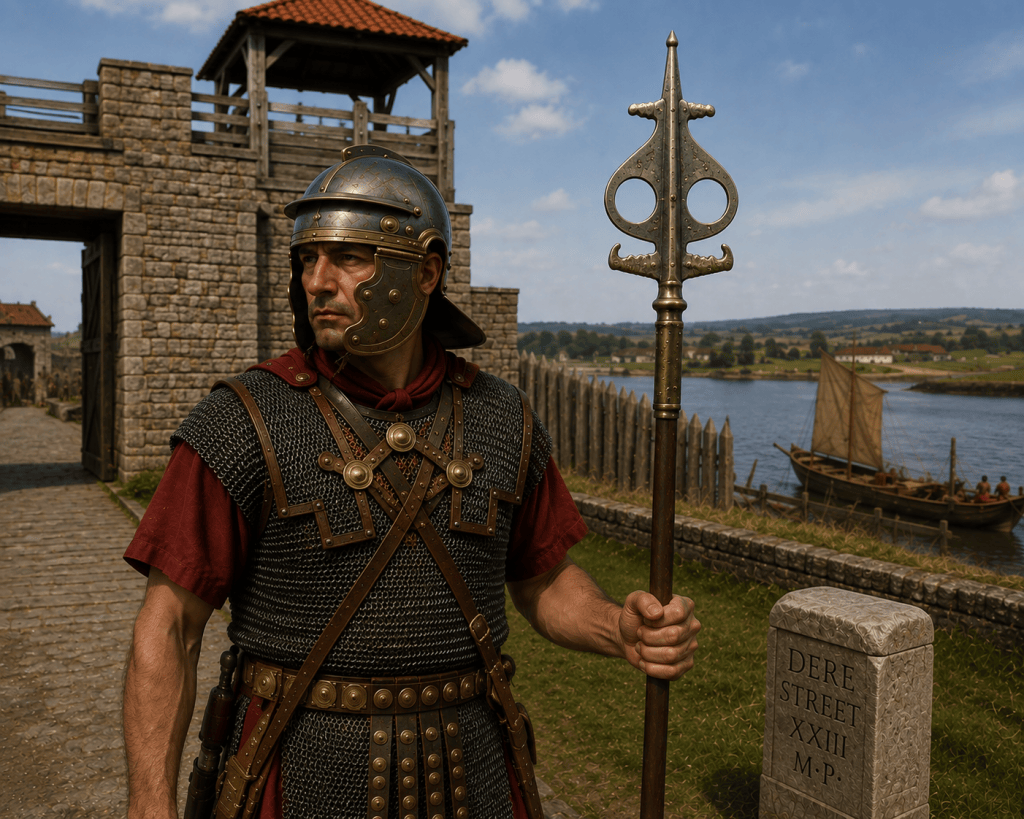
A small, battered piece of copper alloy found 50 years ago outside the Roman fort at Inveresk, near Musselburgh, may have revealed something remarkable about the way the Romans controlled Scotland. A new study by Bethany Simpson of National Museums Scotland suggests the object may have belonged to a Roman soldier known as a beneficiarius — one of the specially selected soldiers who helped the Roman authorities police roads, supervise communications and control the movement of people and supplies around the Empire.
If that identification is correct, the little object gives us a rare glimpse of the Roman officials who helped administer Scotland almost 1,900 years ago.
What was found at Inveresk?
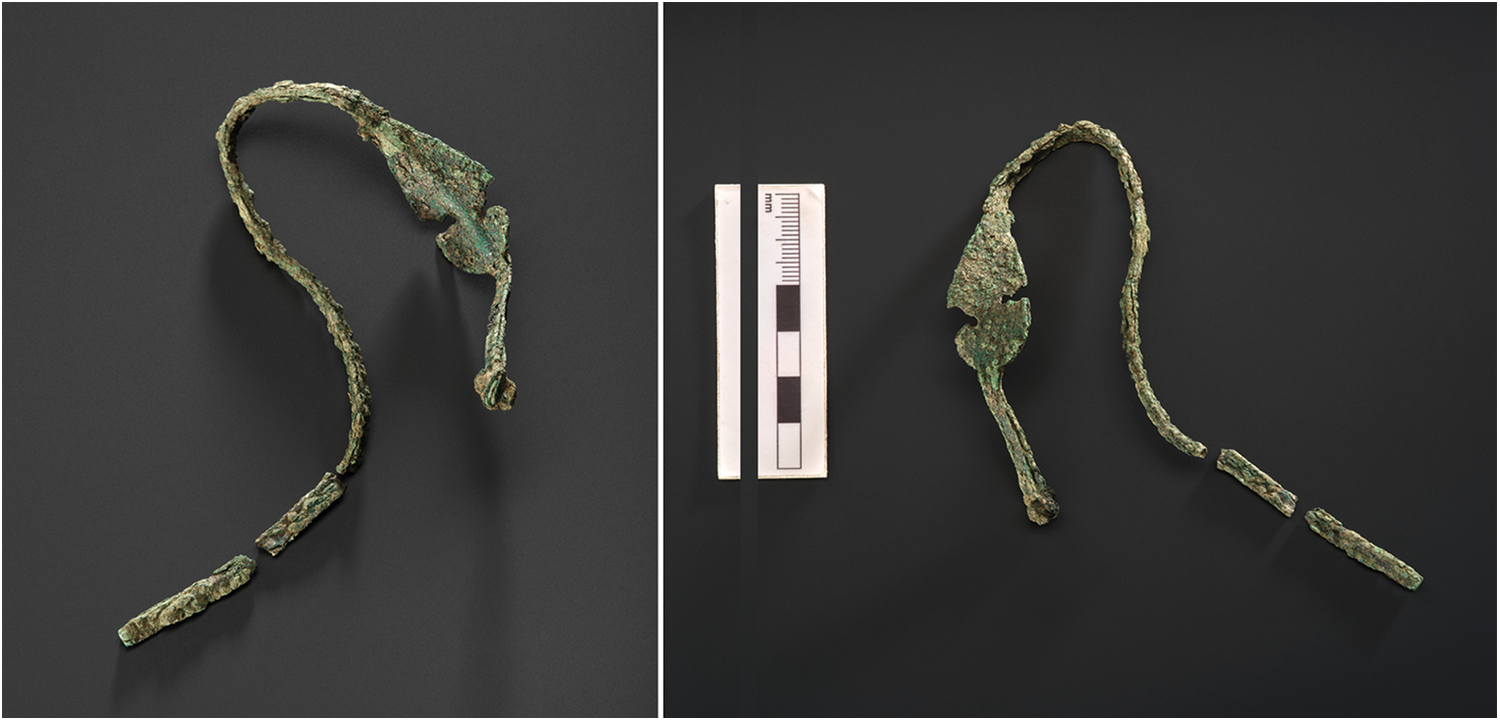
The object is made from copper alloy and, when straight, would have measured about 23 centimetres long. Its shape is distinctive. It has a leaf-shaped section resembling a spearhead, a raised central ridge and small circular holes. A surviving rivet indicates that it was probably attached to something rather than being used as an actual weapon. It was discovered in the vicus, the civilian settlement which developed outside Inveresk Roman fort. At first sight it might be interpreted as a miniature spear offered to the gods. Such miniature weapons are known from religious sites elsewhere in Roman Britain. But the Inveresk object is much more elaborate. Its back is flat, and it has a fixing, suggesting that it was intended to be displayed on another object. Bethany Simpson noticed that its unusual design resembles a very particular type of ceremonial spear associated with Roman soldiers called beneficiarii.
Who were the beneficiarii?
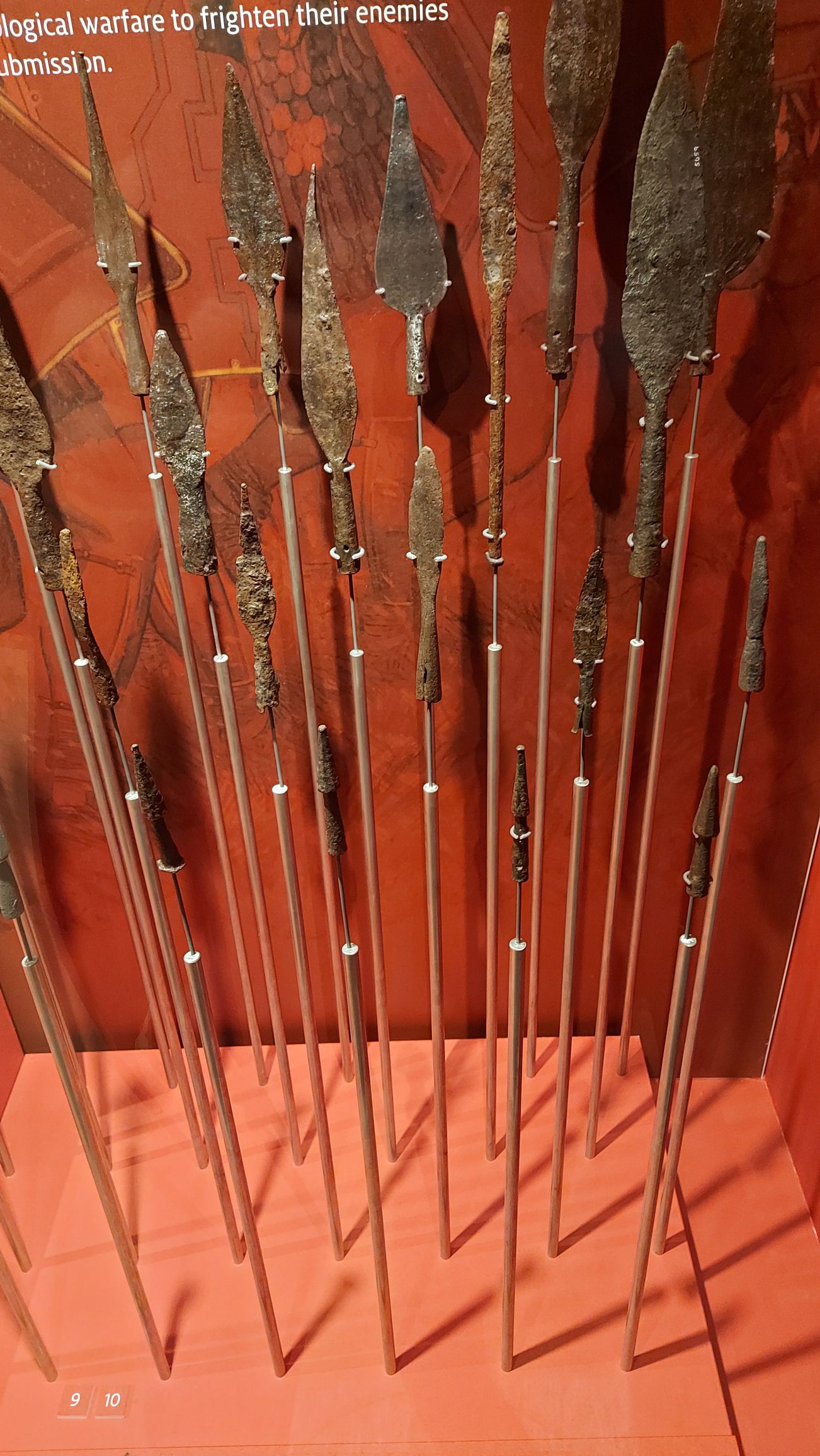
The Latin word beneficiarius roughly describes a soldier who had received a beneficium — a favour, privilege or special appointment. These were not ordinary soldiers – a beneficiarius had been released from normal military duties to undertake specialist work, often for a senior commander or provincial governor. A modern comparison is imperfect – CHiPS was mine -but it may help to imagine a mixture of a military policeman, customs official, government agent and administrative officer. Their duties could include:
- maintaining security;
- policing important roads;
- supervising travellers and traffic;
- protecting communications;
- overseeing the movement of supplies and other resources;
- carrying messages and official instructions;
- representing the authority of senior Roman officials.
Beneficiarii were often stationed at important road junctions, river crossings, frontier points and other places where the authorities needed to keep an eye on movement.
Inveresk Musselburgh
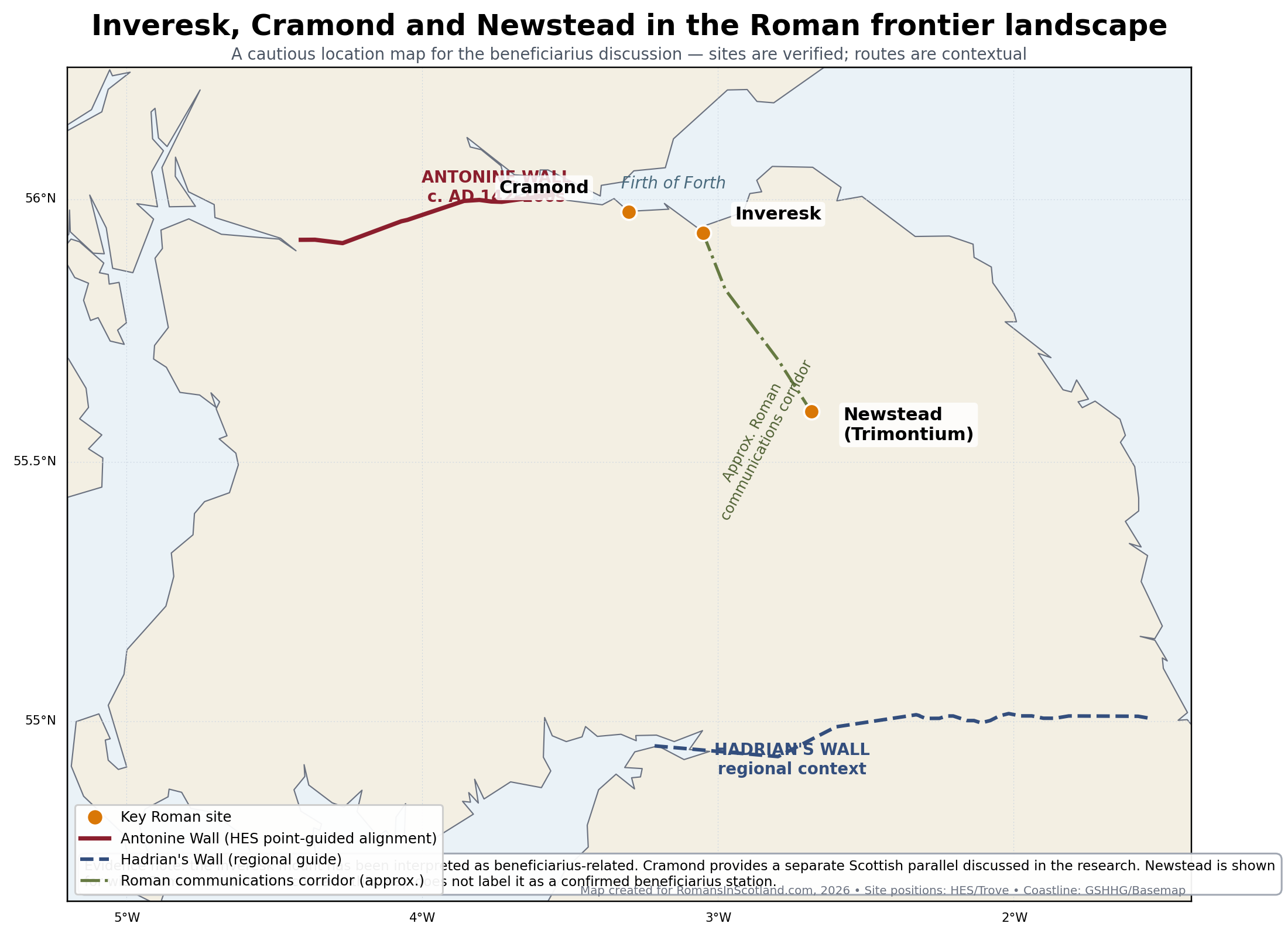
Inveresk occupied an excellent strategic position overlooking the River Esk and close to the Firth of Forth. Several important communications routes met in this area. The great Roman road Dere Street approached from the south, while routes connected Inveresk with other Roman positions along the Forth and ultimately with the Antonine Wall to the west. The coast also provided another means of transporting men and supplies. A Roman official stationed here could therefore help monitor traffic moving north and south by road, east and west across the military network, and by sea along the Forth. Inveresk may consequently have functioned not only as a military base but as an important centre for the administration and security of Roman-controlled southern Scotland. The tiny spear fitting provides tantalising evidence for precisely this sort of activity.
A badge of authority
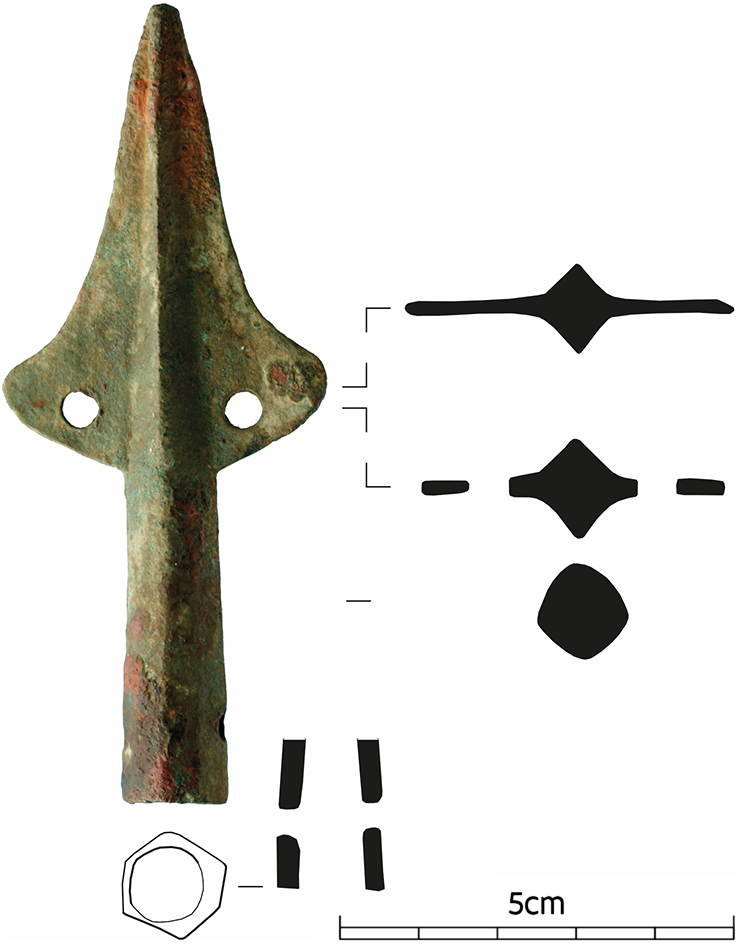
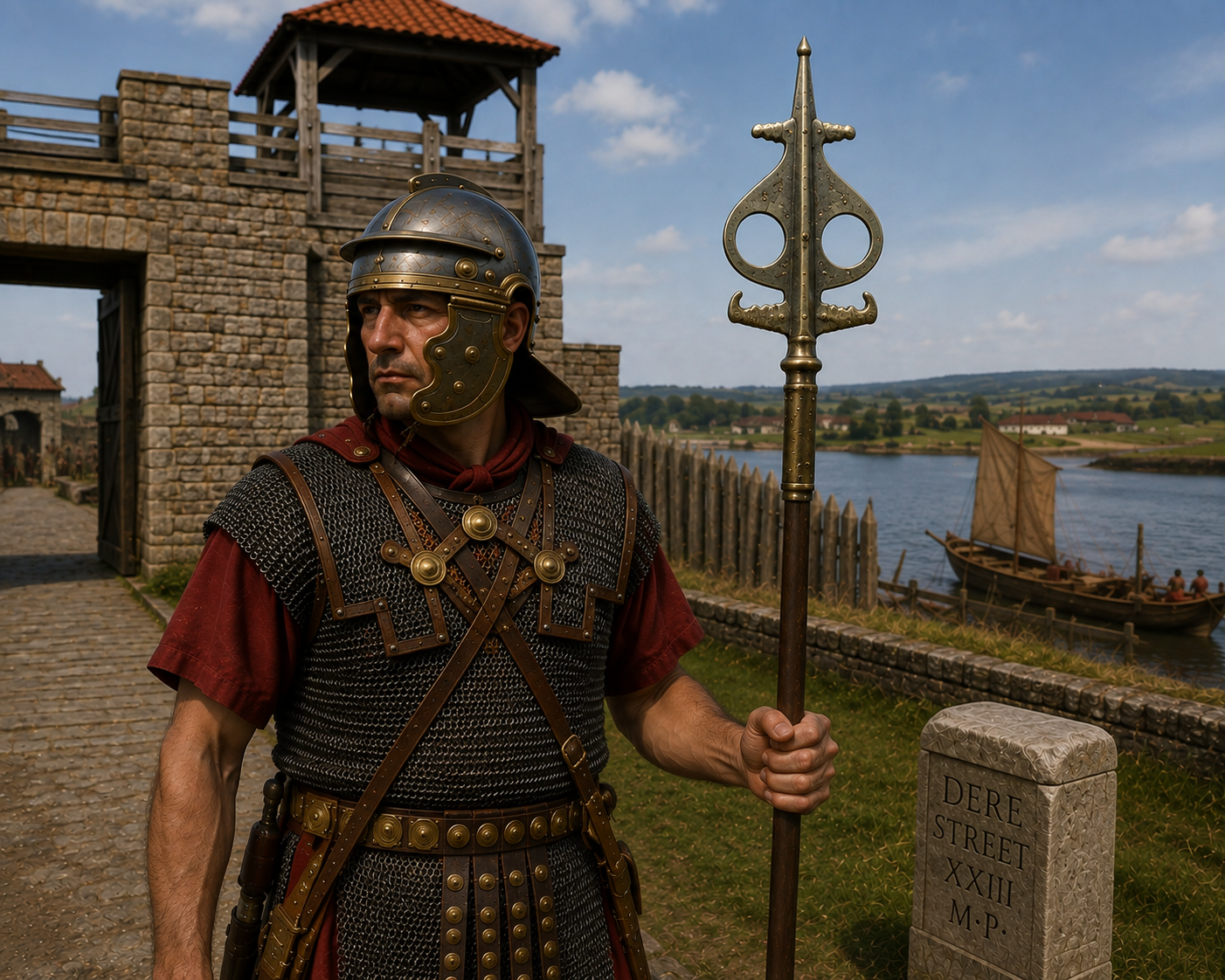
The beneficiarii had their own recognisable symbol. It was a distinctive ceremonial spear or lance, often with an elaborate leaf- or heart-shaped head containing holes or openings. These were probably not primarily fighting weapons. Images of these distinctive lances occur on Roman gravestones and altars associated with beneficiarii. Smaller versions of the emblem were also incorporated into soldiers’ equipment. The Inveresk object appears to belong to this tradition.
German Origins?
The closest parallels for the style of the Inveresk fitting come not from Britain but particularly from the German frontier of the Roman Empire. Beneficiarius insignia with similar leaf-shaped forms are known from Roman sites in Upper Germany. That does not necessarily mean that the owner of the Inveresk object was German. But it raises the possibility that he had previously served on the German frontier, came from a unit associated with that region, or had encountered soldiers who used this particular style of military decoration. Roman Scotland was never an isolated corner of the Empire. Soldiers, officers, administrators and their families could move enormous distances during their careers. Men serving in Scotland might previously have been stationed beside the Rhine or Danube, while troops recruited hundreds or even thousands of miles away could eventually find themselves guarding Rome’s northern frontier. The Inveresk object is a tiny reminder of those connections.
Were there beneficiarii elsewhere in Scotland?
Evidence is extremely scarce. Before the Inveresk object was identified, the most convincing piece of equipment connected with beneficiarii in Scotland came from Cramond Roman fort, only a few miles west along the Forth. A distinctive sword-related pendant discovered there resembles fittings associated with beneficiarii elsewhere in the Empire. Finding related symbols at both Cramond and Inveresk is therefore particularly interesting. It suggests that specialised military officials may have operated along this important corridor on the southern side of the Forth. There are also possible wider indications of beneficiarius activity in northern Britain, where such officials would have been useful at forts, road junctions and other strategically important locations. The Roman Empire was run by more than soldiers.
We often imagine Roman Scotland in terms of legionaries marching north, forts being constructed and battles being fought. But occupying territory was only part of Rome’s problem. An empire also had to be administered. Orders had to travel. Taxes and supplies had to move. Roads needed to remain secure. Officials needed information. Soldiers needed food and equipment. Travellers passed through checkpoints, and strategic routes had to be watched. Behind the Roman army, therefore stood an enormous administrative system. The beneficiarii were part of that system. They show us that Rome’s presence in Scotland involved not just soldiers with swords and shields, but officials carrying out the everyday business of controlling a frontier province.
References
This article is based principally on: Bethany Simpson (2025), “Objects in Miniature: A Copper-Alloy Beneficiarius Spear-Shaped Mount from Inveresk”, Britannia, Volume 56, pp. 357–371. The original academic paper is open access and contains photographs and drawings of the Inveresk object as well as comparative examples from elsewhere in the Roman Empire. [Cambridge Core – Objects in Miniature: A Copper-Alloy Beneficiarius Spear-Shaped Mount from Inveresk]
Large and miniature ‘spearshaped insignia’ of the Roman Empire, or ‘insignia of authority’ (also known as ’beneficiarius lances’), – Joaquin Aurrecoechea-Fernández University of Malaga

