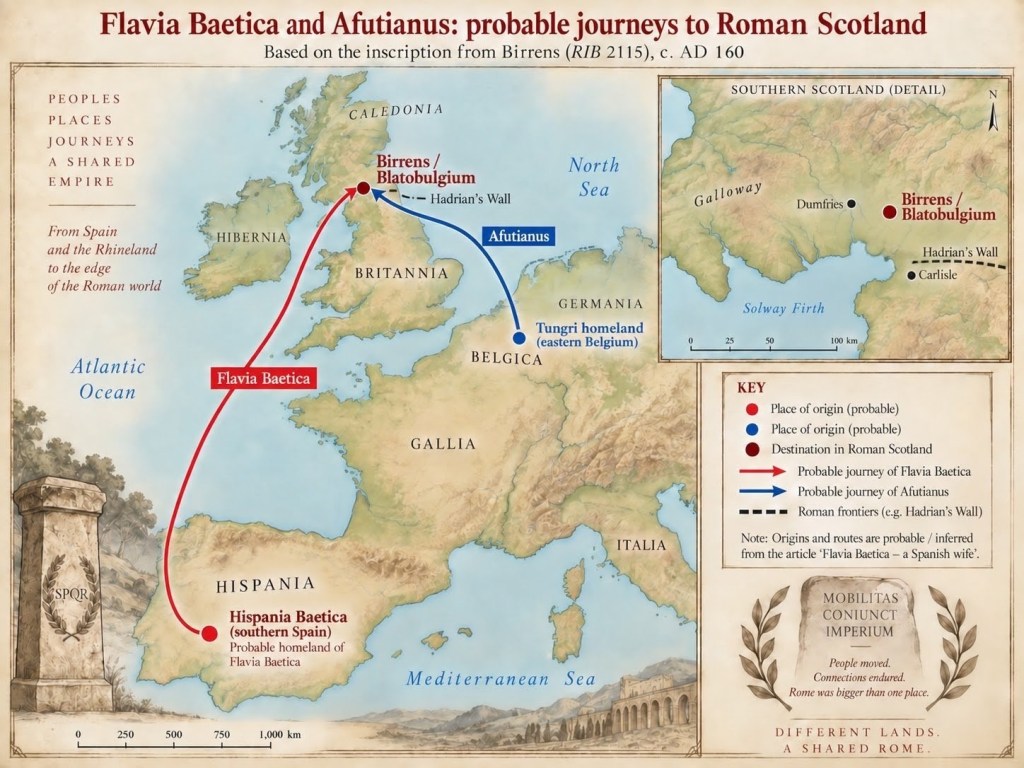
A Roman tombstone (RIB 2115) from Birrens (ancient Blatobulgium) memorialises Afutianus, son of Bassus, centurion of the Second Cohort of Tungrians, and his wife Flavia Baetica. The epitaph shows that Flavia carried the cognomen Baetica – the name of a province in Roman Spain (Hispania Baetica) – suggesting she or her family came from southern Spain. Afutianus’s career in the Tungrian auxiliary unit ties them to the Antonine frontier (c.160 AD). Their social status was relatively high (centurion + citizen wife), yet they may have been non-Italian provincials. The Birrens fort context (mid-2nd century Antonine occupation) matches the tombstone date. We summarise the inscription evidence (RIB 2115), discuss provenance and marriage, and note uncertainties (e.g. citizen status, precise origins, and how a Spaniard ended up in Scotland). We also compare interpretations from scholarship and inscriptions.
The Birrens Inscription (RIB 2115)
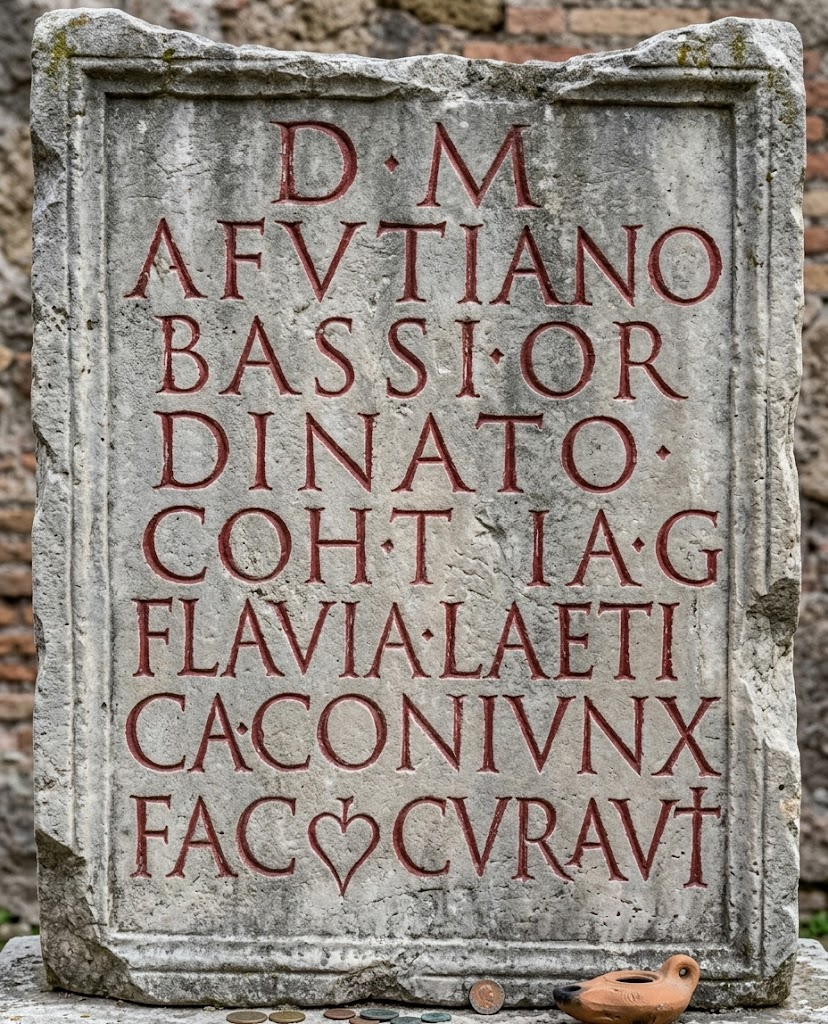
An early antiquarian record (Pennant 1776, Macdonald 1896) and later corpus (Collingwood & Wright RIB I) record a Roman funerary altar found at Birrens. The Latin inscription, drawn by R.G.C. in 1928, reads:
D(is) M(anibus) Afutiano Bassi (filio) ordinato coh(ortis) II Tung(rorum). / Flavia Baetica coniunx faciendum curavit.
Translated: “To the spirits of the departed and to Afutianus, son of Bassus, centurion of the Second Cohort of Tungrians, Flavia Baetica, his wife, had this set up.”. In other words, Flavia Baetica dedicated an altar for her husband Afutianus. The inscription is clear and formulaic; the identity of both individuals is unambiguous. The stone was found at Birrens (Dumfries & Galloway, Scotland) before 1772 and is now in Dumfries Museum. The wording identifies Afutianus as a centurion and Flavia as his wife (Latin coniūnx), with Flavia’s cognomen highlighting Baetica.
Figure: Funerary tombstone of Flavia Baetica and Afutianus. The Latin text (drawn by R.G.C.) shows Afutianus, centurion of II Tungrians, with Flavia Baetica calling herself his wife (coniunx).
Flavia Baetica – From Roman Spain?
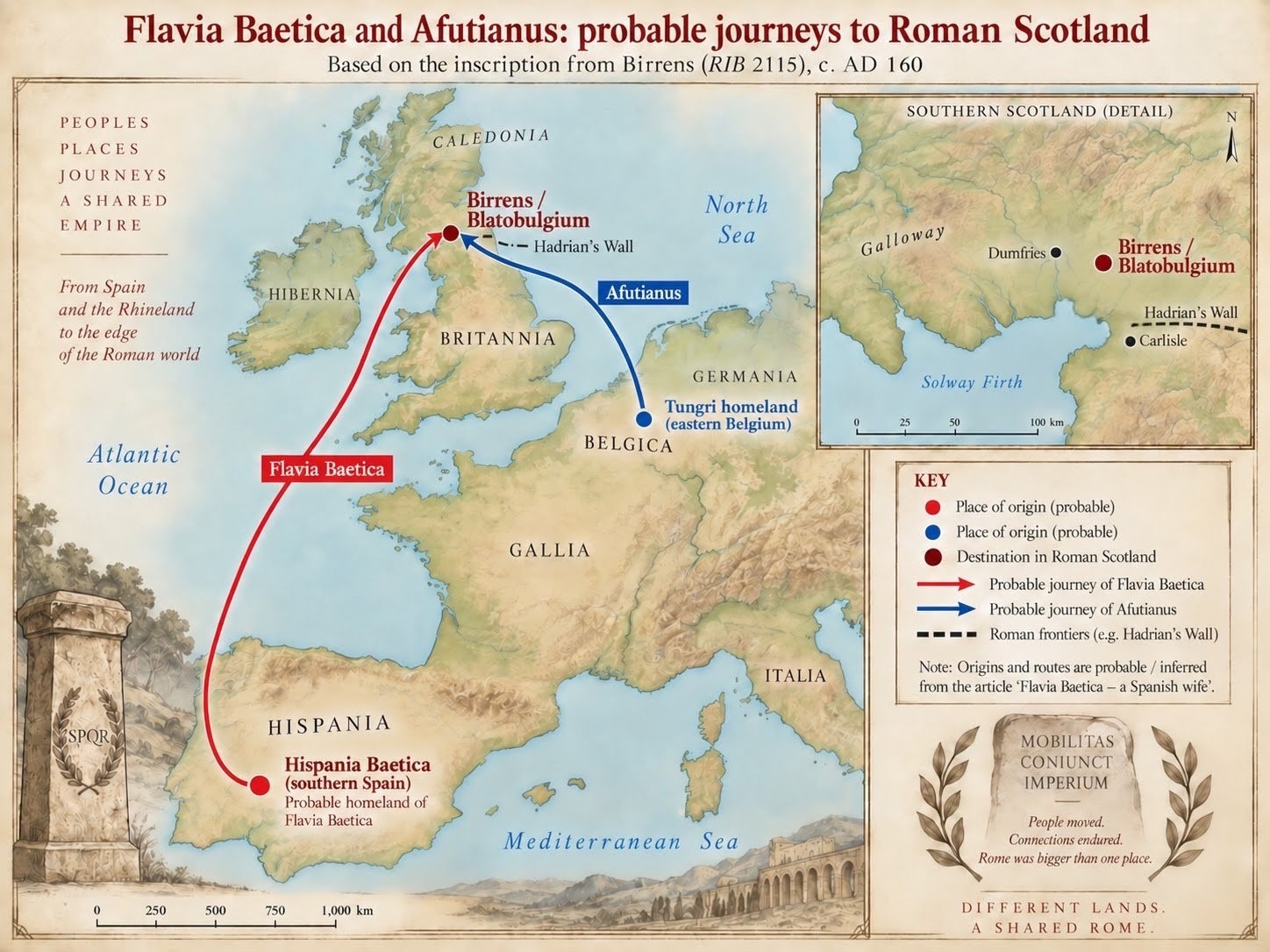
Flavia’s name is striking. Flavia is a common Roman nomen (possibly inherited or via citizenship), but Baetica is a place-name cognomen referring to Hispania Baetica, a wealthy senatorial province (southern Spain) founded under Augustus. In Roman naming, a female cognomen like Baetica usually denotes origin (literally “the [woman] from Baetica”). Thus it is very likely that Flavia (or her family) hailed from Baetica. This fits the pattern of some Roman women in Britain bearing Iberian-origin names. (By contrast, there is no known “Baetica” as a tribe or town in Britain.) Beyond the inscription, no literary source mentions her. If Spanish-born, she would have joined Afutianus in Birrens – an unusual but not impossible migration path. We find no alternative local explanation (no Celtic or Pictish equivalent), so the simplest reading is “Flavia from Baetica province.”
Afutianus & the Second Cohort of Tungrians
Afutianus, son of Bassus, is described as a centurio (centurion) of the cohors II Tung(orum). The Tungrians were an auxiliary unit originally raised among the Tungri tribe of eastern Belgium. By the Antonine period, they were stationed at Birrens, as confirmed by other inscriptions (see below). Afutianus’s tria nomina (though incomplete) hints that he had received Roman citizenship or at least Latin rights. A British museum summary notes that “although a Roman centurion, Afutianus was not a Roman citizen. He may have been born in Germany or France, and was an ordinary soldier who rose through the ranks”. This matches the auxiliary context: centurions could be former auxiliaries promoted by grant of citizenship. In any case, he held an elevated position. Their inscription is one of the many by Cohors II Tung at Birrens – indeed, over one-third of known Birrens inscriptions are by men of this unit.
Living at Birrens Fort in Antonine Scotland
Birrens (Roman Blatobulgium) was an auxiliary fort on the Antonine frontier road in Dumfriesshire. Excavations and inscriptions indicate it was occupied in two main phases: first by Cohors I Nervana Germanorum (mid-150s AD), then rebuilt and garrisoned by Cohors II Tungrians around 159 AD. The 2nd Tungrians were a milliaria (1,000-strong, part-mounted) unit (as confirmed by RIB 2110). (They are recorded dedicating an altar “Second Cohort of Tungrians, one thousand strong, part-mounted” for Antoninus Pius.) The RIB inscription 2110 dates to c.158 AD, so the Tungrians were present in the late Antonine period. Afutianus and Flavia’s tombstone must date around this time (c. 160 AD), consistent with Birrens’ Antonine II occupation. The Birrens fort itself lay in the Selgovae territory and guarded the western route north from Hadrian’s Wall. Today its turf-covered ramparts and some stone buildings remain.
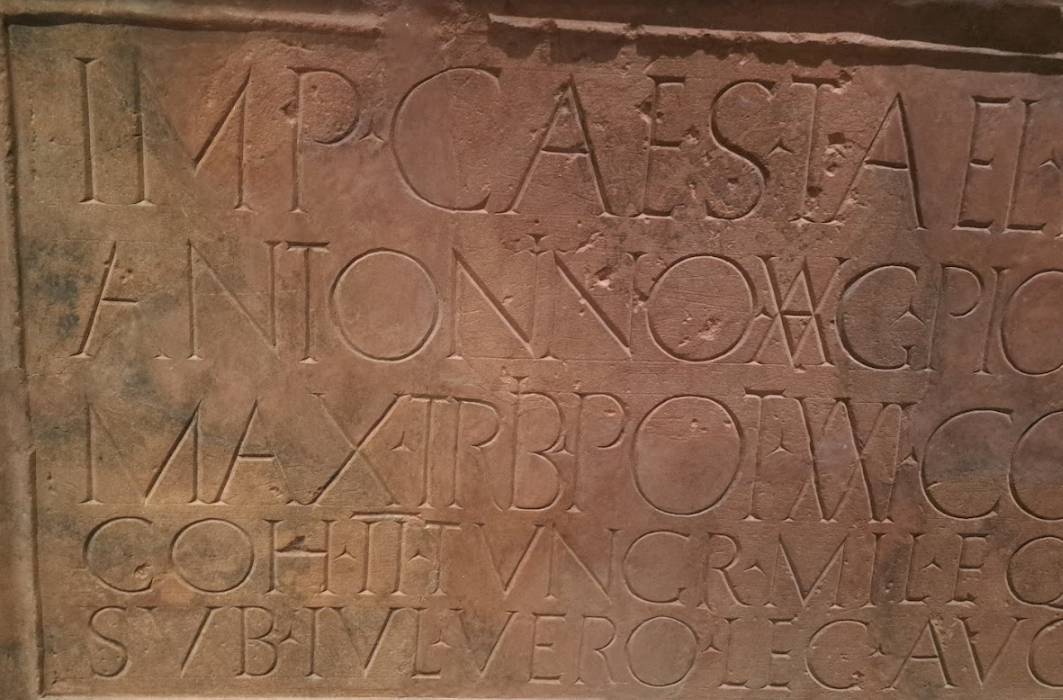
The inscription reads
Marriage, Status and Migration
Several questions arise: How did a Spanish woman marry a Tungrian centurion? Roman soldiers typically gained citizenship only on retirement, and formal marriage for auxiliaries was legalized only in AD 197. In practice however, many soldiers had contubernia (unofficial wives) and children. It is plausible that Afutianus either married Flavia in Spain (or a Spanish province) before or during service, or met her in Britain if her family had settled or traveled there. Flavia, having a Roman name, may have been a citizen already (perhaps by descent) or gained citizen status through marriage. The inscription’s dedicatory form suggests she had authority to erect a tomb, indicating recognized status. Both appear to be provincial rather than Italian elite: Tungrians recruited locally (Belgium/Raetia) and Baetica provincials. After marrying, they either accompanied the unit or settled at Birrens (if Afutianus retired there).
Other migration routes (trade, diplomacy) seem less likely for a centurion and wife. The military itself was the prime vector for movement – e.g. auxiliaries recruited in Gaul ended in Britain, and wives often came from the soldier’s homeland. If Flavia’s family lived in Baetica, Afutianus could have been posted to Spain at some point. Veteran settlement is a possibility: a soldier could be granted land near his last posting. However, no veteran evidence is known at Birrens. In sum, a military marriage (whether during active duty or on retirement) is the most straightforward scenario.
Chronology and Context
The tombstone was likely set up in the late 150s or early 160s AD, during the Antonine occupation of Scotland. The Second Cohort of Tungrians is specifically attested at Birrens in AD 157–158 (during Antoninus Pius’s reign). The RIB 2110 dedication by the Tungrians is dated “21st tribunician power, four times consul” (winter 157/158). Shortly after, the Antonine Wall was relinquished (c. AD 160), and many troops withdrew to Hadrian’s Wall. Birrens continued in Roman use for a couple more decades. Thus, Afutianus and Flavia’s memorial fits the end of the Antonine phase at Birrens (c.160 AD).
Alternative Interpretations & Uncertainties
We must note uncertainties. The inscription text is clear, but Flavia’s exact origin is inferred. It’s theoretically possible Baetica was not her birthplace but an inherited family name, though in Roman practice cognomina like this almost always meant origin. There is no evidence she was from anywhere else named Baetica. Similarly, Afutianus’s name (and rank) suggests Romanised status, but the RIB reports imply he may have lacked citizenship in youth. We cannot tell from the stone whether Afutianus was native to the Tungri homelands, Raetia (some Tungrian cantons were based there) or elsewhere. The tombstone was found reused (likely built into Hoddom Castle, as RIB notes), and its precise find-spot within Birrens is uncertain beyond “site Birrens”. Finally, we do not know what happened to them afterwards – no further inscriptions or records exist.
Given these uncertainties, scholarly interpretations remain cautious. The Spanish connection is strong but not absolutely proven by any other source. If new evidence (e.g. a mention in a Roman letter, or a similar Spanish name at another site) were found, it could revise our picture. For now, the simplest explanation holds: Flavia was a Spanish-born Roman woman married to a provincially raised centurion, together living in Roman Scotland.
Primary Evidence Summary
| Person | Inscription (RIB) | Findspot (modern context) | Date/ Context | Latin Transcription (abridged) | English Translation (abridged) |
|---|---|---|---|---|---|
| Flavia Baetica (wife) | RIB 2115 (Birrens, Scotland) | Birrens (Blatobulgium, Dumfriesshire); found before 1772; now in Dumfries Museum | c.160 AD (Antonine period) | D(is) M(anibus)… Flavia Baetica coniunx fac(iendum) curavit | “(To the spirits of the departed and) Flavia Baetica, his wife, had this set up.” |
| Afutianus (husband) | RIB 2115 (same as above) | Birrens; found <1772; museum artifact | c.160 AD (Antonine period) | …Afutiano Bassi (filio) ordinato coh(ortis) II Tung(rorum)… | “Afutianus, son of Bassus, centurion of the Second Cohort of Tungrians.” |
The table above condenses the key data from inscription RIB 2115 (and RIB 2110 for dating). The Latin text is complete and uniformly interpreted, giving us confidence in names, titles and relationships. The date range is inferred from the known garrison (Antonine mid-2nd century).

