Gaming pieces, dice and boards show that games were part of Roman life. The activities below are modern classroom versions inspired by ancient play; their rules should not be treated as securely documented Roman rulebooks.
ROLLING NUTS
The game
10 nuts for 2 players
or more nuts for other players
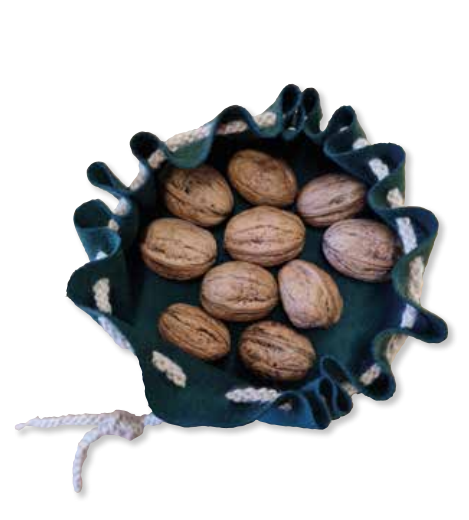
Instructions
- You play in pairs, and each player has five nuts.
- If you have more nuts, several players can play.
- In turns, everyone lets a nut roll down an inclined surface.
- For example, over a book that is lying on a pencil case. Whoever hits the other player’s nut with a nut can keep both nuts.
- If you have no more nuts left, you are eliminated.
- If you have the most nuts at the end, you win.
- Feel free to make up your own rules.
Pyramid Punt
Get something to draw on the floor like chalk
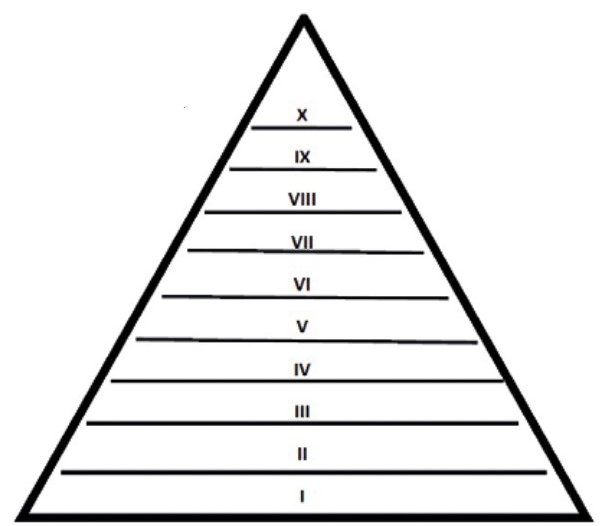
You play in pairs or with several people.
Draw a triangle on the floor, for example in the schoolyard with chalk.
You can decide the size yourself.
Instructions
- Divide the triangle into ten equal-sized fields and number them with the numbers
- from 1 to 10. If you like, you can use Roman numerals (I. – X.).
- Find stones of roughly the same size, three for each.
- Decide on a point from which the stones will be thrown.
- One after the other, everyone throws their stones and tries to get as many points as possible. If the stone stays in the field with the 10, it gives 10 points. In the field with the 9, it gives 9 points and so on.
- Add the points after each round.
- Everyone can throw the three stones three times. In the end, whoever has the most points wins.
Tris
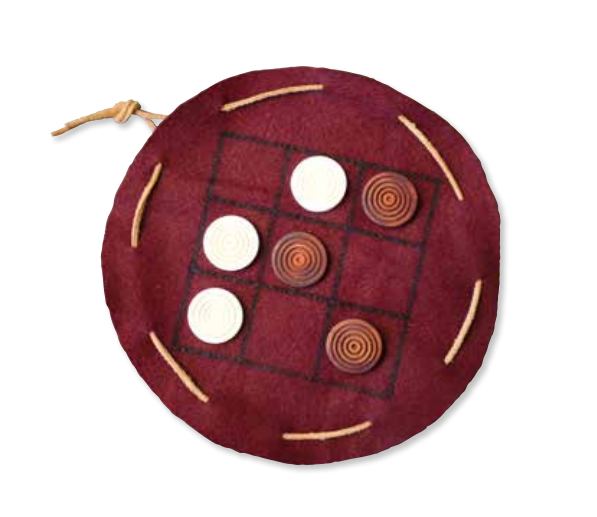
The game
2 x 3 game pieces
Bag with “playing field”
Instructions
- You play in pairs.
- Each player has three game pieces in one colour.
- You take turns placing a game piece in one of the fields.
- When all the pieces are in play, one piece must be moved in each round. This can be done in all directions, even diagonally.
- The first person to have three pieces in a row wins.
Use soft counters or beanbags for the throwing activity. Supervise small pieces and avoid nuts where allergies are an issue.

