A cargo of building stone lying in a sunken Thames vessel gives us a more tangible picture of Roman shipping than a fleet of warships imagined off the Scottish coast. The Romans used water to move heavy goods, soldiers, animals and messages, but the craft involved differed considerably. A broad trading ship, a shallow river barge and a narrow rowing vessel each answered a different need.
This article looks at boats used in Britain during the Roman period, broadly AD 43–410, and at continental examples that help us understand what other vessels may have looked like. That date range covers Roman Britain as a whole; it does not imply continuous Roman occupation of Scotland. Excavated hulls, ancient accounts and modern reconstructions provide different kinds of evidence, and need to be kept distinct.
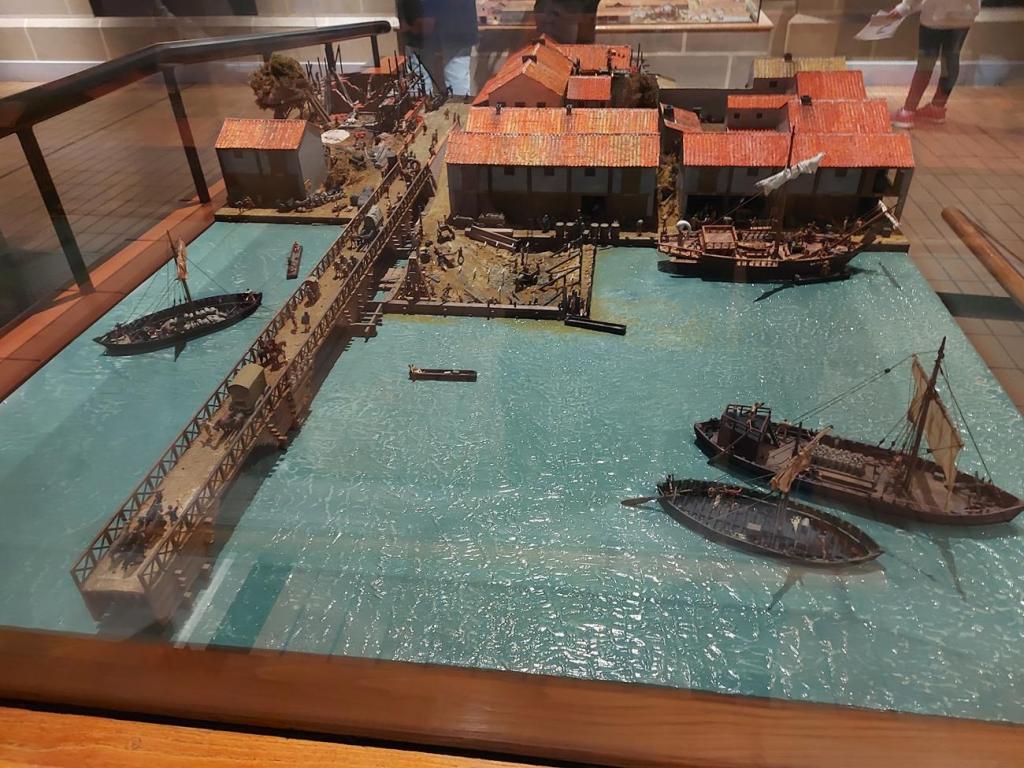
What survives, and what has to be reconstructed?
The surviving British hulls include Blackfriars Ship 1, the New Guy’s House boat and the County Hall ship in London, and the Barland’s Farm boat near Magor in South Wales. These are individual vessels, not examples of a standard fleet specification. Their timbers can reveal how they were assembled, while their shape allows researchers to estimate how they floated and what loads they could support.
The archaeological sample is small and uneven. Waterlogged river deposits can preserve timber that would decay elsewhere, so the surviving boats cannot simply be treated as a representative selection of everything that sailed around Britain. Written sources broaden the picture, especially for military vessels, but rarely give the dimensions or practical details that we would like.
Cargo ships: Blackfriars Ship 1
Discovered in the Thames in 1962, Blackfriars Ship 1 is an important example of a vessel built in the tradition often called Romano-Celtic. The term describes a group of construction practices; it does not establish the ethnic identity of its builders or crew.
Its broad oak planks were fitted edge to edge and secured to substantial frames with large iron nails. Hazel shavings and pine resin helped seal the hull. A surviving mast-step, the timber support for the foot of a mast, shows that it carried sail. This was a substantial working vessel, rather than a small rowing boat.
Most revealing of all is its cargo. The London Museum’s mast-step record associates the sinking, around AD 150, with building stone carried from Maidstone in Kent to London. The Dutch Cultural Heritage Agency’s wreck record also describes traces of marine organisms in the wood, supporting use at sea.
Published reconstructions differ over dimensions and carrying capacity. The Dutch record gives an estimated cargo capacity of about 50 tonnes. Such figures are calculations from a reconstructed hull, not a surviving ship’s certificate. The secure point is that vessels built in this northern tradition could move heavy bulk cargoes and were not confined to quiet inland water.
River barges: the New Guy’s House boat
A vessel found beneath Guy’s Hospital in Southwark shows a different solution. Historic England’s record describes an oak boat at least 16 metres long, about 4.25 metres wide and approximately one metre deep amidships. It lay in a former tidal creek off the Thames and was probably abandoned around AD 200.
Analysis of its buoyancy suggests a load of about seven tonnes. Its shallow hull suited river transport, where getting goods through restricted channels could matter more than seaworthiness offshore. Much of the boat remains buried in place.
This helps explain why a long boat did not necessarily carry a huge cargo. Length alone is a poor guide: width, hull depth and the amount of hull left safely above water all matter. A river barge and a seagoing cargo ship of similar length could have very different capabilities.
Tidal creeks and estuaries: Barland’s Farm
The boat discovered at Barland’s Farm near Magor in 1993 was built around AD 300. The Living Levels account gives a reconstructed original length of about 11.4 metres, a width of roughly three metres and a depth of 0.9 metres.
Its oak planks were nailed to heavy frames. The nearly flat bottom and shallow draught suited the tidal creeks bordering the Severn estuary, where a vessel might settle on mud or load beside a modest landing place. Sailing is thought likely, with rowing also possible.
Its estimated load exceeded six tonnes. Cereal remains between the planks suggest agricultural produce as one possible cargo. This is a useful example of the smaller craft that could connect farms and local landing places with wider transport networks, although a particular route cannot be reconstructed from the hull alone.
Mediterranean methods in a British-built ship
The late third-century County Hall ship, found beside the Thames in 1910, represents another construction tradition. Its planks were joined along their edges with mortise-and-tenon joints: wooden tongues fitted into matching slots, fastening neighbouring planks together.
These methods are associated with Mediterranean shipbuilding, yet the wood has been identified as having grown in south-east England. A Mediterranean technique therefore does not mean a ship was necessarily built in the Mediterranean. The London Museum preserves a repaired plank fragment from the vessel.
Its original function is less certain. It has been discussed as a merchant vessel or a ship with a military connection, but neither an individual owner nor service in a particular emperor’s fleet is established. The construction evidence is firmer than the proposed biography.
Warships and the fleet in northern Britain
The Classis Britannica, the Roman fleet associated with Britain, is attested by inscriptions and stamped tiles. Roman Inscriptions of Britain describes its principal base at Boulogne and its establishment at Dover. These records demonstrate an organised naval presence, without providing a complete catalogue of its ships.
For Scotland, Tacitus supplies unusually useful evidence. In Agricola 25, he describes the fleet scouting harbours during Agricola’s sixth campaigning season and operating alongside the army beyond the Forth. He depicts infantry, cavalry and naval personnel sharing camps and comparing their experiences. This is a literary account written in praise of Agricola, but it explicitly records co-operation between land and sea forces.
There is also a named vessel type. In Agricola 28, mutinous Usipi seize three liburnicae, usually understood as light warships. The episode strengthens the case for oared military craft in British waters. It does not tell us their precise dimensions, loading capacity or the location from which they departed. Read more about the Usipi and Agricola’s campaigns.
Light patrol boats: a useful continental comparison
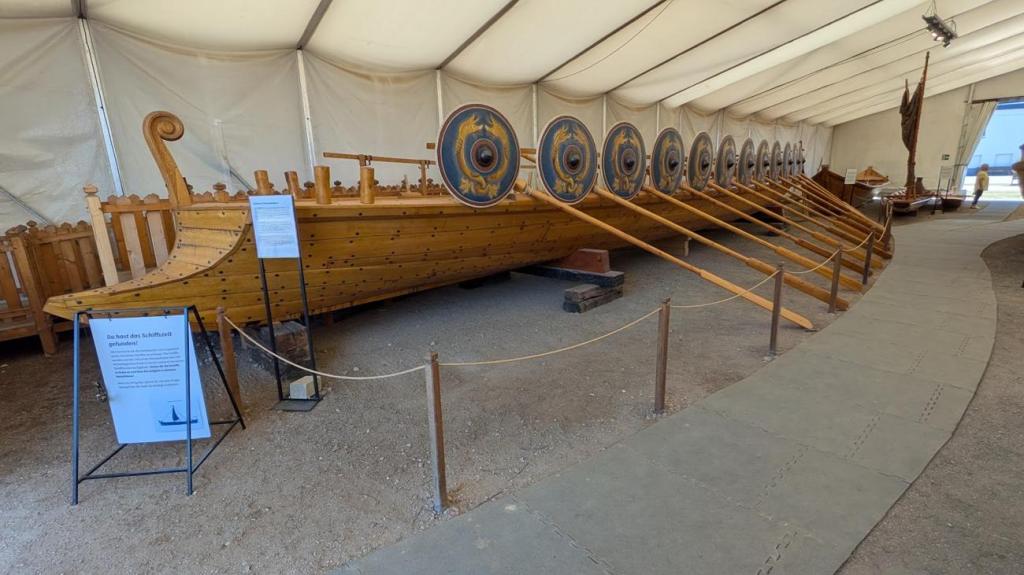
The long, narrow boats often illustrated as Roman river patrol craft are particularly associated with the late Roman Rhine frontier. Finds at Mainz and modern reconstructions help researchers investigate rowing, steering and the practical use of these vessels. The term navis lusoria is commonly used for this type of light patrol boat.
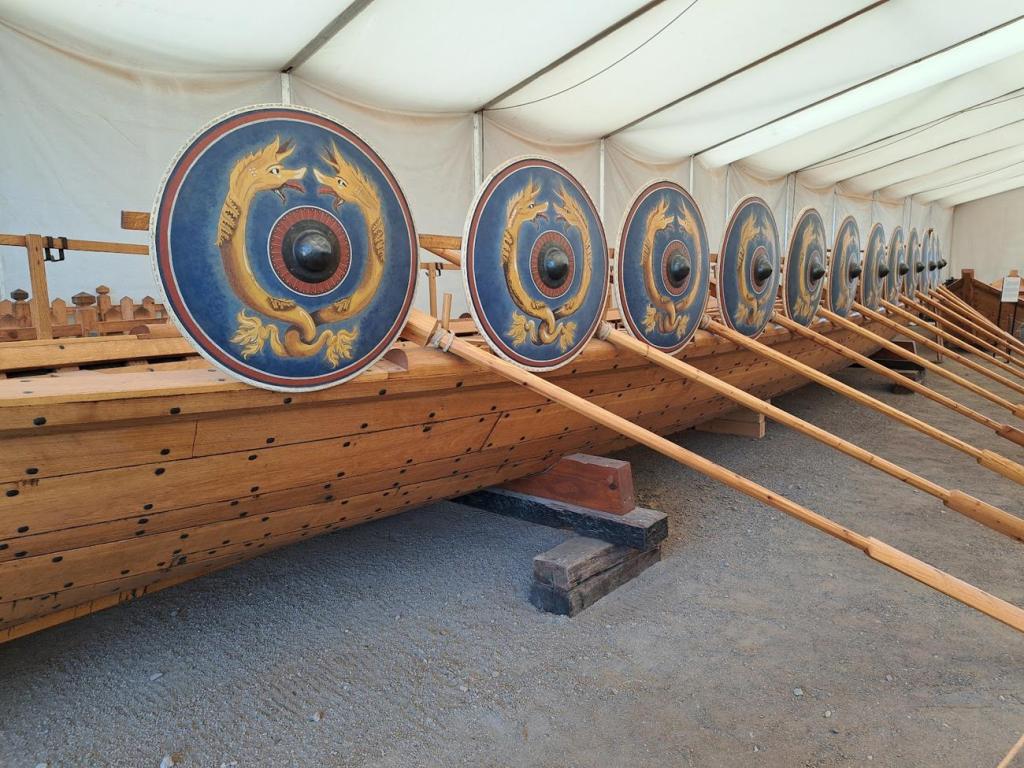
The photographs here show Quintus Tricensimanus at Xanten, a modern reconstruction rather than an ancient hull. Its narrow body and repeated rowing positions make its purpose easier to understand. These are useful comparisons, but no securely identified British hull of this type is established in the sources used here. Nor should a late Roman reconstruction be presented as the known appearance of Agricola’s first-century ships.
Carrying soldiers and horses
Moving an army by water required more than warships. Broad transport vessels offered space for people, provisions and animals, while oared craft could help with reconnaissance and movement near a landing place.
A useful comparison comes from Germanicus’ continental campaign of AD 16. In Annals 2.6, Tacitus describes a varied fleet: some craft had flat bottoms suitable for grounding, others could be steered from either end, and decked vessels could carry horses, supplies or military equipment. This predates the conquest of Britain and concerns a different campaign. It demonstrates Roman transport options, rather than proving which designs crossed the Channel in AD 43.
Horse transport posed particular difficulties. Animals needed room, secure footing and a way to embark and disembark; their movement could affect a vessel’s balance. Stalls, partitions and gangways are reasonable elements in a reconstruction, but the British wrecks discussed here do not preserve a horse-transport installation.
For that reason, a statement such as “this ship carried twenty horses” would imply more certainty than the evidence allows. Estimates made by dividing a supposed payload by the weight of a horse or soldier overlook space, stability, provisions and weather. A maximum cargo load was not simultaneously a maximum passenger load.
Amphorae, barrels and everyday cargo
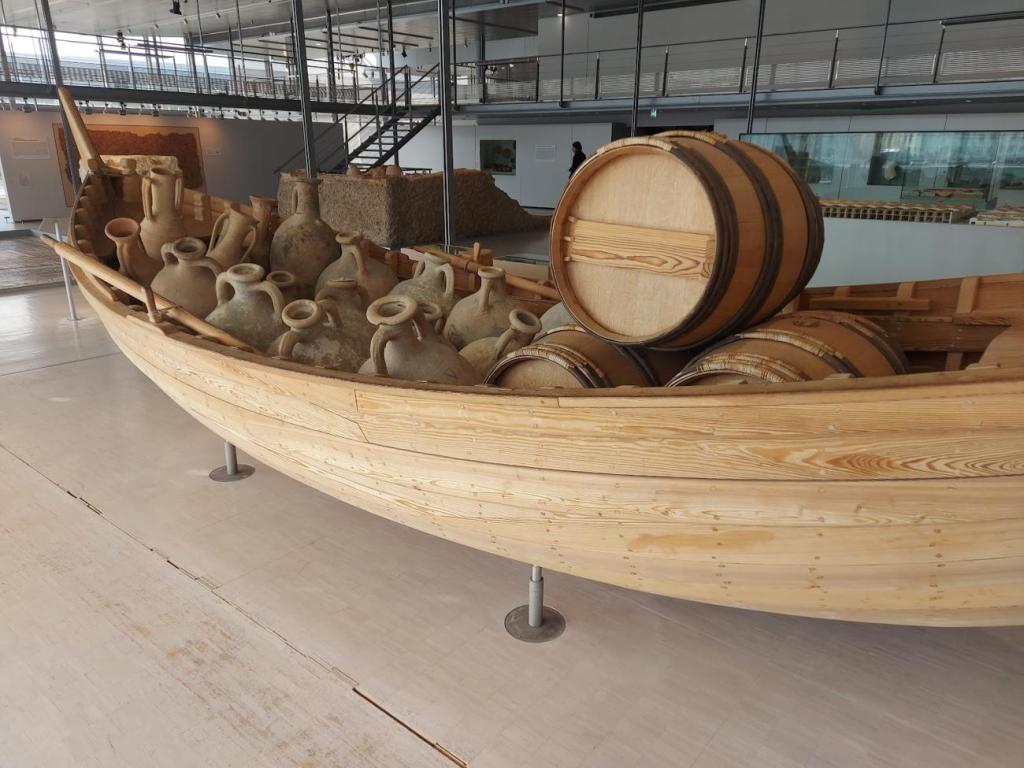
Cargo boats linked the army and civilian settlements to a much wider economy. The amphora, a ceramic transport jar, is one of the most recognisable surviving containers. The University of Southampton’s amphora catalogue identifies the rounded Dressel 20 as an olive-oil container produced in southern Spain and widely distributed to Britain and other western provinces.
The pottery survives more readily than many other cargo containers. Barrels, sacks and baskets also belong in the picture, alongside loose or bundled materials. A display of jars and barrels helps us imagine a cargo, but should not be read as an exact reconstruction of how a particular wreck was loaded.
Heavy goods needed to be distributed with the vessel’s balance in mind and secured against movement. The number of amphorae aboard would depend on their shape, contents, packing and the rest of the cargo. For the containers found on Scottish sites, see Amphorae in Scotland.
Small boats and older traditions
Roman occupation did not make every local boat a Roman military design. Logboats, hollowed from a tree trunk, continued in use: Hardham II in Sussex is a Roman-period example. Such craft belong alongside the larger ships when considering local fishing and short journeys.
Hide-covered boats are harder to document archaeologically. Ancient texts describe this construction in north-western Europe, but the surviving evidence does not justify assigning a standard size or passenger capacity to a “Roman British coracle”. Likewise, prehistoric sewn-plank boats should not automatically be carried forward into the Roman period without evidence.
What can we say about Scotland?
The strongest direct evidence considered here is Tacitus’ account of naval operations during Agricola’s campaigns. The excavated boats from southern Britain show some of the technologies available within the province; the continental reconstructions demonstrate further possibilities. Neither establishes the precise mix of hulls used on the Forth, Tay or western seaways.
Places such as Carpow invite consideration of access by water, especially in discussions of Septimius Severus’ campaigns. However, a riverside setting does not by itself prove a particular quay, landing arrangement or ship type. Ancient shorelines and navigable channels also need to be investigated rather than assumed to match the modern landscape.
The most convincing picture is a varied one: substantial sailing ships moving bulk cargoes, smaller boats distributing goods through rivers and estuaries, and military craft serving the needs of campaigns. Their exact combination in Scotland remains a research question. This article complements the site’s existing Roman Navy in Scotland overview by concentrating on the vessels and the strength of the evidence for them.
Sources and further reading
Prepared from Roman Boats and Ships Used in Britain, AD 43–410, supplied for this article, with its claims checked against the sources below. Detailed troop, horse and amphora capacities in that working document have not been adopted as established archaeological facts.
- Walsh, M. and contributors, “Roman”, A Maritime Archaeological Research Agenda for England. Especially the sections on ships, boats and the Classis Britannica.
- London Museum, Blackfriars mast-step timber, object 77.253/1; County Hall plank fragment, object B709/7.
- Cultural Heritage Agency of the Netherlands, MaSS: Blackfriars Ship 1. Wreck evidence and reconstructed cargo capacity.
- Historic England, New Guy’s House Roman riverboat, list entry 1001979.
- Living Levels, “The Barland’s Farm Boat”. Includes a link to Nayling, N. and McGrail, S. (2004), The Barland’s Farm Romano-Celtic Boat, CBA Research Report 138.
- Roman Inscriptions of Britain, 2481: tile-stamps of the Classis Britannica.
- Tacitus, Agricola 25 and 28 (Latin text and commentary, edited by Cynthia Damon, Dickinson College); Annals 2.6 (J. Jackson’s translation, reproduced by LacusCurtius).
- LEIZA, Museum of Ancient Seafaring, Mainz; LVR’s KuLaDig record for the Archaeological Park Xanten. Continental finds and reconstructions.
- University of Southampton, Roman Amphorae: a digital resource, Dressel 20. Archaeology Data Service, updated 2014.
Photographs supplied by Andrew Wallace from his Roman Boats album. Museum models and replicas are identified in their captions. Online sources checked 7 November 2026.

