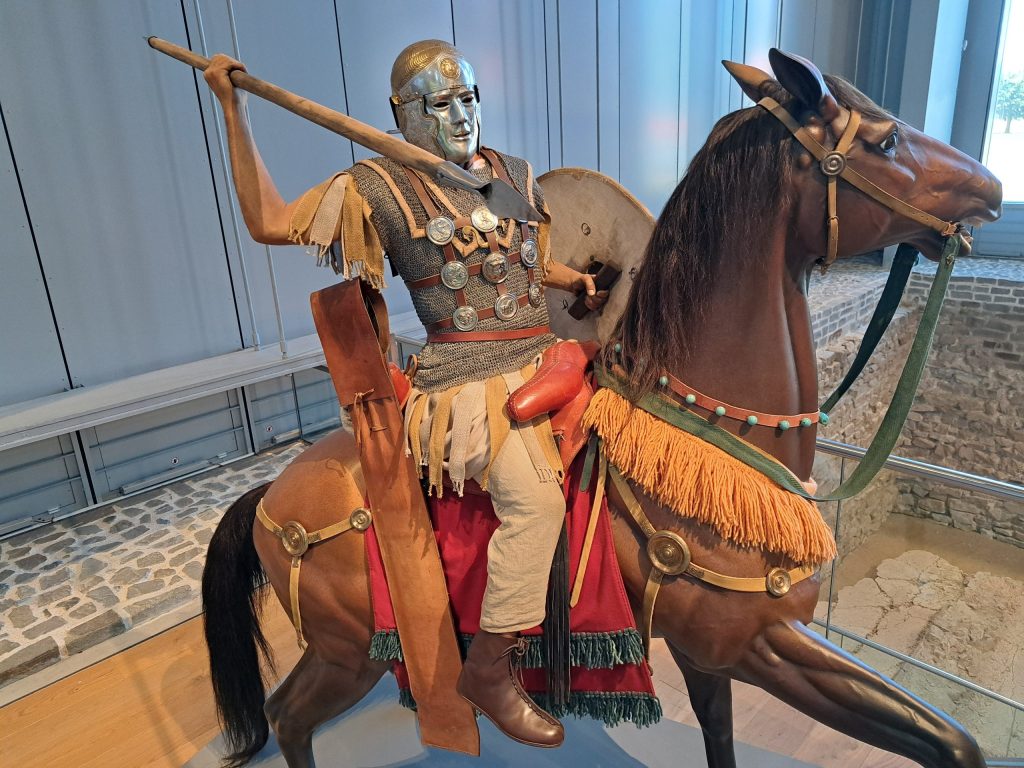
The Ala Gallorum Sebosiana was an auxiliary cavalry regiment serving in Roman Britain. Two finds connect its soldiers with the provincial governor’s mounted guard: a wooden writing tablet naming Agricola, found at Carlisle, and the tombstone of Crescens, discovered near Inveresk. They show how individual cavalrymen could serve away from their parent regiment.
A cavalry regiment in Britain
An ala was a cavalry regiment in the auxiliary army. Gallorum, meaning “of the Gauls”, records the unit’s original association with Gaul. The fuller name Ala Gallorum Sebosiana occurs in military diplomas; shorter forms appear in other documents and inscriptions.
The unit served in Upper Germany before moving to northern Italy during the civil war of AD 69. Its transfer to Britain with Petillius Cerialis in AD 71 is a scholarly reconstruction, not a directly recorded date. See the historical commentary accompanying the Carlisle tablet.
Other Carlisle tablets document a nominally 500-strong cavalry regiment divided into sixteen squadrons, or turmae. A surviving grain account records barley and wheat issued to these squadrons. The regiment is not named in that account: its identification as the Sebosiana rests on comparison with the other evidence. These records bring the daily requirements of cavalry service into view, including feeding the horses as well as the soldiers.
The Carlisle tablet and Agricola
The fragment known as Tabulae Luguvalienses 44 was found during the Annetwell Street excavations of 1981–84. Now in Tullie House Museum, Carlisle, it measures only 82 × 15 mm and preserves part of an address. The published translation reads: “To […] trooper of the ala Sebosiana, singularis of Agricola.”
A singularis was a soldier seconded to the governor’s guard. The editor identifies Agricola here as Gnaeus Julius Agricola, governor of Britain, giving a historical date of approximately AD 77–84. The recipient’s name is lost. This is evidence for one cavalryman’s posting, not for the whole regiment forming Agricola’s bodyguard or fighting in a particular Scottish battle.
Read the tablet’s transcription, translation and commentary, and view its photograph in Roman Inscriptions of Britain.
Crescens: a guardsman commemorated near Inveresk
Crescens’s sandstone tombstone was discovered at Carberry in 2007, about 2 km south-east of Inveresk Roman fort. It is now in the National Museum of Scotland, accession X.2008.47. Its lettering and formulae suggest an Antonine date; the stone does not supply a precise year.
The inscription identifies Crescens as a cavalryman of the Ala Sebosiana serving in the equites singulares, the governor’s mounted guard. He had completed fifteen years’ military service, and his heir arranged the memorial. That is his length of service, not his age.
His presence does not establish that the entire regiment garrisoned Inveresk. The published commentary considers several explanations: detached duties connected with communications or supervision, accompanying a visiting governor or another senior official, or a connection with his parent unit. These remain interpretations. The surviving lower part of the carving includes a horse’s hoof, the rider’s foot and a fallen opponent.
View the tombstone photograph and read the inscription and competing explanations. For the wider setting, see Fraser Hunter’s Bodyguards, corpses, and cults, and the Scottish Archaeological Research Framework’s illustrated discussion of the Carberry stone.
Vindolanda and Lancaster
The unit also appears in Vindolanda writing tablet 671, dated by its archaeological context to AD 97–105. This fragmentary letter mentions cavalrymen of the Ala Sebosiana, although several words and personal names remain uncertain. A reference in correspondence does not establish that the whole regiment was based at Vindolanda.
At Lancaster, a building inscription, RIB 605, records repairs to a bath-house and the rebuilding of a basilica for the regiment’s troopers. It was dedicated on 22 August in a year between AD 262 and 266, under Postumus. The officer overseeing the work was Flavius Ammausius. This provides firm evidence for the unit at Lancaster in the third century; it does not establish an arrival there immediately after AD 125.
Another inscription gives a more personal glimpse of an officer’s life. An altar from Weardale, RIB 1041, records a dedication by Gaius Tetius Veturius Micianus, prefect of the regiment, after capturing an exceptional wild boar which had eluded his predecessors. It illustrates an individual commander’s activities, rather than proving that his entire unit was stationed at the findspot.
Explore further
For the wider military setting, explore the Roman Army in Scotland. Related reading includes the beneficiarius at Roman Inveresk, another example of specialised military service, and The Man from Inveresk, a separate discussion of evidence for an individual life.
Sources and photographs
The object links above lead to scholarly records with transcriptions, translations and, where available, photographs. The Carlisle tablet photograph is credited to Alison Rutherford; the Crescens tombstone photograph is credited to National Museums Scotland. These are linked for readers to inspect; they are not presented here as public-domain images.
R. S. O. Tomlin (1998), “Roman Manuscripts from Carlisle: the Ink-Written Tablets”, Britannia 29, 31–84, especially tablet 44. The online editions of Carlisle tablets 1 and 44, Vindolanda tablet 671, Britannia 39, no. 5 (Crescens), and RIB 605 and 1041 are linked in the relevant sections.
Further reading retained from the earlier article: The Missing Weapons at Carlisle and the legacy Canmore record for Carberry, site 295681.
Updated 14 November 2026: expanded with the Carlisle tablet and Crescens inscription. The discovery date and dating of the tombstone have been clarified. Earlier unsupported statements about a commander called “Sebosiana”, a specific weapons-training programme and the regiment’s arrival at Lancaster after AD 125 have been removed.

