Gods, soldiers and beliefs on Rome’s northern frontier
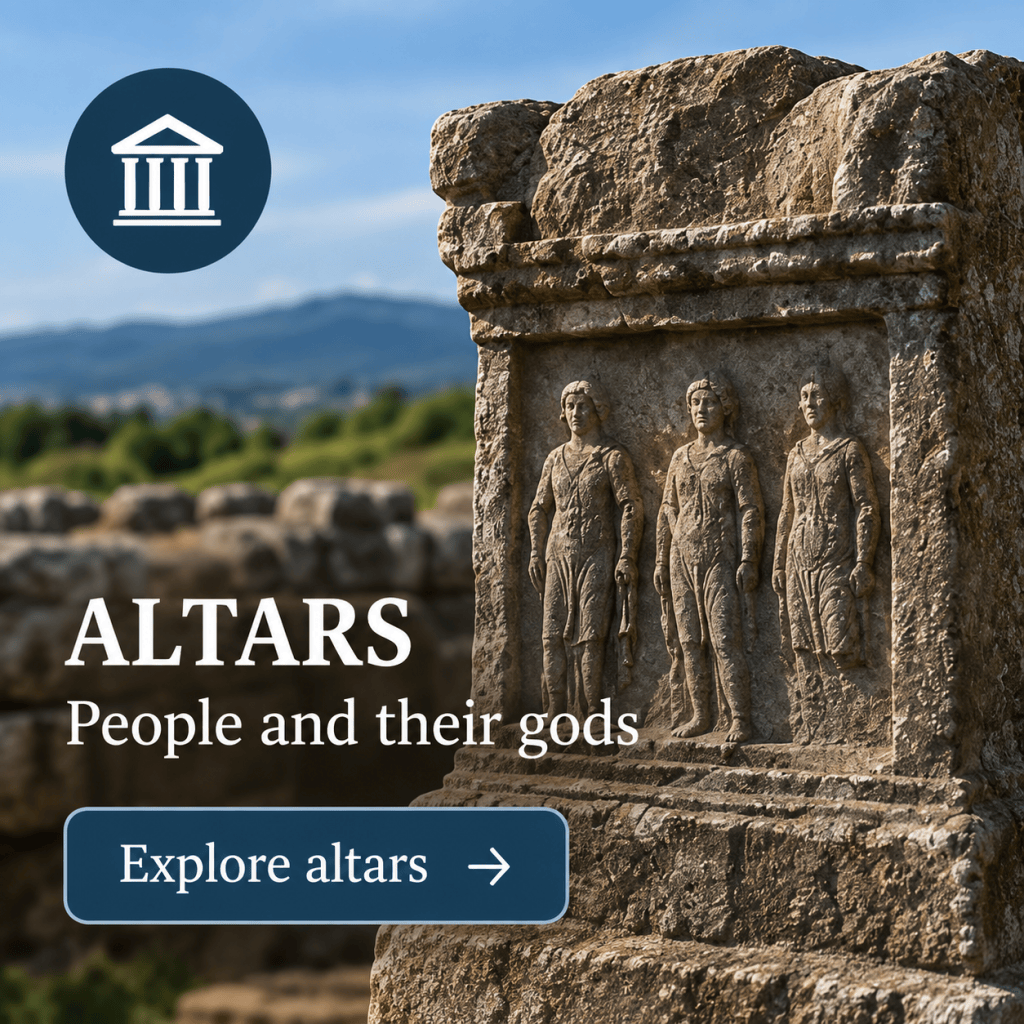
Across Roman Scotland, archaeologists have discovered stone altars dedicated to gods and goddesses. At first sight, they can look rather repetitive: a rectangular block of stone, a few lines of abbreviated Latin and perhaps some decoration. But learn how to read them, and they become some of our most personal pieces of evidence from Roman Scotland.
An altar can tell us:
who dedicated it • which god they worshipped • their military rank • their unit • why they made the dedication • and sometimes something about where they came from
Together, Scotland’s Roman altars reveal a remarkably diverse religious world.
Here we encounter familiar Roman gods such as Jupiter, Mars and Minerva, but also Celtic and provincial deities, gods associated with soldiers and horses, and cults whose connections stretched across the Roman Empire.
It can be a snapshot of someone’s beliefs nearly 2,000 years ago.
🏛️ What was a Roman altar?
Roman altars were places where offerings or sacrifices could be made to a deity.
Many followed a recognisable shape, with a rectangular inscribed body and a projecting top and base.
The inscription normally tells us who the altar was dedicated to and often who dedicated it.
Some also preserve clues to what happened around them.
You may see a patera, a shallow dish used in religious ritual, carved into one side, or a jug used for pouring liquids.
The top might contain a focus or hollow associated with offerings.
But the most revealing part is often the inscription.
🔎 How do you read a Roman altar?
Roman inscriptions used abbreviations extensively.
One of the most common formulas is:
V S L M
This expands to:
Votum Solvit Libens Merito
Usually translated approximately as:
“Willingly and deservedly fulfilled his vow.”
That tells us something important.
Roman religion wasn’t simply about believing in a god.
Someone could make a votum — a vow or promise to a deity.
Perhaps they asked for protection, success, recovery from illness or some other favour.
If the obligation was fulfilled, an altar might be erected in return.
So when we find an altar ending:
V S L M
we may be looking at the surviving evidence of an agreement made between one person and their god.
⚡ Jupiter — the supreme Roman god
One of the most frequently encountered deities in Roman military communities was:
Jupiter Optimus Maximus
Jupiter, Best and Greatest.
The abbreviation:
I O M
is therefore one of the most useful things to recognise on a Roman altar.
Jupiter was closely connected with Roman authority and the state, making him particularly important within the army.
But even apparently familiar gods can appear in unfamiliar forms.
At Birrens, for example, an altar was dedicated to Jupiter Optimus Maximus Dolichenus — Jupiter of Doliche. The cult of Jupiter Dolichenus originated in northern Syria and became particularly popular with soldiers.
A stone found in southern Scotland can therefore connect us to religious traditions thousands of miles away.
Explore the Birrens inscriptions in RIB
🏛️ Marcus Cocceius Firmus at Auchendavy
Few people illustrate the religious diversity of Roman Scotland better than Marcus Cocceius Firmus.
Firmus was a centurion of Legio II Augusta stationed at Auchendavy on the Antonine Wall.
In 1771, during construction of the Forth and Clyde Canal, a remarkable group of altars was discovered close to the fort. Your existing article brings the surviving group together.
The dedications securely associated with Firmus include:
Diana and Apollo
the Genius of the Land of Britain
Jupiter Optimus Maximus and Victorious Victory
and an extraordinary combination of:
Mars • Minerva • the Campestres • Hercules • Epona • Victory
A fifth altar from the same discovery was dedicated to Silvanus, although its attribution to Firmus is less certain.
Explore Marcus Cocceius Firmus
🌍 The Genius of the Land of Britain
One of Firmus’s most intriguing dedications was:
GENIO TERRAE BRITANNICAE
To the Genius of the Land of Britain.
The Romans imagined places as possessing their own divine spirit or genius. Here was a Roman officer serving at the very edge of the Empire acknowledging the divine spirit of Britain itself. It is an extraordinary little glimpse of how Roman religious ideas could adapt to the places in which people found themselves.
See the inscription — RIB 2175
🐎 Epona — goddess of horses
Firmus’s great multi-deity altar at Auchendavy includes another fascinating name:
Epona
Epona was a goddess particularly associated with horses, ponies and mules, whose cult had strong roots in the Celtic-speaking provinces of the Roman world.
Her presence alongside Mars, Minerva, Hercules, Victory and the Campestres — goddesses associated with the parade ground — is a reminder that Roman religion wasn’t divided neatly into “Roman gods” and “Celtic gods”.
Gods, people and religious practices moved around the Empire.
A centurion serving in Scotland could participate in a religious world drawing upon several different traditions.
See Firmus’s Epona dedication — RIB 2177
🐎 Hercules Magusanus at Mumrills
Another altar takes us towards the Lower Rhine.
At Mumrills on the Antonine Wall, a cavalryman called Valerius Nigrinus dedicated an altar to:
Hercules Magusanus
Nigrinus was a duplicarius — a cavalry soldier receiving double pay — in the First Cavalry Regiment of Tungrians.
Hercules Magusanus was particularly associated with the Lower Rhine region.
The combination is fascinating.
A Tungrian cavalryman serving in Scotland was worshipping a deity strongly associated with the region from which his unit had originated.
That doesn’t prove Nigrinus himself had been born there.
But it demonstrates how religious traditions could travel with military communities.
See the original altar — RIB 2140
☀️ Apollo Grannus at Inveresk
At Inveresk we encounter another fusion of religious traditions:
Apollo Grannus
Apollo was one of the great gods of the classical world.
Grannus was a deity with Celtic associations, often linked with healing and sacred waters.
The combination Apollo Grannus is a good example of what is often called religious syncretism — different religious traditions being associated or combined rather than one simply replacing another.
A fragmentary altar from Inveresk records Quintus Lusius Sabinianus and a dedication to Apollo Grannus. RIB records religious dedications by Sabinianus at Inveresk, and your existing page examines the evidence.
☀️ Mithras and the gods of Inveresk
Inveresk has produced some of the most fascinating evidence for religion in Roman Scotland. Among the discoveries are altars connected with Mithras, a mystery cult especially popular within parts of the Roman military world.
The Inveresk evidence is particularly significant because it demonstrates that religious ideas found across the Empire had reached a Roman community on the Firth of Forth.
Explore Roman Inveresk and its altars
🌲 Silvanus — god of the countryside
Silvanus was associated particularly with woodland, countryside and boundaries.
His name occurs in the religious evidence from Roman Scotland.
A Silvanus altar was among the group discovered at Auchendavy, although unlike the four Firmus altars, its dedicator is uncertain.
🌊 Neptune at Birrens
Roman religion could also reflect the concerns of everyday life.
At Birrens, an altar was dedicated to Neptune. RIB records it as RIB 2105.
We normally think of Neptune as the Roman god of the sea. But identifying the god is only the beginning. Why was Neptune being worshipped at an inland military site in southern Scotland? Was the dedication connected with water more generally? Was it a personal devotion? Was the dedicator carrying a religious tradition acquired elsewhere? Sometimes an altar answers one question while creating several more.
See the Neptune altar — RIB 2105
🪽 Mercury at Birrens
Birrens also produced evidence for the worship of Mercury.
Mercury was associated with trade, travel, communication and prosperity, among many other things.
One Birrens dedication is particularly interesting because it records that the dedicator provided a statuette from his own resources and fulfilled his vow willingly and deservedly.
That takes us beyond simply identifying another god.
It shows an individual spending his own money on an act of worship.
See the Mercury dedication — RIB 2102
🛡️ Brigantia
Few deities found across southern Scotland capture the ambiguities of Rome’s northern frontier quite like Brigantia.
Tutelary goddess of the Brigantes—the dominant tribal confederation occupying much of northern Britain—her worship extended well into the military zone. At the fort of Birrens (Blatobulgium) in Dumfriesshire, a stone dedication (RIB 2091) dated broadly between AD 119 and 161 confirms her veneration directly within an auxiliary garrison setting.
Rather than fitting neatly into modern preconceptions, the Birrens stone exposes the fluidity of provincial religious life. It is impossible to say with certainty whether we are witnessing a Roman military official adopting an indigenous goddess, a local deity being filtered through classical visual and religious conventions, or an outright blend where traditional labels like “Roman” and “native” cease to make sense.
The altar leaves those questions open, but it firmly establishes Brigantia as an integral part of frontier belief.
See the Brigantia dedication — RIB 2091
👑 Gods and emperors
Religion and imperial power were closely connected.
Altars could be dedicated for the welfare of the emperor, to imperial Victory or to the divinity associated with imperial rule.
At Auchendavy, Marcus Cocceius Firmus dedicated an altar to Jupiter Optimus Maximus and Victorious Victory, for the welfare of the emperor as well as himself and his family.
At Birrens, another altar was dedicated to Mars and the Emperor’s Victory.
Such inscriptions remind us that religion, army and state were deeply interconnected.
Worship could be personal.
It could also be political.
See Firmus’s Jupiter and Victory altar — RIB 2176
🗺️ A religious map of the Empire
Put the altars together and something remarkable happens.
Roman Scotland begins to connect with a much wider world.
Jupiter connects the frontier with the Roman state.
Jupiter Dolichenus points towards Syria.
Hercules Magusanus has strong connections with the Lower Rhine.
Epona had roots in the Celtic-speaking provinces.
Apollo Grannus combines Roman and Celtic religious traditions.
Brigantia connects us with the peoples of northern Britain.
Mithras belonged to a mystery cult found across large parts of the Empire.
These weren’t isolated religions existing in separate boxes.
A single person could worship several gods.
Marcus Cocceius Firmus demonstrates that spectacularly.
Roman religion was capable of absorbing, combining and transporting gods and religious traditions across enormous distances.
And some of those journeys ended in Scotland.
🙏 Were these people’s personal beliefs?
Surviving altars show us that an act of devotion took place, but they rarely give access to personal belief. Epigraphy reflects public duty as much as private faith: an auxiliary prefect or centurion commissioned an altar because his post required it, just as dedications for an emperor’s welfare carried clear political freight alongside religious ritual. Polytheism was also fluid. A soldier might sacrifice to Jupiter Capitolinus on parade, consult an eastern mystery cult in private, and still propitiate a local water goddess when marching through unfamiliar territory. Above all, silence in the archaeological record is not absence; lack of a dedicated stone simply means that cult practice left behind perishable offerings, oral traditions, or ceremonies that never reached the mason’s yard.
There is another major bias:
Stone survives. Most religious activity doesn’t.
Prayers disappear. Food offerings disappear. Wooden objects usually disappear. Songs and ceremonies disappear. Many shrines disappear.
The stone altars that survive are therefore only fragments of a much richer religious world.
🔎 Investigate an altar yourself
When looking at a Roman altar, ask:
Who is the god?
Is it a familiar Roman deity or a god with origins elsewhere?
Who dedicated it?
Do we know their name?
What was their job?
Soldier, centurion, prefect, civilian?
Which military unit did they belong to?
Could that help explain the choice of deity?
Does the inscription mention a vow?
Look for V S L M.
Where was the altar found?
Inside a fort? A settlement? A pit? Reused in a later building?
Was that its original location?
Not necessarily.
And finally:
What does the altar actually prove — and what are we adding through interpretation?
🔍 Explore the original evidence
You can investigate Scotland’s Roman altars yourself using Roman Inscriptions of Britain Online.
RIB provides inscriptions, translations, findspots, dates, references and, for many stones, photographs or drawings.
Its Scotland index includes sites from Ardoch and Birrens to Inveresk, Mumrills, Newstead, the Antonine Wall and Westerwood.
Explore Roman inscriptions from Scotland in RIB
Try searching for:
Auchendavy
Birrens
Mumrills
Inveresk
Cramond
Newstead
Then look for the entries described as altar, religious dedication or votive.
Explore the gods
At the bottom of the page, I would use visual cards linking into the main themes:
⚡ JUPITER
God, army and empire
Explore Jupiter and the many forms in which he was worshipped.
🐎 EPONA
Goddess of horses
Follow a deity whose cult travelled across the Roman world.
☀️ APOLLO GRANNUS
Roman and Celtic traditions meet
☀️ MITHRAS
A mystery cult at Inveresk
🏛️ AUCHENDAVY
One centurion — many gods
🔎 ALL INSCRIPTIONS
Investigate the evidence yourself
Explore Roman Inscriptions of Britain
From altars to the Antonine Wall
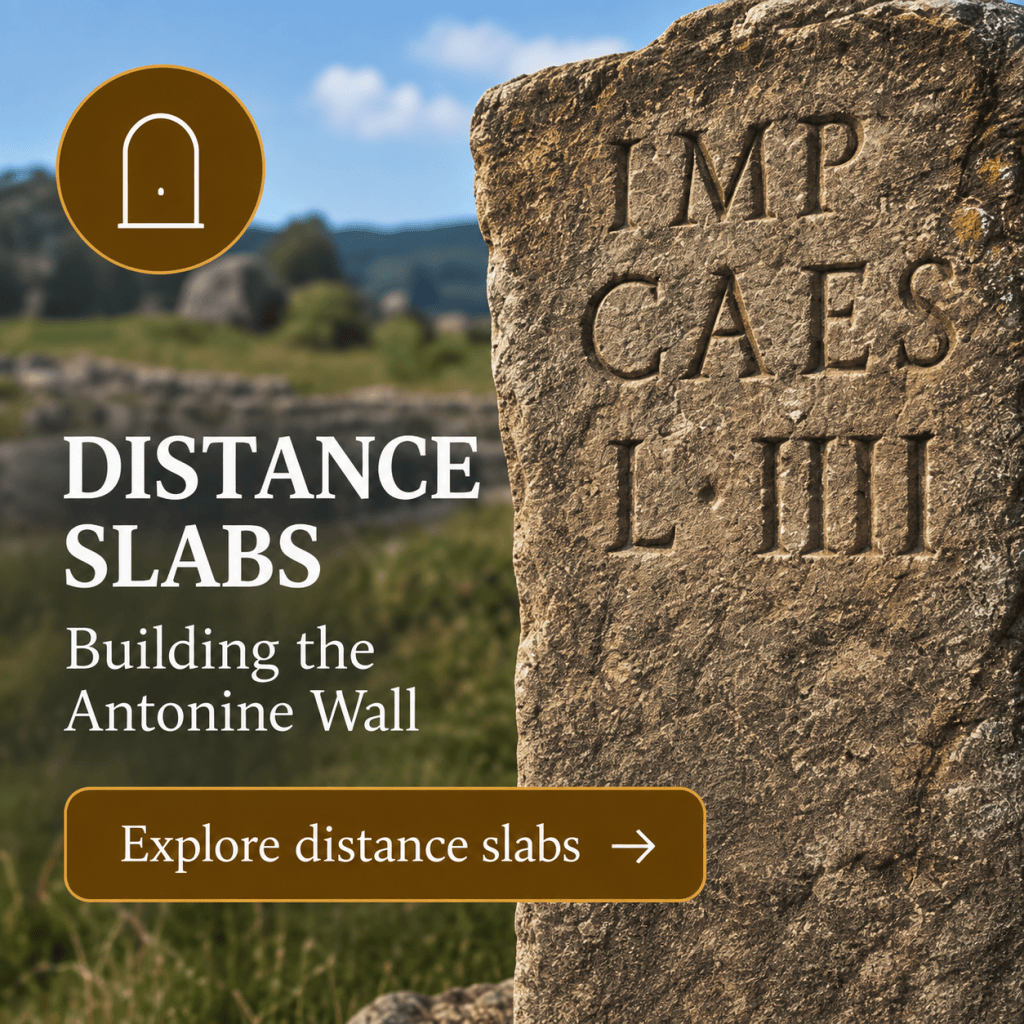
Altars are intensely personal. They can record one person making one dedication to one god. But Roman inscriptions could also operate on an altogether different scale.
Along the Antonine Wall, Rome erected some of the most spectacular inscribed monuments ever discovered in Britain. They recorded the work of entire legions. They displayed Roman soldiers, legionary symbols and defeated enemies. And they measured the construction of Rome’s new northern frontier.
These are the extraordinary Antonine Wall Distance Slabs.
→ Next: Explore the Antonine Wall Distance Slabs