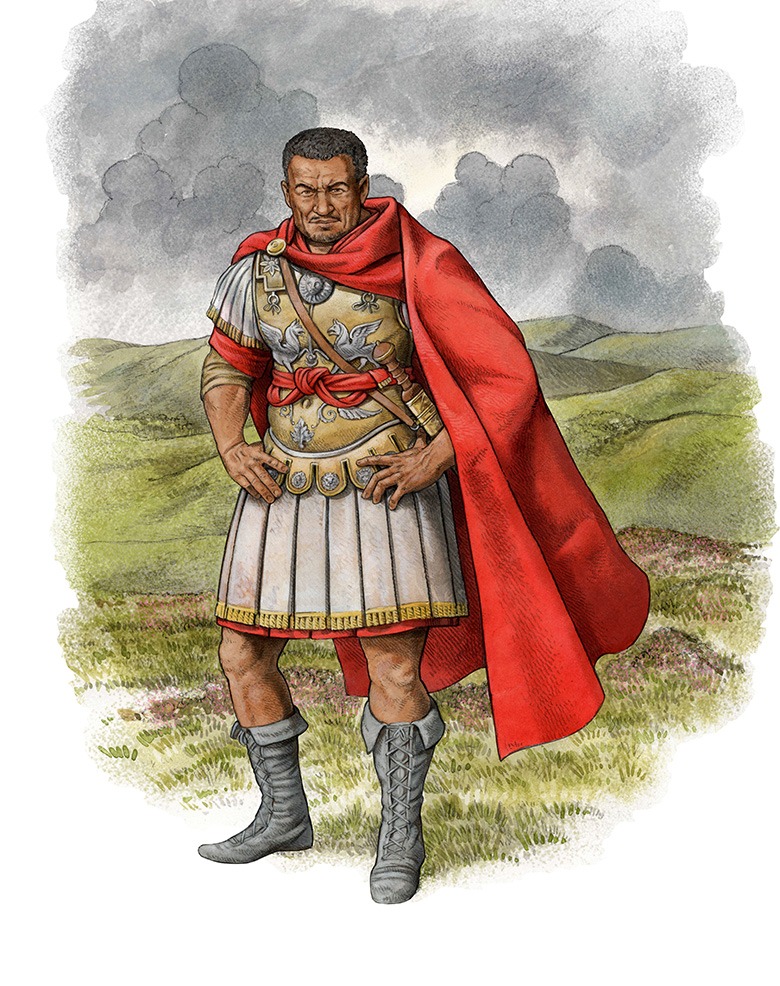

For a few years in the early AD 140s, Quintus Lollius Urbicus was probably the most powerful man in Britain. As governor of the province, he commanded the Roman army during a renewed invasion of what is now southern Scotland and appears to have begun the construction programme that created the Antonine Wall.
Remarkably, the man responsible for Rome’s northernmost permanent frontier came from Roman North Africa. Urbicus originated in Numidia, in the area around Tiddis and Cirta in modern Algeria, before rising through the Roman military and political system to become a senator, general, provincial governor and eventually one of the most senior officials in Rome itself. His career is known particularly well because it was recorded in inscriptions erected in his homeland. (OUP Academic)
From North Africa to the Roman elite
Urbicus came from a prosperous family in Roman Numidia. His parents were Marcus Lollius Senecio and Grania Honorata, and a substantial circular mausoleum belonging to the Lollius family still survives near Tiddis.
His career demonstrates just how international the Roman Empire could be. A man from North Africa could serve in Germany and the Danube provinces, fight in Judaea, govern Britain and ultimately hold high office in Rome.
Early in his career Urbicus served as a military tribune with Legio XXII Primigenia in Germany. He later commanded Legio X Gemina, and under the Emperor Hadrian took part in the suppression of the Bar Kokhba revolt in Judaea between AD 132 and 135. He was awarded military decorations for his service.
After becoming consul, probably in AD 135 or 136, Urbicus governed Germania Inferior before being selected for an altogether more ambitious assignment: Britain. (OUP Academic)
Antoninus Pius changes Rome’s northern policy
The Emperor Hadrian died in AD 138. His successor, Antoninus Pius, inherited a frontier based largely on Hadrian’s Wall between the Tyne and Solway.
Antoninus soon decided to move the effective frontier northwards again.
Why he did so remains uncertain. There may have been unrest among communities in northern Britain, but there was also a political reason. Antoninus had little military experience and had become emperor without winning a great military victory. A successful campaign in Britain would provide useful prestige for the new regime. This remains one of the main explanations advanced by modern scholars. (Scarf Scotland)
Urbicus was probably appointed governor of Britain in AD 139 and preparations for an advance began almost immediately. David Breeze notes that he is recorded undertaking construction work at Corbridge in AD 139–140, almost certainly connected with preparations for the northern campaign.
The invasion of Scotland
Unfortunately, no surviving historian gives us a detailed description of Urbicus’ campaign.
We do not have an Antonine equivalent of Tacitus’ account of Agricola. We therefore cannot confidently reconstruct individual battles, marching routes or exactly which Scottish peoples resisted the Roman advance.
Our most important literary statement was written much later in the Historia Augusta. It says that Antoninus Pius:
“overcame the Britons … and built a second wall, one of turf”
and specifically attributes the victory to Lollius Urbicus. (penelope.uchicago.edu)
Despite the lateness and problems of the Historia Augusta, archaeology and inscriptions confirm the basic outline of this account.
The Roman army advanced beyond Hadrian’s Wall and re-established control over southern and central Lowland Scotland.
Exactly when the fighting occurred is interesting. Antoninus had certainly received his second acclamation as Imperator—effectively recognition of a military victory—by 1 August AD 142. Allowing time for news of the victory to travel from Britain to Rome, David Breeze argues that the campaigning probably ended in AD 141, perhaps after only one or two campaigning seasons.
The victory was also publicised on Roman coins. Issues depicting Britannia and Victory allowed Antoninus Pius to take political credit in Rome for a campaign actually conducted thousands of kilometres away by Urbicus and his soldiers. (Scarf Scotland)
How far north did Urbicus go?
This is much harder to answer.
The ultimate Roman frontier established after the campaign ran across the narrow central belt between the Firth of Forth and the River Clyde. Roman forts and roads also extended beyond the Wall, and some older military positions dating back to the campaigns of Agricola were reused.
But it is important not to turn gaps in the evidence into a detailed imaginary campaign.
There is no surviving account saying that Urbicus personally captured a particular sequence of forts or fought named battles across Scotland. Much of what is sometimes presented as a route of conquest is reconstruction from the distribution of forts, roads and temporary camps.
What we can say confidently is that the campaign brought the Southern Uplands and much of Lowland Scotland back under direct Roman military control and prepared the ground for a completely new frontier.
Urbicus and the Antonine Wall
Urbicus’ most enduring connection with Scotland is the Antonine Wall.
The frontier ran for about 60 kilometres or 37 miles from the Forth to the Clyde. Unlike most of Hadrian’s Wall, its rampart was principally constructed from turf laid on a stone base. Behind it ran the Military Way, while forts, fortlets and other military installations controlled movement along and through the frontier.
The ancient account specifically associates the turf Wall with Urbicus’ victory:
Antoninus defeated the Britons through Lollius Urbicus and, after driving back the barbarians, constructed another wall of turf.
The archaeological evidence gives us something even more valuable: Urbicus’ own name on the Antonine Wall.
The Balmuildy inscription
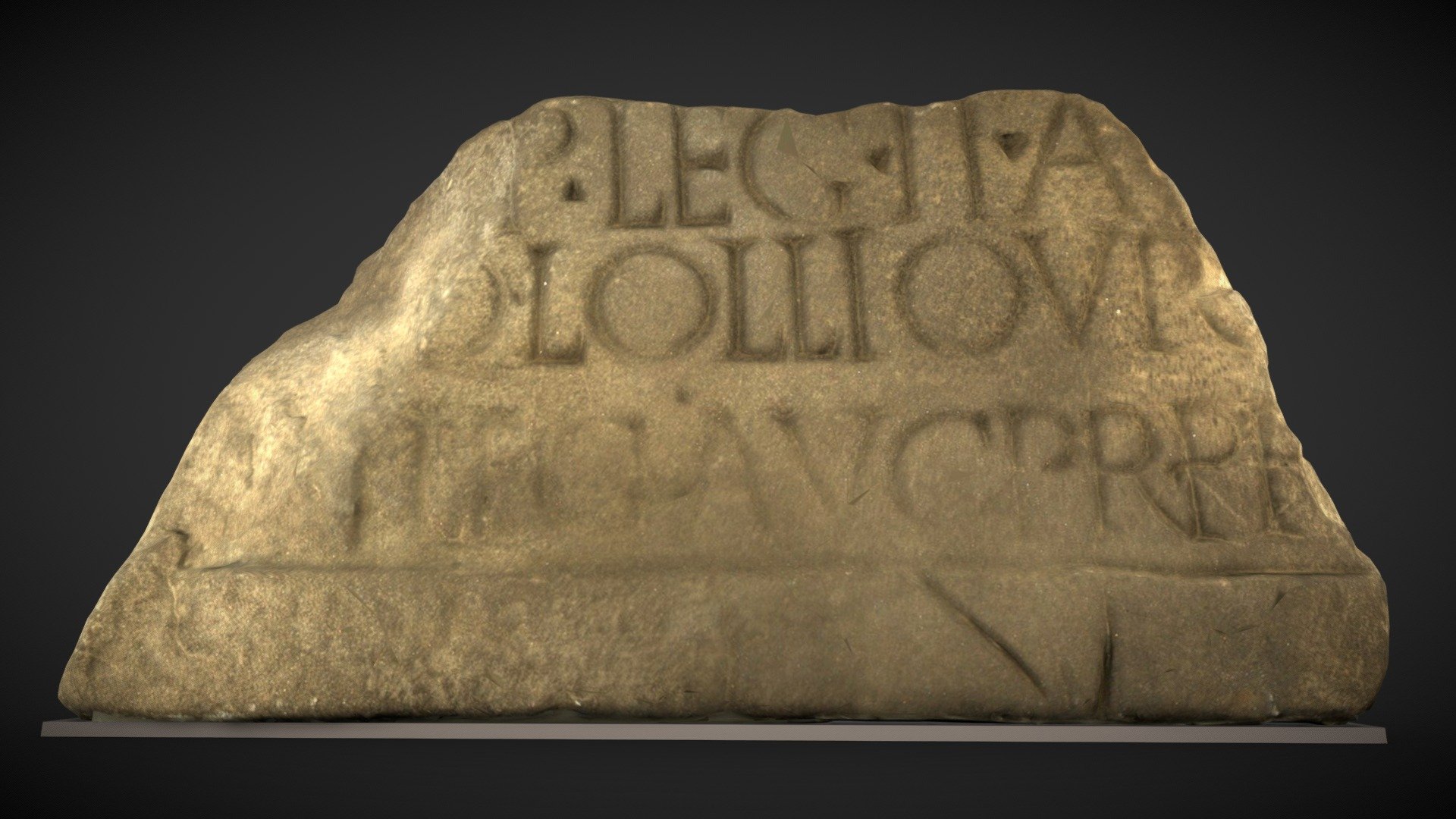
At Balmuildy, near Glasgow, fragments of a building inscription were discovered naming both Urbicus and Legio II Augusta.
The reconstructed inscription records that the Second Legion built the structure:
“under Quintus Lollius Urbicus, emperor’s propraetorian legate.”
(Roman Inscriptions of Britain)
This is exceptionally important because it connects an individual Roman governor directly with the earliest construction of the Antonine frontier.
Balmuildy appears to have been one of the primary forts in the original scheme. Breeze argues that Urbicus’ name appearing at Balmuildy but apparently nowhere else among the Wall installations may indicate that he initiated the building programme but left Britain before it was completed.
That would fit the normal length of a governor’s appointment.
Construction probably began around AD 141–142, at about the same time that Rome was celebrating victory in Britain.
Who actually built the Wall?
Although Urbicus was the governor responsible for the operation, he certainly did not arrive with an army carrying out a single fixed blueprint from one end of the country to the other.
Detachments from Britain’s three legions participated in the construction:
- Legio II Augusta
- Legio VI Victrix
- Legio XX Valeria Victrix
Thousands of auxiliary soldiers were also stationed in the forts along and around the frontier.
The construction scheme itself appears to have evolved. Forts were added, some fortlets were replaced and the spacing between installations was altered as work progressed. The result was an unusually dense military frontier across central Scotland.
Urbicus therefore probably oversaw the opening phase rather than every stage of construction.
A Roman army from across the Empire
The forces Urbicus commanded in Britain demonstrate another striking feature of Roman Scotland.
The army was not simply composed of men from Italy. Auxiliary units serving on or around the Antonine frontier had origins across the Empire—in areas corresponding to modern Germany, the Netherlands, Belgium, France, Spain, the Balkans and Syria.
Their commander had been born in North Africa.
The Roman occupation of Scotland was therefore part of a much larger imperial system in which soldiers, officers, administrators, craftsmen and supplies moved enormous distances.
Urbicus’ own life perhaps illustrates this better than almost anyone connected with Roman Scotland.
What happened to Urbicus?
Urbicus does not seem to have remained in Britain for the whole life of the Antonine frontier.
If he arrived around AD 139, a conventional governorship of roughly three years would place his departure around the time construction of the Wall was getting under way. His successors therefore probably supervised much of its completion and occupation.
Urbicus’ career was far from over.
He eventually became Prefect of Rome (praefectus urbi), one of the most prestigious positions available to a Roman senator. (OUP Academic)
The man who had commanded armies in Judaea, Germany and Britain ended his known career close to the centre of imperial government.
The short-lived conquest
Urbicus’ advance succeeded militarily, but the frontier he helped create did not last.
Current interpretations place the beginning of the abandonment of the Antonine Wall around AD 158, when inscriptions indicate renewed major work on Hadrian’s Wall. The precise chronology remains debated, but Rome ultimately withdrew its main frontier south to the Tyne–Solway line.
Urbicus’ conquest therefore did not permanently move the Roman Empire into Scotland.
Yet for roughly a generation, Rome’s official frontier lay across central Scotland.
Urbicus’ place in the story of Roman Scotland
Quintus Lollius Urbicus deserves to be better known.
Agricola has traditionally dominated the story of Roman invasion in Scotland because Tacitus left us a dramatic literary account of his campaigns. Urbicus left us no friendly biographer.
Instead, his story has to be reconstructed from inscriptions, coins, forts and the remains of the Antonine Wall.
Those sources reveal an extraordinary career.
A Roman from North Africa rose through the imperial hierarchy, fought in one of the major wars of Hadrian’s reign, governed Germany and was then sent to Britain. Around AD 141 his army advanced into Scotland. Within a year or so Rome was celebrating victory and work had begun on a new frontier between the Forth and Clyde.
And at Balmuildy, almost 1,900 years later, the stone still preserves the name of the man who commanded it:
Q. LOLLIO VRBICO — Quintus Lollius Urbicus.
Useful sources
David Breeze’s The Antonine Wall describes Urbicus’ appointment, the invasion and the beginning of construction of the Wall. David Breeze’s detailed Bearsden: A Roman Fort on the Antonine Wall provides the particularly useful argument that the campaign probably ended in AD 141 and that Urbicus began, rather than completed, the Antonine building programme.
Read RIB 2192 – the Balmuildy inscription
Read the Historia Augusta account of Antoninus Pius

