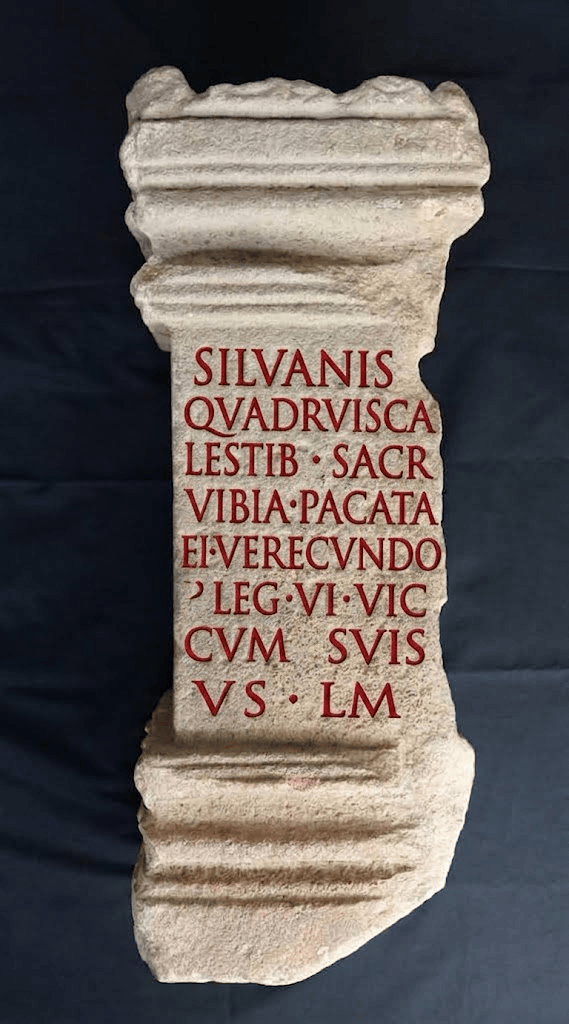
Vibia Pacata is said to be a North African wife of a centurion and is named on a tombstone near Falkirk at Westerwood Fort on the Antonine Wall. She is the only known married woman in Scotland. ” Sacred to the celestial Silvanae and Quadriviae. Vibia Pacata (wife) of Flavius Verecundus, centurion of the Sixth Legion Victrix, with her family paid her vow willingly, deservedly.” See https://romaninscriptionsofbritain.org/inscriptions/3504
North African Origins
Her surname (cognomen) “Pacata” was highly popular in Roman North Africa. Furthermore, her dedication to the Caelestes (“Celestial ones”) strongly mirrors the worship of the African goddess Caelestis (the Romanised Tanit of Carthage).
Secondary studies (Wright 1964; Birley 1984; Foubert 2013; Ferlut 2022) agree that Vibia Pacata likely travelled widely – possibly from Pannonia or North Africa – before reaching Britain, reflecting the mobility of Roman military families. She exemplifies one of the few Roman women attested in Scotland, and the only known married woman at the Antonine Wall. Interpretations of her origin hinge on her cognomen and choice of deities; some suggest North African roots via the epithet caelestibus, others emphasise Pannonian cult links. No tomb or other personal record of Vibia survives. Given the paucity of evidence, assessments rely on the altar and parallels: hypotheses about her life and status remain largely circumstantial. The consensus is that she was a citizen and army wife of the mid-2nd century AD; beyond that, gaps mean her story is partly conjectural.
Legio VI Victrix’s role in Scotland was to man fortlets and forts; auxiliary units (cohortes, alae) were also present but poorly documented. Burial practices in Roman Britain typically placed cemeteries outside fort boundaries. Women and children of soldiers often lived at or near forts, though legionaries could not legally marry until AD 197. In practice, many had de facto families accompanying them. Vibia Pacata’s altar implies she was present with her centurion husband at Westerwood, consistent with evidence from other frontier sites (e.g. Vindolanda letters) that soldiers’ wives did travel to and reside in Roman Scotland.
Mobility was a key feature of Roman military life. Soldiers and their families could move between provinces when units were reassigned. Foubert notes instances of such female travellers (referencing Julia Lucilla on Hadrian’s Wall). In Vibia’s case, the uniquely Pannonian connection of her altar’s cult suggests she (or her husband) served in Pannonia before Scotland. North African links (Caelestis cult) hint at possible later service in Mauretania, after which unit(s) were sent to Britain (as documented transfers after 150 AD). The Antonine campaigns of 154–158 included forces from multiple provinces, so a career path from Danubian to African postings was plausible.
References
Birley, E. “A Centurion of Leg. VI Victrix and His Wife.” Zeitschrift Für Papyrologie Und Epigraphik 57 (1984): 230–32. http://www.jstor.org.nls.idm.oclc.org/stable/20184148.

