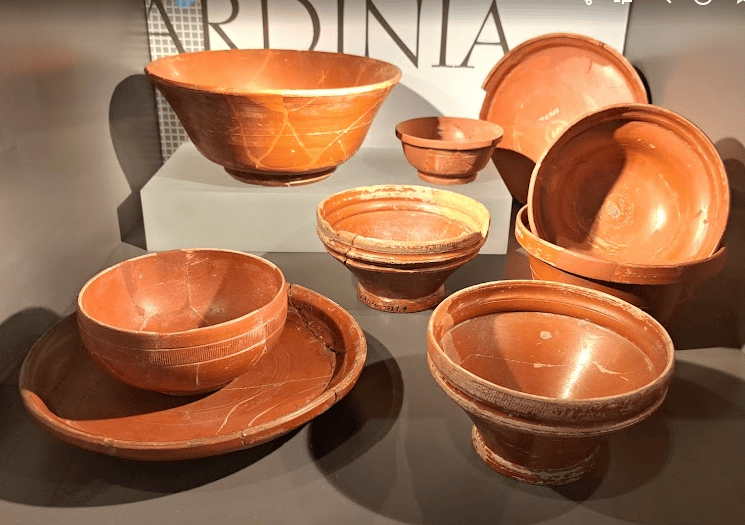
Tiny fragments of Roman pottery found at forts across Scotland can now be traced back to the workshops in France where they were made almost 1,900 years ago — without damaging them.
One of the most familiar finds from Roman sites in Scotland is samian ware: the distinctive, smooth red pottery used for bowls, cups and dishes.
To most of us, a broken piece may not look particularly exciting. To an archaeologist, however, samian pottery can contain an extraordinary amount of information.
A new study by Louisa Campbell and Richard Jones of the University of Glasgow has tested a way of using X-rays to identify where individual pieces of samian pottery were made. More than 300 fragments from northern Britain were examined, including material from 15 Roman military sites in Scotland, an Iron Age hillfort and the Roman fort at South Shields in northern England. (Eprints Glasgow)
The results offer another glimpse of the huge supply networks that connected Roman Scotland with workshops hundreds of miles away in what is now France.
What is samian ware?
Samian ware — also known as terra sigillata — was the Roman equivalent of good-quality tableware.
Attribution: The Portable Antiquities Scheme/ The Trustees of the British Museum
It was generally well made, smooth and covered with a characteristic shiny red coating. Some vessels were plain, while others carried elaborate moulded decoration. Potter’s stamps sometimes identified the people or workshops responsible for making them.
Most of the samian reaching Roman Britain was not made here. Major pottery industries developed in Gaul, roughly modern France and neighbouring areas, and their products were exported across the Roman Empire.
That means a bowl discarded at a fort in Scotland might originally have been manufactured more than a thousand kilometres away.
How could archaeologists tell where it came from?
Traditionally, samian specialists identify pottery by studying things such as its shape, colour, clay, decoration and potter’s stamps.
An experienced specialist can often recognise the products of particular manufacturing centres.
There is a problem, though. Archaeologists frequently recover tiny and undecorated pieces with no surviving stamp. Different workshops could also produce very similar-looking pots.
Chemical analysis can help, because clay from different areas contains slightly different combinations of elements. In effect, the pottery carries something resembling a chemical fingerprint.
Some traditional chemical tests require a small sample to be removed from the pottery. That is undesirable — and sometimes prohibited — when dealing with valuable museum collections.
Campbell and Jones instead tested portable X-ray fluorescence, usually shortened to pXRF. (archiqoo.com)
An X-ray gun for archaeology
A portable XRF machine is a handheld instrument which can be placed against the surface of an object.
It fires X-rays at the pottery and measures the response from the elements within it. The resulting readings allow researchers to compare the chemical composition of one fragment with another.
Most importantly for archaeologists, no piece of the pot has to be cut off.
The machine can therefore be taken into museum stores and used on collections where destructive sampling would be unacceptable. It is relatively quick and comparatively inexpensive, allowing hundreds of fragments to be examined. (archiqoo.com)
Where was Scotland’s Roman pottery coming from?
The clearest result concerns Central Gaul.
The researchers were particularly successful in recognising pottery associated with Lezoux, a huge Roman pottery-production centre in what is now central France.
Central Gaulish pottery, mainly of Antonine date, formed the largest identifiable element in the material studied. That is especially relevant to Scotland because the Antonine period coincides with the Roman advance, which resulted in the construction of the Antonine Wall from the AD 140s. (ScienceDirect)
The technology also recognised pottery produced farther south in Gaul. The results appear to distinguish material associated with the important centres of La Graufesenque and Montans.
These southern industries are particularly important for understanding earlier Roman activity. At least one South Gaulish source was supplying pottery during the earlier period represented in the collections. (ScienceDirect)
Pottery from eastern Gaul was much less common in the samples. Products associated with Rheinzabern and other East Gaulish workshops proved harder to distinguish confidently. (Eprints Glasgow)
Why does this matter for Roman Scotland?
There is more to this than simply discovering where a Roman bowl was made.
Samian pottery is extremely useful for dating archaeological sites because the changing pottery industries, vessel designs and individual potters can often be dated surprisingly closely.
Knowing where pottery originated can also help archaeologists investigate how the Roman army in Scotland was supplied.
A piece manufactured at Lezoux had to travel an enormous distance before somebody ate or drank from it at Britain’s northern frontier. It passed through a chain involving pottery workshops, merchants, transport by road, river or sea and finally distribution within Britain.
The study does not tell us the exact journey taken by an individual bowl. Finding that a vessel was made at Lezoux does not prove whether it arrived in Scotland through London, the west coast, the east coast or an army-controlled supply system.
But identifying the production centres accurately gives archaeologists another piece of the puzzle from which those wider patterns can eventually be reconstructed.
And it works surprisingly well
One of the most encouraging results was the close agreement between the new chemical analysis and traditional identification.
Where specialists had already attributed pottery to particular regions using its form, decoration or potter’s stamp, its chemical composition generally pointed in the same direction. (ScienceDirect)
That is important because the method can then be applied to the far less distinctive pieces which make up much of an archaeological pottery collection.
A tiny undecorated red fragment that previously could only be labelled “samian” may sometimes be assigned to a broad production area.
It isn’t a magic machine
The researchers are also careful about the limitations.
Portable XRF does not provide the same precision as some laboratory methods. Results can be affected by the condition and thickness of a sherd, inclusions in the clay and the particular part of the surface being measured. Its measurements are also described as semi-quantitative.
It is therefore best thought of as another archaeological tool rather than a replacement for pottery specialists.
For example, the technique is much better at recognising the broad Central Gaulish group associated particularly with Lezoux than it is at separating every individual pottery workshop. (archiqoo.com)
A useful new tool for Scotland’s museum collections
Perhaps the greatest potential lies not underground but in museum stores.
Scottish museums contain large collections of pottery recovered during excavations stretching back well over a century. Some were studied before today’s scientific techniques existed, while other collections contain large quantities of relatively anonymous fragments.
Because pXRF does not normally require material to be removed, those pots can potentially be investigated again.
And there is another issue. Campbell and Jones point out that the number of specialists with the detailed experience required to identify samian using traditional methods is declining.
The chemical method provides an independent means of checking identifications and examining material which specialists cannot identify visually. The authors see this combination of scientific analysis and traditional archaeological expertise as potentially valuable both to researchers and to commercial archaeology. (Eprints Glasgow)
What does the study tell us about the Romans in Scotland?
Perhaps the most striking thing is the distance represented by an otherwise unremarkable fragment of red pottery.
A soldier eating from a samian bowl at a fort in Scotland could be using an object manufactured at Lezoux in Central Gaul.
The Roman frontier may have been at the north-western edge of the Empire, but it was not isolated from it.
Its forts were connected to a much wider economic world — and almost two thousand years later, the chemical signature left in a broken bowl can still reveal where that journey began.
Source
The original academic paper is Louisa Campbell and Richard Jones, “Non-invasive analysis of samian pottery assemblages from frontier contexts: the benefits and limitations of portable X-ray fluorescence”, Journal of Archaeological Science: Reports 74 (2026), 105881. It was first published online on 16 June 2026, and the University of Glasgow repository makes the published version freely available under a Creative Commons Attribution licence. (Eprints Glasgow)

