Easter Happrew belongs to Rome’s first-century advance through the Tweed valley. Today its remains are largely hidden, but excavation reveals a defended base near the meeting of important river corridors, close to the later Roman fort at Lyne.
Visit Easter Happrew
📍 Location: Near the Lyne Water and River Tweed, west of Peebles, Scottish Borders.
👁 What survives: Buried fort remains, principally known from excavation and cropmarks.
⭐ Best for: Comparing first-century occupation with the later fort at nearby Lyne.
🥾 Visit: A field site without exposed barracks. Use established routes and avoid crops; do not confuse it with Lyne fort.
🏛 Nearby Roman places: Lyne Roman Fort and the Tweed valley route.
Easter Happrew at a glance
| Feature | Evidence and interpretation |
|---|---|
| Occupation | Flavian, probably the AD 80s; c. AD 80–86 is a working range. |
| Garrison | Unidentified auxiliaries, plausibly a cohort-sized force. |
| Size | Approximately 1.42 hectares (3.5 acres). |
| Probable troop strength | Around 500 troops as a rounded capacity estimate; no unit headcount survives. |
Inside the early fort
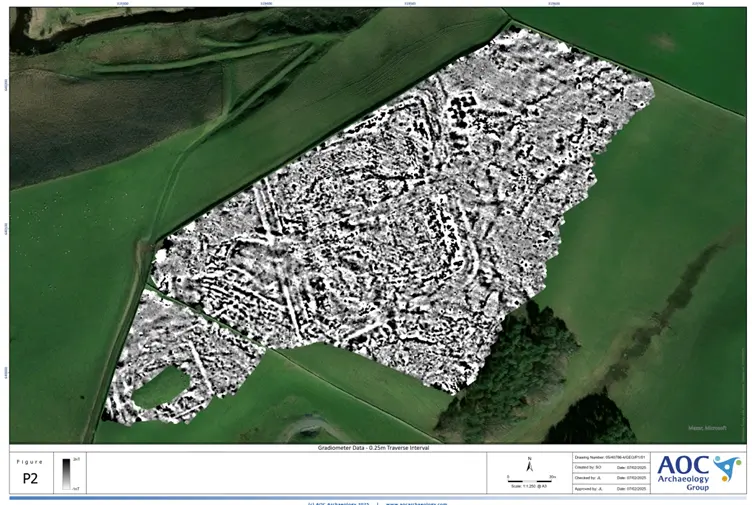
Excavation in 1956 recorded a substantial turf rampart, defensive ditch and internal road. Part of a building interpreted as the commander’s residence was also examined. These discoveries help turn a cropmark outline into a place where soldiers lived, worked and received orders.
The surrounding settlement
An annexe extended the defended area. Evidence nearby has also prompted discussion of a possible civilian settlement or vicus, a particularly interesting suggestion for Flavian Scotland. The research framework treats this as an interpretation requiring care, not a completely excavated town.
How many soldiers?
The 1.42-hectare enclosure gives a rounded estimate of about 500 in the supplied size model. That fits the broad scale of an ordinary auxiliary cohort, whose conventional infantry establishment was 480. It does not identify a particular regiment or prove that the full establishment was present. Troops could be detached, accommodation could change, and cavalry required additional space. Nearby Lyne belongs to a later occupation and should not be merged into one continuous garrison history.
Inscriptions and the identity of the troops
No inscription naming Easter Happrew’s unit has been identified in the consulted records. The possible civilian settlement is likewise not evidence for a named regiment. Links to auxiliary units provide comparisons rather than a confirmed local garrison list.
For the regiments and types of troops represented across Scotland, see Auxiliary units in Roman Scotland. The Roman Army guide explains the wider organisation, while Roman fort layout introduces the buildings found in permanent bases.
References and further reading
- Historic Environment Scotland: Easter Happrew, NRHE 50032 — site record, archaeological notes and excavation bibliography.
- Geophysical Survey at Lyne and Easter Happrew (Destination Tweed 2025)
- Historic Environment Scotland: Easter Happrew Roman fort, SM1493
- ScARF: landscapes of settlement and the possible Easter Happrew vicus
- Roman Inscriptions of Britain: search Easter Happrew — consult find contexts and commentary; a search result is not itself evidence for a garrison.
- Romans in Scotland fort-size spreadsheet — supplied copy used for dimensions and rounded capacity estimates, with archaeological measurements preferred where revised.
- Paul Holder (2003), ‘Auxiliary Deployment in the Reign of Hadrian’, especially p. 120 — nominal unit organisation, consulted in the supplied PDF; not a local garrison identification.
- Borders Archaeology Aerial Photos

