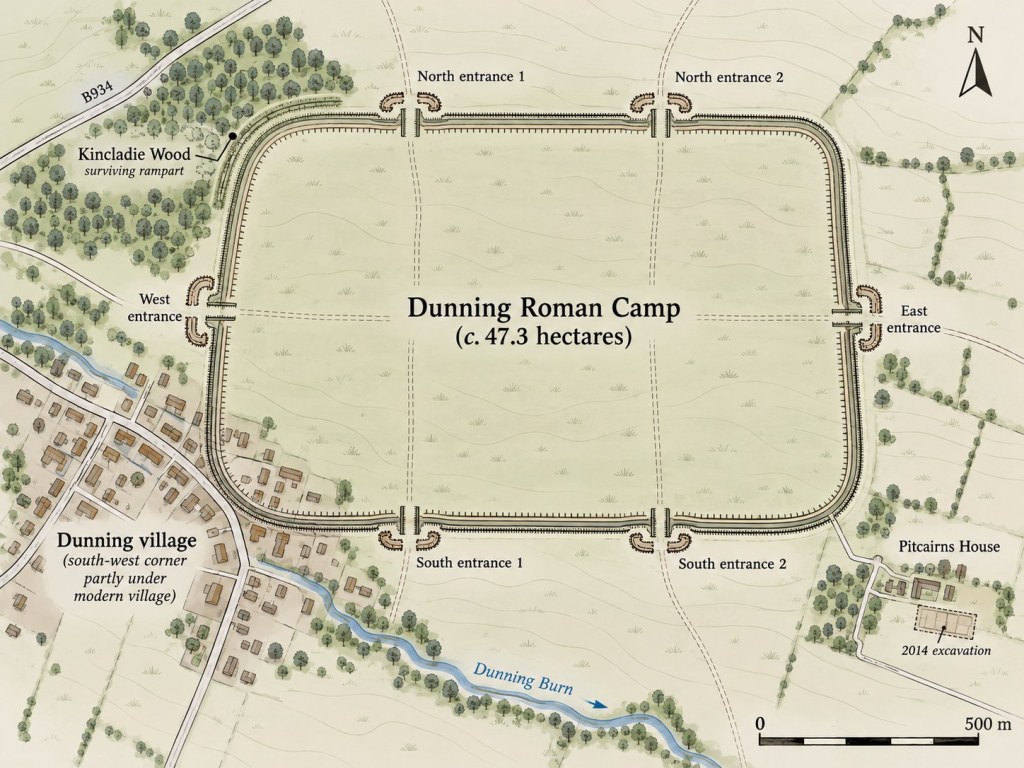
A Roman marching camp is often drawn with four gates, one on each side. That is a useful introduction to Roman military planning, but it does not describe every camp. In Scotland, several large temporary camps had six entrances. Dunning, north-east of the village in Perthshire, is one of them.
These were gaps in the defensive perimeter, not necessarily gateways with towers or substantial gatehouses. Their positions, and the earthworks protecting them, help us understand how Roman engineers laid out an enclosure for an army on campaign.
Dunning: two entrances on two sides
Dunning enclosed about 47 hectares. Its six entrances were arranged with two on the north side, two on the south, and one each on the east and west. The 2014 University of Glasgow excavation report describes how trenches at Pitcairns House established the southern defensive line. Changes in that line at two suspected entrances supported the six-gate interpretation.
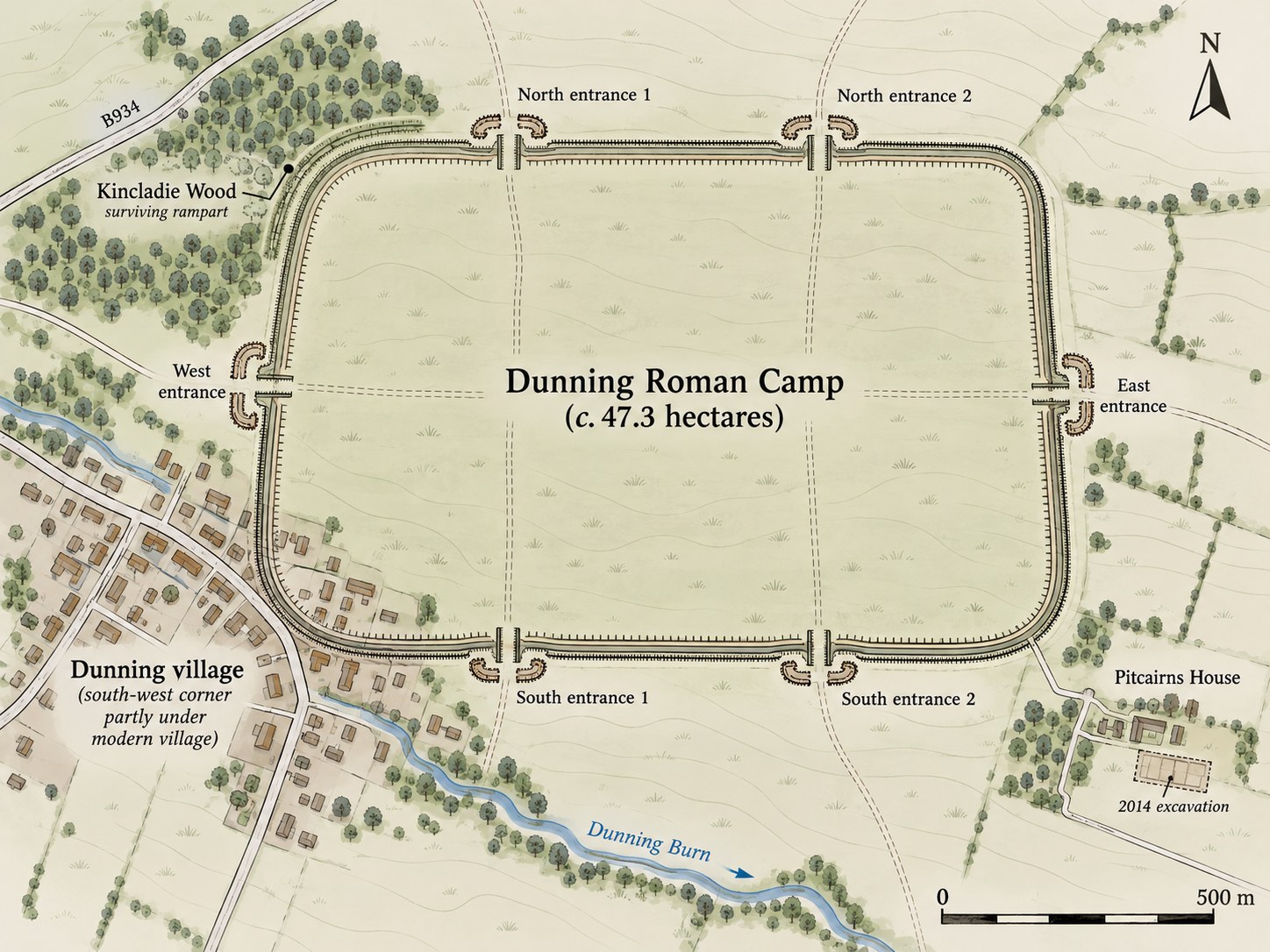
The excavations also found evidence that the ditch had been re-cut after an interval of silting. Dunning therefore had more than one occupation, although the report did not securely date those phases. There is more about this in Dunning Roman Camp: evidence of a second occupation.
Why have six gates?
An extra pair of entrances offered more ways into and out of a large enclosure. That could help with the movement of soldiers, animals and supplies, and reduce the distance between parts of the camp and an exit. This is a practical interpretation of the layout; it is not a purpose established by excavation at every six-gate camp.
The arrangement also reminds us that Roman planning allowed for different forces and different ground. A camp could preserve recognisable Roman features while departing from a neat textbook rectangle. Raedykes, near Stonehaven, is particularly useful here: its irregular outline follows the terrain, yet its gateway defences belong to the same Roman tradition.
Six entrances do not establish the number of legions present. Nor do they prove that a camp belonged to Agricola, Antoninus Pius or Septimius Severus. Gate numbers need to be considered alongside the enclosure’s size, its relationship with other sites, and whatever dating evidence survives.
How the entrances were defended
Every opening interrupted the rampart and ditch. One answer was a detached earthwork outside the entrance, usually called a titulus, with tituli as the plural. Its bank and ditch obstructed a direct approach and made an attacker turn around the barrier. This was different from a clavicula, where a curving extension of the defences sheltered the entrance.
At six-gate camps, the evidence for these outworks can be as important as the entrance gaps themselves. A surviving titulus may help identify a gateway even where ploughing has removed much of the main rampart. Conversely, a reconstructed total of six should not be mistaken for six entrances still visible on the ground.
Scottish examples
The following examples have explicit support in archaeological reports or heritage records. They are a starting point rather than a complete catalogue.
| Camp | What the evidence says |
|---|---|
| Dunning, Perthshire | The 2014 excavation report identifies six entrances: two north, two south, one east and one west. |
| Raedykes, near Stonehaven | Historic Environment Scotland records six original tituli, four surviving as low earthworks. The camp has an irregular outline. |
| Normandykes, near Peterculter | The Historic Environment Record describes six gates defended by tituli. |
| Keithock, near Brechin | Historic Environment Scotland records six original entrances, each protected by a titulus; four are visible as cropmarks. |
| Kirkbuddo, Angus | The national record describes six gates with detached outworks and notes that all six were preserved when William Roy recorded the camp. |
Names need care. Keithock is also referred to as Battledykes, Keithock, but should not be confused with the separate camp at Battledykes, Oathlaw. At sites with several overlapping camps, a gateway count belongs to a particular enclosure, not to the whole complex.
Probable six-gate camps
Some records use more cautious language. At Ythan Wells I, Historic Environment Scotland describes probably six original tituli, of which two are clearly visible as cropmarks. The smaller, overlapping Ythan Wells II has four entrances.
At Kair House, the local heritage record says that six gates are assumed from the camp’s size. Only limited gateway evidence is recorded. It belongs in a probable category, rather than a list claiming six demonstrated entrances.
Reading a camp plan
A plan can bring together features recorded at different times: surviving earthworks, cropmarks, excavation trenches and reconstructed stretches of ditch. Before counting the gates, check which parts are observed and which are inferred. The distinction matters particularly at sites where modern roads, buildings or woodland interrupt the perimeter.
Dunning provides a useful example of a six-gate camp, while Raedykes shows how a Roman enclosure could adapt to uneven ground. Together they broaden the familiar picture of a marching camp. For the organisation of the interior, see Inside a Roman marching camp; for the wider landscape, see Roman Camps in Scotland.
Sources and further reading
Campbell, E., Durnan, J. and Driscoll, S. (2014), Excavations at Dunning Roman Camp: Data Structure Report, especially pp. 3–7. The individual camp records are linked in the table and text above.
For the wider archaeological context, see Rebecca H. Jones, Roman Camps in Scotland (Society of Antiquaries of Scotland, 2011).

