At Burnswark Hill in Dumfriesshire, small lead bullets help to tell the story of a Roman attack. At Newstead in the Borders, iron spearheads preserve the equipment carried by individual soldiers. At Bar Hill on the Antonine Wall, an inscription identifies a unit whose name connects it with specialist archers. Together, these different kinds of evidence reveal an army with far more than swords at its disposal.
Roman forces in Britain used hand weapons, thrown missiles, bows, slings and mechanical artillery. Equipment changed over the centuries and varied between legionaries, auxiliary infantry, cavalry and specialists. The familiar picture of every Roman soldier carrying the same short sword and javelin is too simple.
Swords and daggers: fighting at close quarters
The gladius was a relatively short, double-edged sword suitable for close fighting. Its point could deliver a thrust, while its edges could cut: describing it as a weapon used only for stabbing misses part of its function. The Royal Armouries’ Roman collection includes a blade bearing the names of two probable successive owners, a reminder that weapons could pass from one soldier to another.
A British example is the Fulham sword, recovered from the Thames and dated by the British Museum to AD 1–75. River finds need care in interpretation: a weapon may have been lost, deliberately deposited or offered to a deity. Its discovery does not by itself identify a battle.
The longer spatha, associated particularly with cavalry in the earlier imperial period, became more widespread among infantry later. A mounted soldier needed reach, but sword use cannot be reduced to a permanent division between short-sword legionaries and long-sword auxiliaries. The pugio, a dagger, provided another close-range weapon. An iron example in London Museum survives without its hilt.
Spears, javelins and the pilum
A spear could be used to thrust at an opponent; a javelin was intended to be thrown. The Roman army employed several forms of both. Auxiliary infantry and cavalry relied heavily on shafted weapons, and a detached iron head does not always reveal whether its original shaft was carried by a rider or a foot soldier.
The pilum was a distinctive legionary javelin, with a small penetrating point at the end of a long iron shank attached to a wooden shaft. A surviving head from Caerleon illustrates this construction. A pilum lodged in a shield could make that shield awkward to handle; bending could also hinder its removal or reuse. It is best not to assume that every surviving type behaved identically on impact.
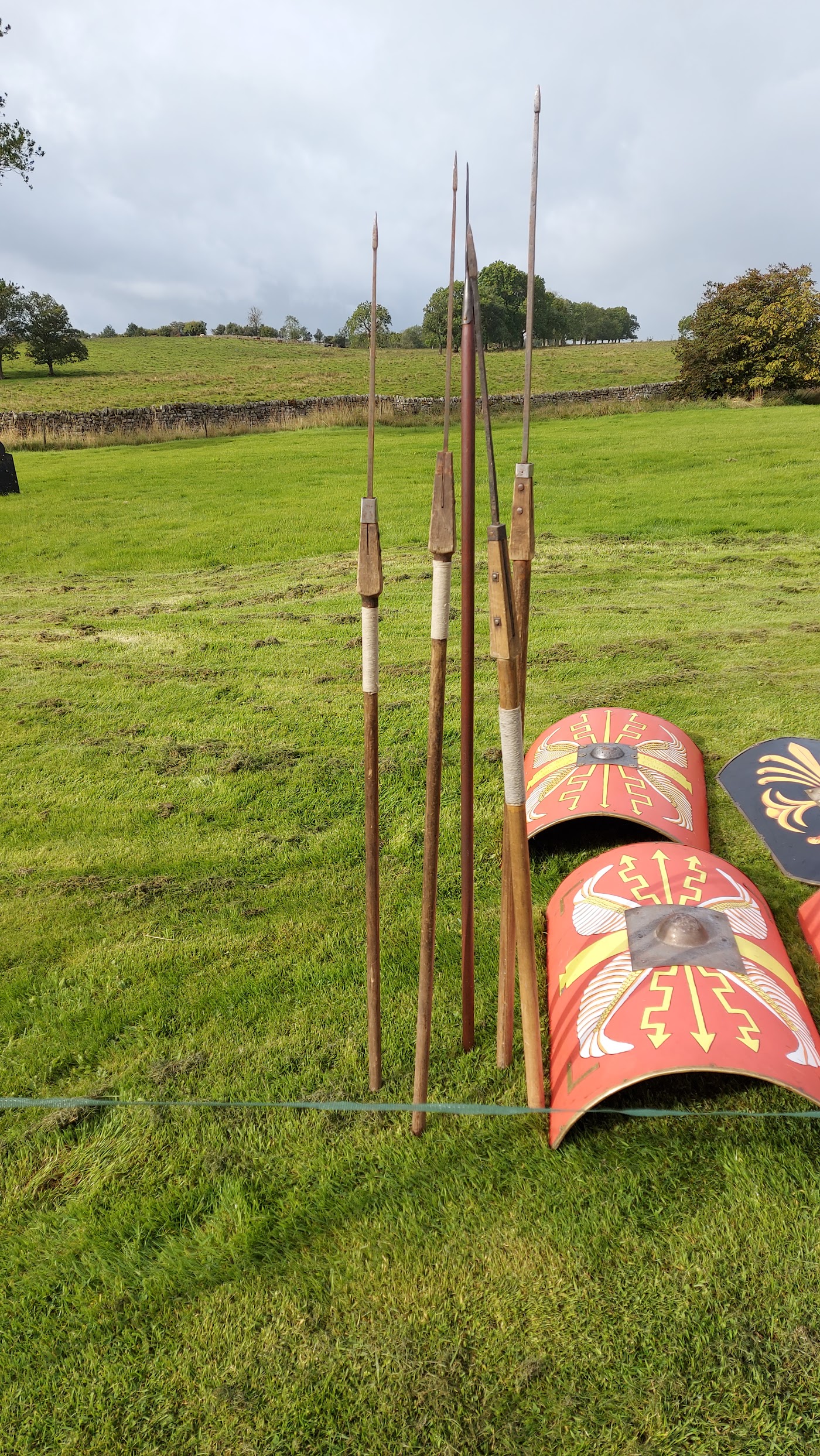
In Scotland, National Museums Scotland records an inscribed iron spearhead from Newstead, dated AD 80–100, and another retaining part of its wooden shaft inside the socket. These are direct evidence for weapons at Trimontium, although they do not reveal a particular combat encounter.
Bows and archers
Archers could shoot before opposing formations reached spear or sword range. Some Roman military bows were composite weapons, combining materials such as wood, horn and sinew. Their organic parts rarely survive as readily as iron arrowheads.
At Bar Hill, RIB 2172 commemorates Gaius Julius Marcellinus, a prefect of the First Cohort of Hamians. The same cohort is explicitly called a unit of archers in an inscription from Carvoran in the Hadrian’s Wall region. This establishes a connection between the Scottish frontier and a named specialist unit; it does not prove that every man in the cohort was an archer.
Slings and sling bullets
The Roman sling, or funda, was a pouch suspended between two cords. The slinger accelerated it and released one cord, sending the projectile towards the target. It was not the elastic, forked “slingshot” familiar today. In archaeological descriptions, “slingshot” often means the ammunition itself.
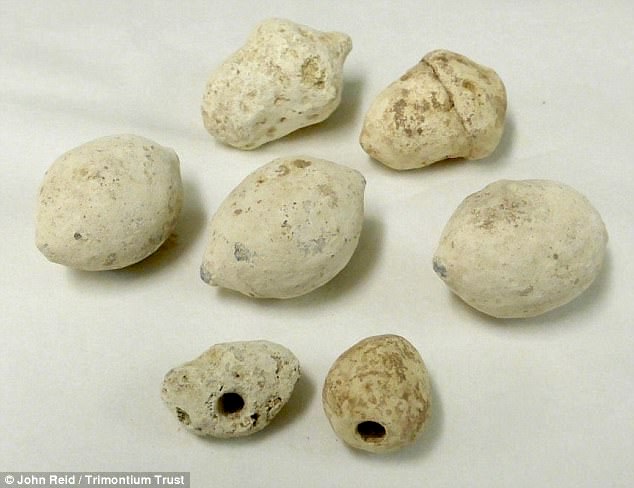
Stones were readily available ammunition, while cast lead bullets put considerable weight into a small projectile. Many are shaped like almonds, lemons or acorns; glandes, the Latin term often used for them, means acorns. Slings required skill and practice, and were used by Rome’s opponents as well as its soldiers. An isolated rounded stone is therefore much weaker evidence than an identifiable lead bullet from a securely recorded context.
Their use in Britain is explicitly described by Caesar. In Gallic War 4.25, his account of the landing in 55 BC, he says that slings, arrows and artillery were used from warships to drive the defenders back. This is the commander’s own presentation of his campaign, but it is a clear ancient reference to several kinds of missile weapon operating together.
Burnswark: ammunition across a battlefield
At Burnswark, lead sling bullets, stone artillery ammunition and iron arrowheads occur around a hillfort flanked by Roman camps. The importance lies in the distribution of the finds, not simply their presence. John Reid and Andrew Nicholson’s fieldwork supports an assault on the hillfort, challenging the earlier interpretation of the site as a Roman training ground.
Some small bullets have deliberately drilled holes. Experiments have shown that such holes can produce a whistling sound, leading to the interpretation that these missiles added an intimidating noise to the bombardment. Their intended psychological effect remains an interpretation rather than something archaeology can directly measure.
Reid and Nicholson favour a connection with the Antonine advance into Scotland in the second century AD. That campaign attribution should remain qualified: the ammunition does not carry a date or identify the commanders. A 2025 study of the conflict landscape further examines how the terrain and missile evidence relate to the proposed assault.
How torsion artillery worked
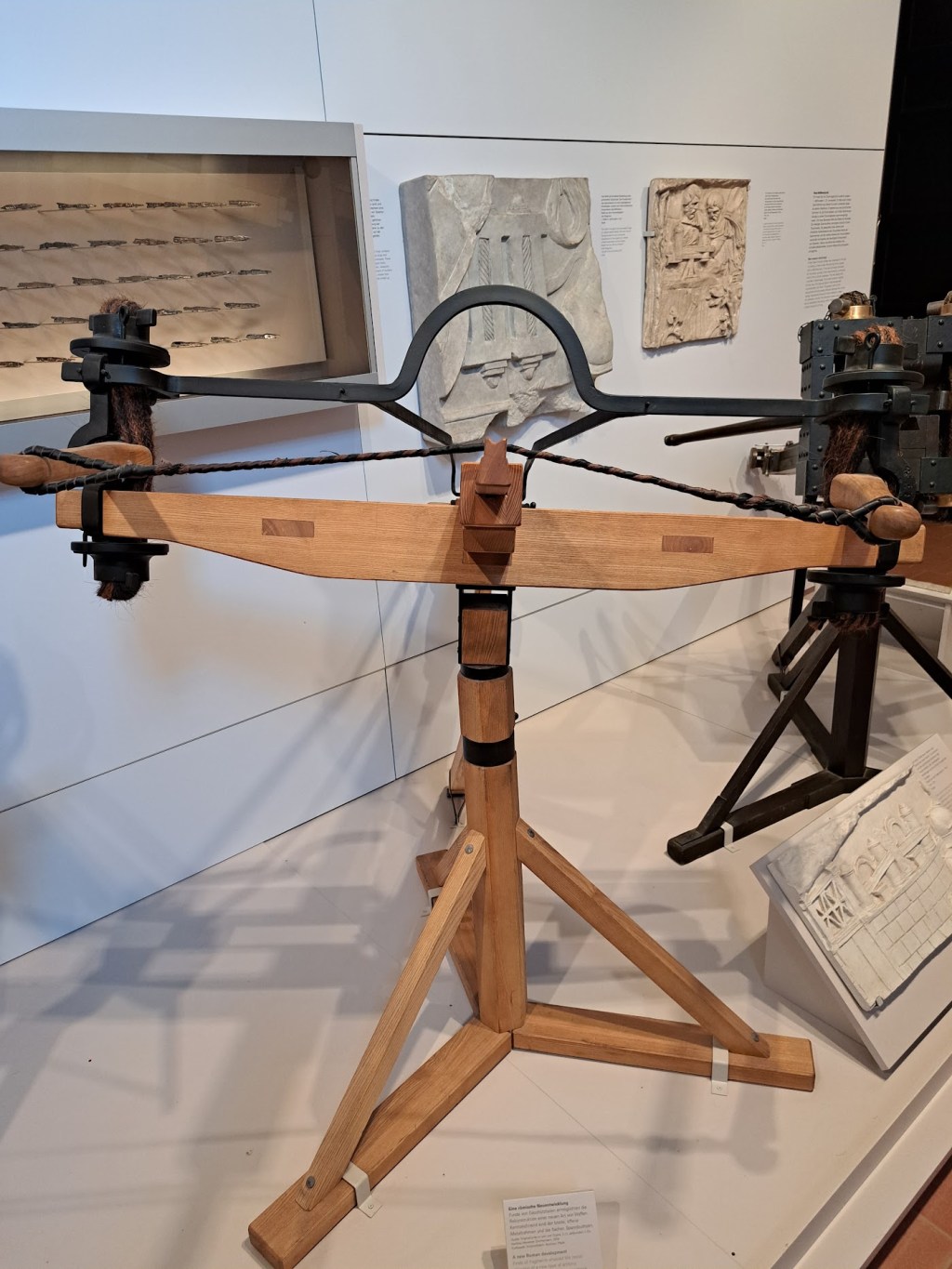
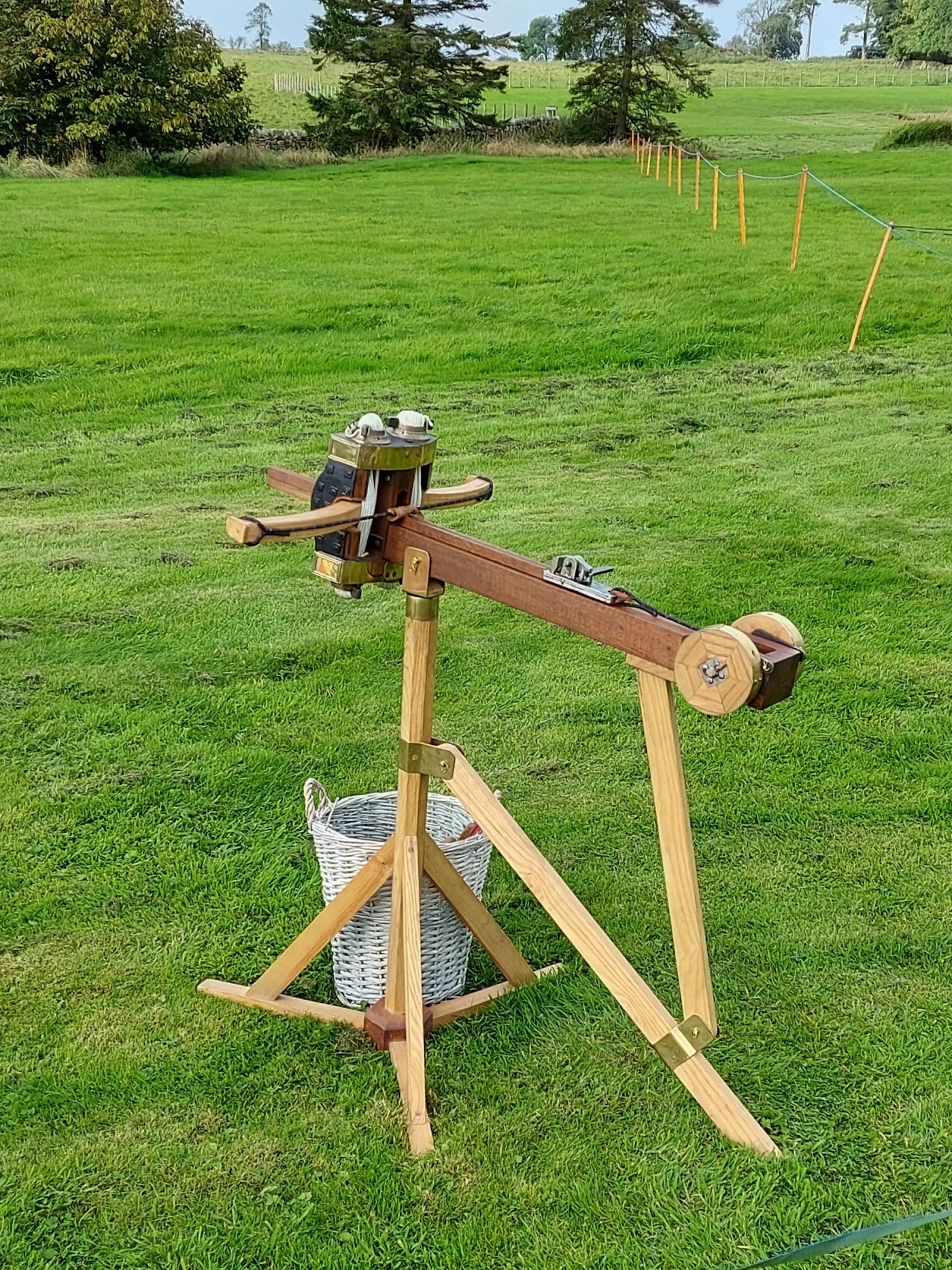
Torsion means twisting. Imagine twisting a bundle of cords: the bundle resists and tries to return towards its previous position. Roman artillery used this resistance as a spring. In a two-armed torsion machine, each rigid arm passed through a tightly tensioned bundle of fibres. Drawing the connecting string backwards rotated the arms and twisted the bundles further. Releasing the catch allowed the bundles to drive the arms forwards, accelerating the string and projectile.
The energy came from the crew’s work in drawing the weapon. The springs stored that energy until release. A bow stores energy mainly by bending its limbs; a torsion engine stores it in its twisted spring bundles. Neither mechanism involves gunpowder.
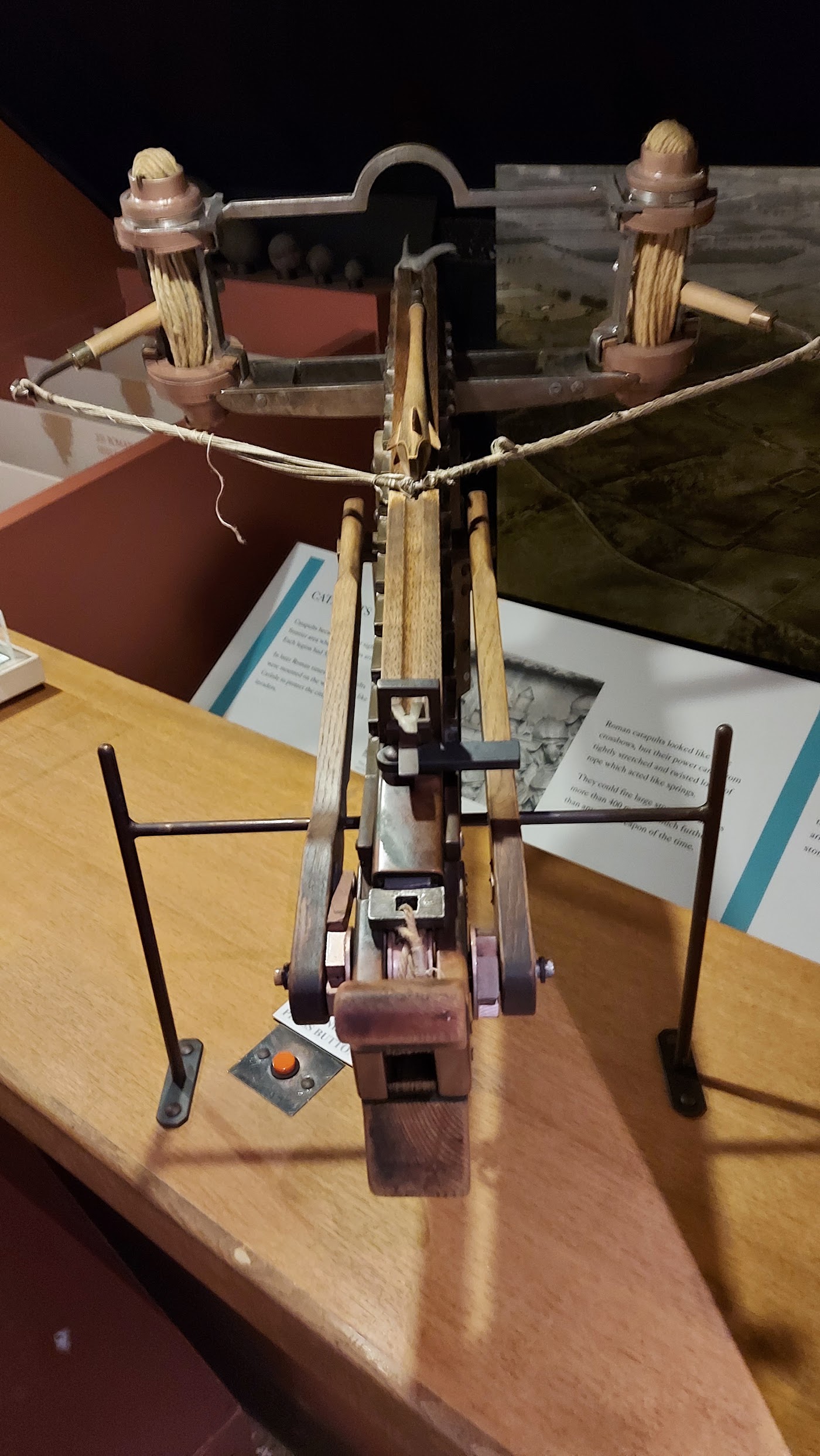
Vitruvius describes these machines in On Architecture 10.10–12, including spring material made from sinew or hair. He also describes tuning the two sides by sound, so that the tension was balanced. Maintenance and adjustment were therefore part of making the machinery work reliably.
Scorpions, ballistae and stone-throwers
A scorpio, or scorpion, commonly refers to a bolt-shooting engine. Larger artillery could throw stones. Names such as catapulta and ballista changed in meaning over time, so a modern label should not be treated as a universal Roman classification. The projectile and mechanism are usually more useful descriptions.
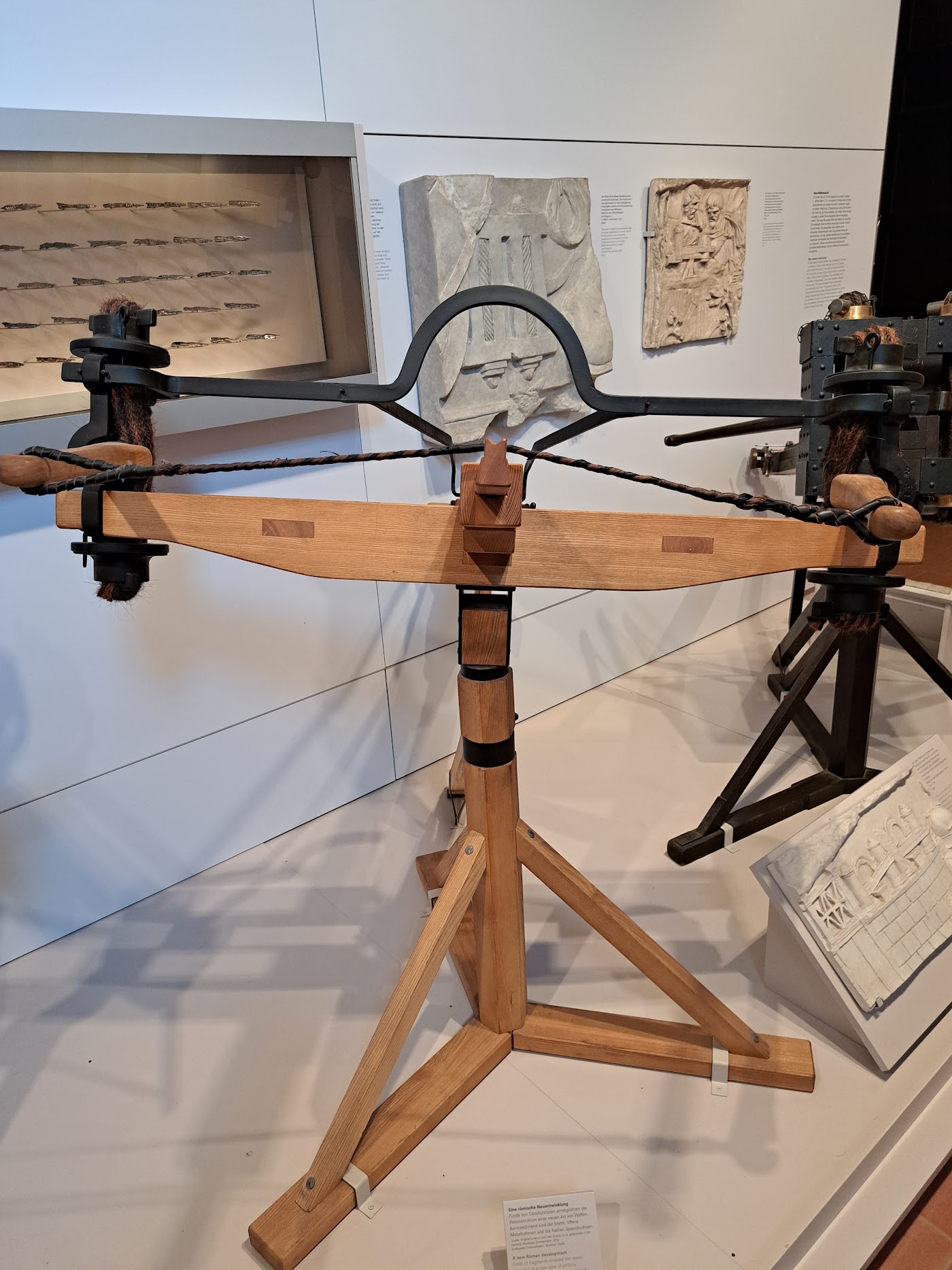
British evidence includes both bolt heads and stone shot. The Yorkshire Museum’s collections research guide records artillery bolt heads from Catterick. In Scotland, the Roman Inscriptions of Britain introduction to stone balls notes more than 100 examples from Bar Hill. Stone ammunition establishes the presence of projectiles interpreted as artillery shot, but cannot on its own identify the exact machine that discharged them.
How fast did the projectiles travel?
No one measured the launch speed of a Roman weapon in Britain. Figures must come from modern experiments or calculations, and depend on the reconstruction, projectile weight, materials and operator. The examples below are measured experimental results, not specifications for every ancient weapon.
| Weapon or experiment | Reported launch speed | Approximate mph | What the figure means |
|---|---|---|---|
| Hand sling: Skov’s trials | Technique averages 32.1–43.3 m/s; fastest recorded throw 50.5 m/s | 72–97 mph averages; 113 mph maximum | Modern sling trials; not a measurement of Roman lead bullets at Burnswark |
| Reconstructed scorpio: FAU tests | 55 m/s | 123 mph | Reported average for this reconstruction |
| Later Orșova-type torsion engine: FAU tests | 77 m/s | 172 mph | Reported average at full draw; a comparison from a later machine type |
| Bow used for comparison in the FAU project | 55 m/s | 123 mph | A modern Hungarian bow of 56 lb draw weight; not an excavated Roman bow |
Sources: Eric Skov’s 2013 experimental study, table 5, p. 65; and the FAU artillery project. The FAU bolt tests used projectiles weighing 125–140 g. These examples demonstrate capability under particular conditions; they do not establish the speeds achieved by troops in Scotland.
Launch speed is also different from impact speed: air resistance slows a projectile during flight. Maximum range is not the same as useful accuracy against a target. A stone ball, arrow and lead sling bullet can cause very different injuries even at the same speed, because mass, shape, impact angle and protection all matter. A single “Roman projectile speed”, or a simple claim that sling bullets equalled modern handgun ammunition, would be misleading. Comparable, well-documented figures have not been established here for pila or heavy stone-throwers.
Where is the Scottish evidence strongest?
| Place | Evidence | What it supports |
|---|---|---|
| Burnswark, Dumfriesshire | Lead sling bullets, arrowheads and stone artillery ammunition; mapped distributions | A strong case for a Roman assault; campaign date remains an interpretation |
| Newstead / Trimontium, Scottish Borders | Museum-recorded spearheads; a biconical lead sling bullet (X.2009.12.255) | Weapons and sling ammunition at the fort; not proof of a particular battle |
| Bar Hill, Antonine Wall | Stone shot and inscriptions naming the First Cohort of Hamians | Artillery ammunition and the presence of a unit associated with archery |
| Bochastle, near Callander | A documented Roman fort and temporary camp; the records checked do not verify sling ammunition | Roman military occupation; a specific weapon-use claim needs a finds reference |
The Newstead sling bullet is recorded in the Trimontium Museum catalogue. “Bocastle” is also encountered as a spelling of Bochastle. The Historic Environment Scotland record confirms its military remains, but does not list sling bullets or demonstrate their use in a battle. The published excavation report should be checked before making that more specific claim. This is an unresolved point, not evidence that no weapons were ever used there.
The onager: a single-armed stone-thrower
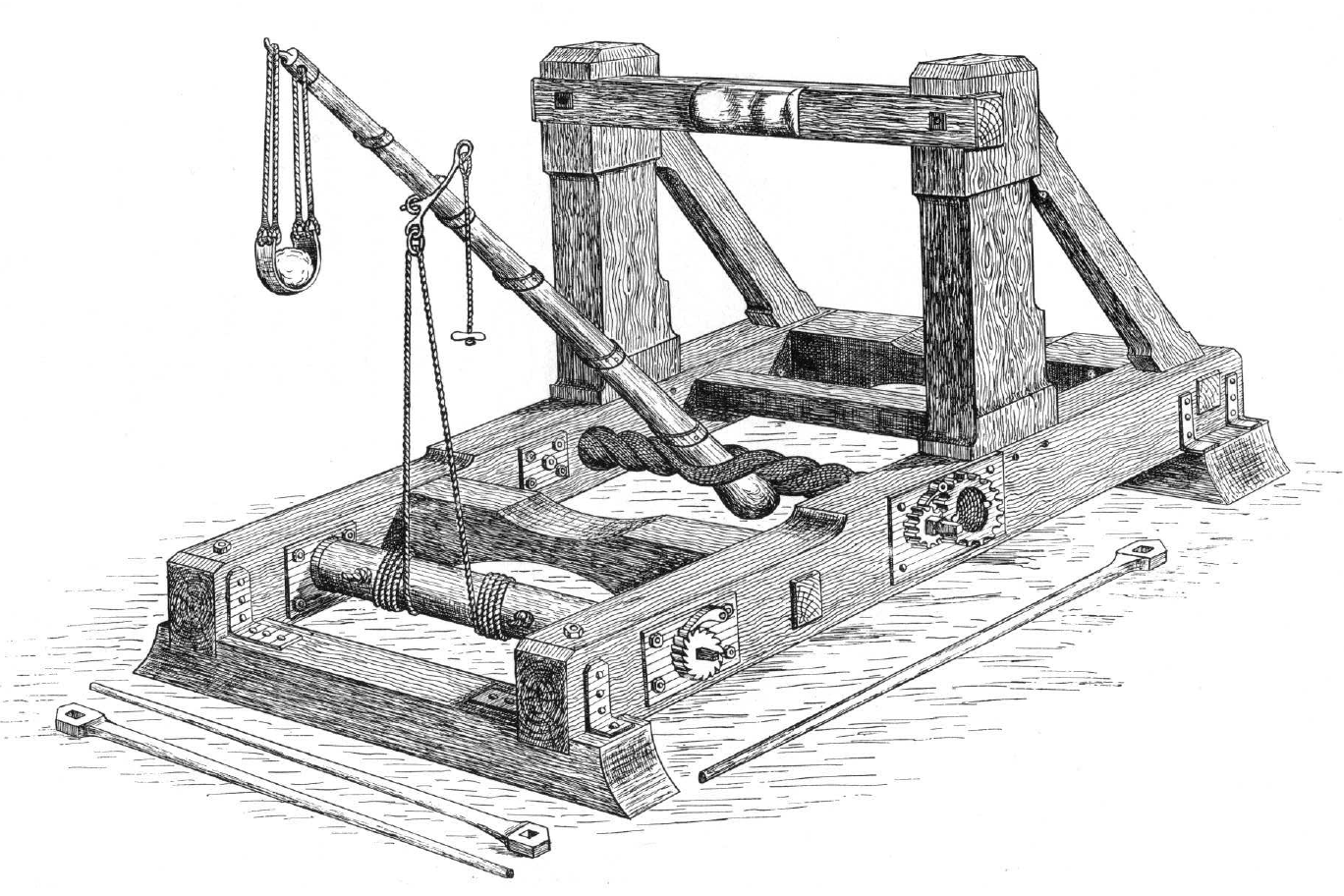
The onager was a single-armed torsion stone-thrower described by the fourth-century historian Ammianus Marcellinus (Roman History 23.4.4–7). Its arm was powered by a twisted spring bundle and carried a sling for the projectile. It belongs in the wider history of Roman artillery, but should not automatically be inserted into reconstructions of every earlier British fort. Nor was it the same machine as a medieval counterweight trebuchet.
Reading the weapons in their context
A sword from a river, a spearhead from a fort and a scatter of sling bullets across a defended hill answer different questions. Some show what soldiers possessed; others help reconstruct what they did. Scotland’s strongest evidence comes when objects, excavation contexts, inscriptions and terrain can be considered together. Burnswark makes the power of Roman missiles tangible, while sites such as Newstead and Bar Hill reveal the wider equipment and specialist skills behind that force.
Sources and further reading
- Reid, J. H. and Nicholson, A. (2019), “Burnswark Hill: the opening shot of the Antonine reconquest of Scotland?”, Journal of Roman Archaeology 32, 459–477.
- Fernández-Götz, M., Cartwright, R., Reid, J. H. and Nicholson, A. (2025), “Assessing ancient conflict landscapes through KOCOA analysis: the case of Burnswark hillfort (SW Scotland)”.
- Skov, E. T. (2013), Experimentation in Sling Weaponry, MA thesis, University of Nebraska–Lincoln, especially p. 65, table 5.
- FAU, “Roman Artillery: Torsion Guns, Onager, Bows and Arcuballistae”, project account dated 28 March 2026.
- Vitruvius, On Architecture 10.10–12, translation by Morris Hicky Morgan; Caesar, Gallic War 4.25, translation by H. J. Edwards.
- Museum object records and inscription entries are linked alongside the relevant examples. For the Fulham sword, see the British Museum’s Legion activity cards; for changing sword equipment, the English Heritage Hadrian’s Wall teaching resource.
- For the interpretation of drilled bullets, see the Scottish Archaeological Research Framework’s discussion of conflict and violence. Online sources checked 8 November 2026.


